Wednesday, September 29, 2010

New Reviews

Here are a few of my reviews of CDs distributed by Naxos Records.  Adding more, but I'm still behind!

Alicia de Larrocha playing Manuel de Falla, on a new disc from Newton:


A new Naxos compilation of Ginastera ballets, conducted by Gisele Ben-Dor:


The latest Granados piano disc in Douglas Riva's series on Naxos:


Ignacio Cervantes' Danzas Cubanas played by Davide Cabassi:


Friday, September 24, 2010

Marcelo Bratke at the Penitenciária Feminina do Butantã

I came across another interesting project by the amazing pianist Marcelo Bratke. He recently performed a concert (in his Cinemusica Villa-Lobos and Brazil series) before an audience of 270 at a women's prison in Sao Paulo. This story at Estadao.com.br is full of moving bits.  Raquel, serving 4-1/2 years for armed robbery says "É uma música diferente, faz bem para a alma." (It's a different song, it's good for the soul).  Bratke was a bit surprised by such a positive response:

"Elas chegaram a cantarolar quando toquei as Cirandinhas do Villa-Lobos, não esperava que isso pudesse acontecer....Senti aqui uma energia diferente. Elas me ajudaram a tocar." (They began to sing when I played the Cirandinha of Villa-Lobos; I did'nt expect this to happen.... I felt a different energy here. They helped me play.)

Here is a video with some highlights from that concert.  The piece being played is Caixinha de Musica Quebrada, from Bratke's latest Villa-Lobos CD.


Bratke will bring his Cinemusica Villa-Lobos and Brazil project to London, when he performs Brazilian music in front of a film by Mariannita Luzzati, at Southbank Centre on December 2nd.

Friday, September 17, 2010

Guitar Concerto video with Turibio Santos

Recently posted on YouTube, an impressive performance of the Guitar Concerto with Turibio Santos.

Wednesday, September 15, 2010

Tuesday, August 17, 2010

Sonia Rubinsky Contest Ends

Congratulations to Carl Woideck of Eugene OR, the final winner of a CD from Sonia Rubinsky's complete set of Villa-Lobos's Piano Music on Naxos.  Thanks, everyone, for participating!


This 8-CD set is available at a bargain price [Amazon.com - HBDirect]; it's an indispensable part of any good Villa-Lobos collection.

Thursday, August 5, 2010

Sonia Rubinsky Contest, v.7 winner & v.8 review

The contest is now over; thanks, everyone, for participating!

Congratulations to Joe Michels of Troy NY, the penultimate winner of a CD from Sonia Rubinsky's complete set of Villa-Lobos's Piano Music on Naxos. We're now down to the last disc in this set; your last chance to win! It's easy to enter: send an email to villa-lobos@rdpl.org and tell me your favourite piano piece by Villa-Lobos. If you've already entered, your name stays in the pool.

The winner of Volume 8 will be drawn on Friday, August 6. 

The final disc in the series was recorded, once again, in L'Eglise Saint-Michel in Paris, this time in April 2007.  The focus of this disc is the world of children and Brazilian folklore.  The final two volumes (#10 and 11) of the piano albums of the Guia Pratico require a high level of virtuosity from the pianist.  As James Melo points out in his liner notes, the last album is dedicated to the great Polish pianist Mieczyslaw Horzowski.  It's too bad, by the way, that Hozowski hasn't left any significant Villa-Lobos recordings behind; the only one I know of is on a BBC Classics CD with 2 short pieces.

The 11th Album of Guia Pratico, by the way, is much later than the first ten.  It was published in 1949, nearly 20 years after the bulk of the collection came out, during Villa's musical education phase.  Rubinsky handles everything Villa-Lobos throws her way, and that's not inconsiderable.  Rubinsky also handles the simpler, more delicate early Suites Infantils very well.  I find some of these early pieces quite impressive; they speak to the innocence and purity of childhood.

Tuesday, August 3, 2010

A New Complete Villa-Lobos Piano Series


It's great to finally hear the first disc in Marcelo Bratke's Complete Solo Piano Works of Villa-Lobos series on Quartz.  It includes the Cirandas, Cirandinhas, and Caixinha de Musica Quebrada.  You can order the CD or download the disc on the Quartz site (the Download is only £5.99), and read the excellent liner notes by Bratke and journalist Celso Masson. 

Monday, August 2, 2010

Brasil: Folclore de Norte a Sul


An interesting concert by the Camerata Heitor Villa-Lobos de Batatais, on Aug. 29 in Batatais, from their blog.  That looks like a Saci in the lower-left corner.  This prankster character from Brazilian folklore shows up in Villa's String Quartet #01.

Brazilian Classics at Carnegie Hall


Brazilian Classics: from Villa-Lobos to Tom Jobim.  A great lineup for this November 24, 2010 concert at Carnegie Hall.

Sunday, August 1, 2010

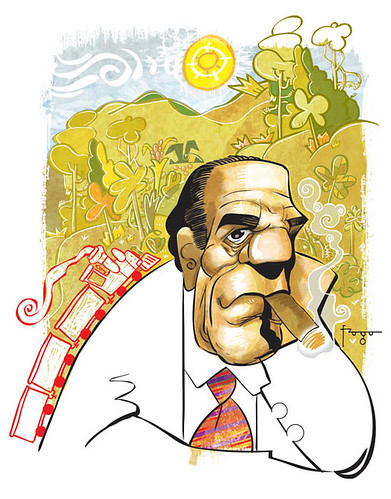
Villa-Lobos by Fraga

Caricaturists love Villa-Lobos; here's a great one by the Brazilian artist Fraga, from his excellent blog, Fraga Caricaturas.

Friday, July 23, 2010

More home movies

It's nice to see these pictures of domestic life. One of the great love matches in classical music: Villa and Mindinha.

And I always love seeing Tom Jobim talk about his idol. I wish I knew what he was saying, but maybe the Villa-Lobos-inspired cigar says it all!

Tuesday, July 20, 2010

Sonia Rubinsky Contest, v.6 winner & v.7 review

The contest is now over; thanks, everyone, for participating!

 Congratulations to Joana Gama of Portugal, the sixth winner of a CD from Sonia Rubinsky's complete set of Villa-Lobos's Piano Music on Naxos. Only two more discs will be awarded, and the set will be complete. It's easy to enter: send an email to villa-lobos@rdpl.org and tell me your favourite piano piece by Villa-Lobos. If you've already entered, your name stays in the pool.

The winner of Volume 7 will be drawn on Friday, July 23rd.

The seventh volume in the series was my favourite, since it included so many pieces I hadn't heard before.  In 1932 Villa-Lobos made a piano version of his early orchestral score Amazonas, which was first published in 1917.  Like in the great Rudepoema of the early 1920s (which Villa-Lobos orchestrated in the same year, 1932, as the Amazonas reduction), there's a lot happening for only 10 fingers and 88 keys to manage at once.  It's interesting that Prof. Tarasti should say, about the Rudepoema orchestration: "... one can only be amazed at how 'orchestral' the piano work already is."  And, though you can't always un-scramble an egg, I find the piano version of the great Stravinsky-infused orchestral version of Amazonas quite pianistic.  I wonder how it was that Villa-Lobos was reducing and orchestrating these two big scores at the same time.  Was it a case of the always practical composer coincidentally needing different versions of these scores, or did he just decide one day to set himself these interestingly symmetrical tasks?

The transcriptions for piano of the Guitar Preludes by José Vieira Brandão provide another fascinating listening experience, and one which I found even more musically satisfying.  These five pieces are among the greatest in the guitar literature, and are the first Villa-Lobos works I heard (and, naturally, fell in love with).  They fit very well in their new piano guise, which is a tribute both to Brandão's re-thinking of the music for the piano, and Rubinsky's phrasing on the keyboard.  I thought the third Prelude, inspired by Bach, worked especially well on the piano.  James Melo, in his excellent liner notes, calls the Brandão transcriptions "true transcendental etudes for the piano."  They deserve to be taken up by more pianists, either as a group, or one at a time as a encores.  It's a good way to get this response: "I know this piece. What is it? It's by Villa-Lobos, but wait a minute! Something doesn't sound right!"

In the 1940s Villa-Lobos transcribed the third movement of Bachianas Brasileiras #2 (not #3 - a typo in the liner notes) for piano.  Dedicated to Georgette Baptista, this version was never published (the score is in the Museu Villa-Lobos), and was first played by Cláudia Tolipan in London in 1990. It sounds a pretty slight piece on the piano.  It makes you want to hear a really good orchestra led by a really good conductor (let's say the Simón Bolívar Symphony Orchestra of Venezuela, conducted by Eduardo Mata).

The rest of the disc is filled with really interesting little bits, including some world premiere recordings.  I play Feliz aniversario from the Canções de Cordialidade every year on Villa-Lobos's birthday (March 5th), and Feliz Natal is always in my Christmas playlist as well.

The sound from this 2007 recording continues excellent, especially in the turbulent Amazonas.  I've read reviewers who prefer the bright sound of the later Paris recordings (6-8) to the softer sound provided by Kraft & Silver in their earlier Toronto ones (2-5).  But the whole series seems to me to place one in a realistic space, and Rubinsky does the rest!

Monday, July 19, 2010

Paulo Moura & Turibio Santos Play Villa-Lobos

Here's a YouTube find: the late Paulo Moura and guitarist (and Museu Villa-Lobos Director) Turibio Santos play Claude Pascale's "Melodia Sobre o Prelúdio No. 1 de Villa Lobos".

A new book from France

A new book from French musicologist Rémi Jacobs has been published by Bleu Nuit, in their Horizons series.  It's a slim volume (174 pages), but according to this post at ClassiqueNews.com, it includes some interesting interviews: John Neschling discussing the Choros series; Sonia Rubinsky on Rudepoema; Christina Ortiz on the Piano Concertos; Debora Waldman on The Discovery of Brazil; and Wilhem Latchoumia on the Ciclo Brasileiro.

The book is available from Amazon.fr.

Rémi Jacobs: Heitor Villa-Lobos. Bleu nuit éditeur, collection Horizons. 174 pages.  ISBN: 978 2 35884 011 8

I'll send in my order, and post a review once I've deciphered the text with the help of my two brilliant French-immersion-educated children.

Here is some information on Rémi Jacobs from the Bleu Nuit website (thanks to Google Translate):

A graduate of the Paris Conservatoire, Remi Jacobs studied harmony, counterpoint, music history and musicology. He has spent his entire professional career in various record companies, particularly with EMI Classics.  He has published several books on music and musicians. A trip to Brazil has fueled his passion for this great country and revived his knowledge of Villa-Lobos.

Remembering Paulo Moura


The sad news came last week: Brazilian musician Paulo Moura was dead at the age of 77.  Larry Rohter's fine tribute in a July 18, 2010 New York Times article shows Moura's versatility and his importance as a musician in his native land and abroad.  Moura, like many Brazilian musicians, was absolutely at home in both the classical and popular musical worlds.

Moura has recorded a number of Villa-Lobos pieces over the years.  One of the most important of all Villa-Lobos recordings is the great CD on the Kuarup label Os choros de câmara.  Moura played the clarinet in Choros #02, and the alto saxophone in Choros #07.  It's a shame that this disc (and the rest of the Kuarup catalogue) is no longer available; if you ever see a copy on eBay or in a used record shop, buy it!

In 1983 Moura recorded the Saxophone Fantasia in the version with piano (with the great pianist Clara Sverner), though again one would be hard-pressed to come across this Brazilian EMI LP that I don't believe has ever been re-released on CD.

Moura also recorded the Saxophone Fantasia in its original orchestral version, in 1992 with the Orquestra de Câmara Brasileira, conducted by Bernardo Bessler.  This is at least available on CD, from Le Chant du Monde, and may be available from online vendors.

Luckily, many of Moura's jazz and MPB recordings are easily available.  I especially recommend his Latin Grammy winning Pixinguinha, from 1998.

Monday, July 12, 2010

Villa-Lobos & Electronic Music

In 1955, H. De Carsalade Du Pont published an article called "Regards sur Villa-Lobos", in the Paris periodical Études, (1955/07, pp. 94-103). I'm slowly making my way through this interesting article with my cereal-box French (helped, of course, by Google Translate). In the meantime, here are some interesting words about Villa's involvement in the early electronic music scene:

Apres les instruments classiques, il s'interessa a ceux que l'electronique venait de faire naitre. Il connut l'Onde Martenot lors de son premier sejour a Paris en 1923, mais l'appareil etait encore si imparfait que, malgre l'insistance de M. Gaveau, Villa-Lobos refusa de composer pour un instrument sur lequel on ne pouvait pas encore placer une note avec precision. Il ne cessa pas pour autant de s'interesser aux inventions nouvelles et il fut un des premiers a ecrire pour le Novacorde, le dernier ne a ceux dont le son resulte des oscillations d'un circuit electrique.

Villa-Lobos was always interested in new instrument technologies, and hung out with avant-garde composers in Paris in the 1920s, most notably Edgard Varèse and Olivier Messiaen. I was unaware, though, that he was exposed to the Onde Martenot as early as 1923.  Messiaen's use of this interesting instrument came more than a decade later.

As to the Novacorde, I wonder if this is the same as the Sonovox/Solovox that Villa-Lobos included in his score for Amazonas?

This issue of Études is available from the Gallica Digital Library, a valuable resource.

Monday, July 5, 2010

City of London Festival on BBC Radio 3

This year's City of London Festival features Portugal and the Portuguese-speaking world.  One of the first concerts was on June 24th, featuring the Elias Quartet.  They played Villa-Lobos's First String Quartet, and you can hear their concert on BBC Radio 3 on Friday, July 9th, at 13:00 British Summer Time, and on the BBC iPlayer for a week afterwards.  Read Ben Hogwood's review of the review at ClassicalSource.com (follow Ben on Twitter @benjammin22).

Another Villa-Lobos concert in the Festival was by pianist Arthur Pizarro, on July 1st.  Read Ben's review here - I'm hoping this will also show up on Radio3.

Here are the ten concerts from this year's Festival that include works by Villa-Lobos:

City of London Festival - Events - Artur Pizarro
City of London Festival - Events - 6pm series: Daniela Lehner
City of London Festival - Events - 6pm Series: Tai Murray
City of London Festival - Events - 6pm Series: Elias String Quartet
City of London Festival - Events - Patricia Rozario and Antonio Meneses
City of London Festival - Events - Tomorrow's Artists Today (8): Cellophony cello octet
City of London Festival - Events - 6pm series: Nicolas Altstaedt
City of London Festival - Events - Adam Walker, Morgan Szymanski and O Duo
City of London Festival - Events - BBC Singers
City of London Festival - Events - Joanna MacGregor & Britten Sinfonia

Friday, July 2, 2010

Sonia Rubinsky Contest, v.5 winner & v.6 review

The contest is now over; thanks, everyone, for participating!

Congratulations to Pablo Lorenzo Barreto of the Canary Islands, the fifth winner of a CD from Sonia Rubinsky's complete set of Villa-Lobos's Piano Music on Naxos. Three more discs will be awarded, one each week until the entire set has been sent out. It's easy to enter: send an email to villa-lobos@rdpl.org and tell me your favourite piano piece by Villa-Lobos. If you've already entered, your name stays in the pool.

The winner of Volume 6 will be drawn on Friday, July 2 (that's today!).


For the sixth edition of the Complete Piano Music, Rubinsky went to Paris to record at the Eglise Evangelique, Saint-Marcel, in March of 2006. This CD included both previously unrecorded (and unheard) pieces as well as some of Villa's greatest works for piano.

The minor novelties include the early works Carnaval de Pierrot and Bailado infantil, along with the 1952 waltz from the opera A menina das nuvens (the recent production of which made such a big stir in Brazil). This waltz was first recorded by Alfred Heller in 1991, soon after it was discovered in the Museu Villa-Lobos.  There are also two pieces included that make use of the interesting practice of millimetrization, which involves the transfer of contours of a natural scene onto the musical scale.  This technique is seen by the always-excellent James Melo (who again writes the liner notes for this release) as similar to the avant-garde experiments of Villa's close friend Edgard Varese.   An identical technique was invented by Joseph Schillinger, and may have been used by George Gershwin while writing Porgy & Bess in the mid-1930s.  I wonder if Villa-Lobos knew of Schillinger's work (and, as always, I wonder if Villa-Lobos knew Gershwin's music at all).  The works in question on this disc are the well-known New York Skyline Melody from 1939 (which also exists in an orchestral version), and the previously unrecorded Melodia da montanha, "Serra da Piedade de Belo Horizonte", from the early 1940s.  Villa-Lobos's final experiment with this technique is the 1944 Symphony #06, which has as its theme and model The Mountains of Brazil. 

But wait: there's more!  In 1939 Villa-Lobos used a similar technique to write his beautiful As Tres Marias, whose three movements are based on the patterns that three stars make in the constellation Orion.

Of the more substantial works on the disc, the stand-outs are Sul America (1925), Saudades das selvas brasileiras (1927), and, of course, Rudepoêma (1926).  Rudepoêma is probably Villa's greatest work for piano, and one of the great 20th century works by any composer.  Rubinsky's version certainly has the requisite virtuosity, though some may prefer Heller, Friere, or (as I do) Marc-André Hamelin.  All in all, this disc is a real winner; perhaps the best in the set.

P.S. Sul America could have been the theme for the 2010 World Cup, until the unfortunate loss of Brazil to the Netherlands in this morning's game (still, Argentina, Uruguay, & Paraguay are left in the remaining 7).

Villa-Lobos on Cultura FM - July 2010

Every month I post highlights from the upcoming schedule of Cultura FM from Sao Paulo. Since you can listen live to this station on the Internet, it's a great way to hear Brazilian classical music.

July 2:
01h00min
PIANISSIMO – o piano, seu repertório, seus intérpretes com Gilberto Tinetti
PIANISTAS BRASILEIROS
Villa-Lobos
Suite Floral, Idílio na rede, Uma camponesa cantadeira, Alegria na horta
Marcello Verzoni (piano)

more

Monday, June 21, 2010

Sonia Rubinsky Contest, v.4 winner & v.5 review

The contest is now over; thanks, everyone, for participating!

Congratulations to Harold Lewis of the UK, the fourth winner of a CD from Sonia Rubinsky's complete set of Villa-Lobos's Piano Music on Naxos. Four more discs will be awarded, one each week until the entire set has been sent out. It's easy to enter: send an email to villa-lobos@rdpl.org and tell me your favourite piano piece by Villa-Lobos. If you've already entered, your name stays in the pool.

The winner of Volume 5 will be drawn on Friday, June 25.


In 2006, the recording sessions for the fifth volume in the series moved from Toronto to the Township of King City, just north of Canada's biggest city.  Once again the technical side of things was in the more than capable hands of Norbert Kraft and Bonnie Silver.

For many this was the first chance to hear the entire cycle of Guia Pratico (though they'd have to wait for volume 8 of the series for Albums 10 and 11).  Anna Stella Schic had included the bulk of the Guia Pratico piano pieces in her complete Piano Music set of 7 LPs, released in the mid-70s in France.  Though this set was re-released on CD, it's never been easy to find.  Caio Pagano included Albums 1-6 in his 1999 album Music for Children.  Clara Sverner didn't release her complete series on the Brazilian Biscoito label until 2008; it's still available on Amazon.com.

Many of the songs in the Guia Pratico were gathered by Villa-Lobos from folk-songs and children's round songs.  I wonder if Brazilian children in the 1930s skipped rope while they sang them?  Like other Villa-Lobos works from the world of children (Prole do Bebe, especially), the Guia Pratico includes many pieces and passages that would tax the most accomplished pianist.  So in spite of Villa-Lobos's didactic agenda in the choral versions of these songs, many of these pieces are written about children rather than for them to learn to play the piano.  As well, many of these songs were re-cycled by Villa-Lobos in a variety of works later in his career.

Two very positive components of the Naxos series continued with volume 5.  James Melo again provided excellent liner notes - you can read them here.  Furthermore, the notes included the original Portuguese texts of the songs, along with English translations.  And the cover once again featured a very relevant painting - this time a stage set design from Lasar Segall's 1938 Rio de Janeiro ballet of A Midsummer Night's Dream.