Thursday, March 31, 2016

Villa conducts Forest of the Amazon

In my last post I talked about Villa-Lobos conducting his own music. On the recording side I quite naturally focussed on the Paris Pathé-Marconi sessions of the mid-1950s. But there was also an important recording session in New York in 1958, just over a year before Villa died.

Recording session pics, photo from Museu Villa-Lobos.

This was A Floresta do Amazonas, Forest of the Amazon, the great suite Villa-Lobos put together from the music he wrote for (and very little ended up in) the MGM picture Green Mansions. The orchestra and choir was the Symphony of the Air and Chorus, and the star soprano was Bidu Sayão, who had recorded a famous version of Bachianas Brasileiras no. 5 with the composer. This is amazing music, and though the music is heavily abridged, an amazing recording.


There are modern recordings, including an excellent one by Renee Fleming and Alfred Heller, and a fine Brazilian CD conducted by Isaac Karabtchewsky. But, as so often happens with Villa-Lobos, authenticity rules!

Villa thanks his players. Great job, everyone!

Wednesday, March 30, 2016

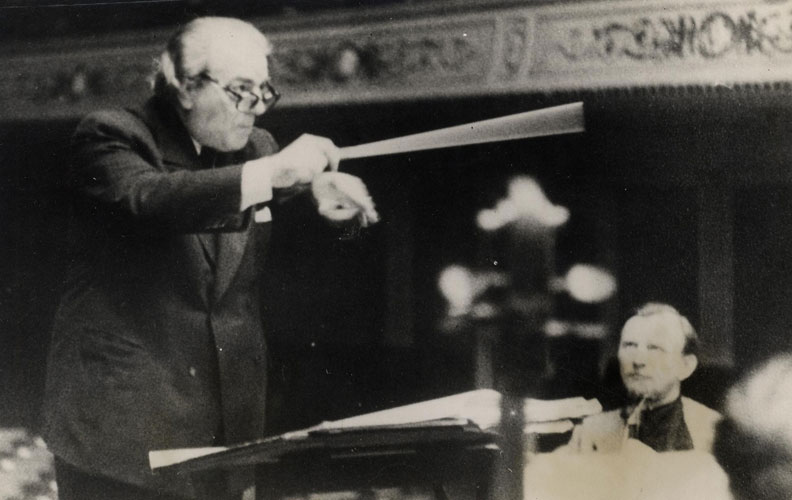
Villa-Lobos conducts his own music

Photo from Museu Villa-Lobos
In this picture Villa-Lobos rehearses the Vienna Symphony Orchestra (Wieneker Synfoniker) in the Grosser Konzerthaus, March 13, 1953. I've posted about Villa-Lobos as a conductor before, and in this post I'll re-use some of that material here and in the next post, where I talk about Villa conducting music by other composers.

When Villa-Lobos came to New York after the war, it was primarily to present himself to America as a composer.  Offering himself as a conductor of his own music made it easier to arrange performances. Here's a list of works he was ready to present in Europe and New York, from the late-1940s. His second Piano Concerto was written in 1948, with the rest coming in the 1950s. There are already a lot to choose from!

This prospectus is from a folder held by the NY Philharmonic Archives.

Villa had conducted his own music in Brazil for a long time. In August of 1918 in Rio he led an orchestra in the first performance of Naufragis de Kleonica. This, according to Pierre Vidal's notes in Villa-Lobos par lui-même, was his first gig as conductor, but he may also have conducted his music in 1915, or even 1908. He presented two of his early symphonies at a Rio de Janeiro concert for the King of Belgium in 1920, and in November and December of 1922 conducted four orchestral concerts in Sao Paulo. But when he made his way over the Paris for his first European trip in 1923 it was mainly his piano and chamber music that made his name outside of Brazil. He wasn't a good enough pianist to play his own works, so he relied on the support of pianists like Rubinstein, Novaes, Vera Janacopulos, and Joao de Souza Lima. The Salle Gaveau concert of October 24, 1927, was a milestone. Villa-Lobos conducted the premiere of Choros no. 10, which Figaro termed "the music of the future." The next year saw the first concert of his orchestral music in New York, but it was Leopold Stokowski who conducted the Philadelphia Orchestra in the Dancas africanas. On October 21, 1929 he was able, though, to conduct for himself his massive new Choros no. 12, with the Boston Symphony. In the 1930s he began the Bachianas Brasileiras series, which included some orchestral works, so along with the orchestral Choros and his first concertante works, he had enough music to present in any venue.

With the rise of modernism in Europe the always adaptable orchestral musicians made their way through the new music, and the brusque Brazilian made his wishes known, largely in French, but I suspect also largely with gestures. Villa-Lobos had himself been a professional orchestral musician, working as a cellist in cinema "orchestras", which would have been small chamber groups, but then in the pit at the Opera, and onstage with large Rio de Janeiro orchestras. His music quickly won over the critics in Paris, but there were always reactionary elements in the audience. At a March 14, 1930 concert in Paris Villa-Lobos, Edgard Varèse and Marcel Mihalovici appeared together as composer-conductors. The concert included Varese's Offrandes and Octandre, along with a selection of chamber works by Villa-Lobos. A newspaper reviewer reported:
At the end of yesterday’s concert, ‘chez Lamoureux,’ certain virtuosos of the whistle, endowed with uncommon pulmonary vigor, showed their disgust for the Choros of M. Villa-Lobos. What a tumult… For a quarter hour, members of the audience bellowed invective at one another…
Such was musical life between the wars.

In the 1930s Villa's music continued to attract star conductors. Dmitri Mitropolous conducted the premiere of Bachianas Brasileiras no. 2 in Venice, of all places, in 1934. Villa's close friend Walter Burle Marx, himself a composer, conducted Villa's music in Brazil, and later in America. Though Villa-Lobos was busy with his educational work in Brazil in the 1930s, there were some important occasions when he mounted the podium, among which are the premiere of the ballet Jurupary (based on Choros no. 10) in Paris in 1934, the premiere of Bachianas Brasileiras no. 3 with the CBS Symphony Orchestra in New York in 1939, and the premiere of Bachianas Brasileiras no. 8 with the orchestra of the Academy of St. Cecilia in Rome in 1947.

1944 was an important milestone for Villa-Lobos the conductor. On November 21, 1944 he conducted the Werner Jansson Orchestra, possibly at the Hollywood Bowl, in a performance of one of his older works, the 2nd Symphony of 1917. Part of this concert was recorded, or perhaps there were microphones at a dress rehearsal, and it ended up on an LP released in the Historical series of Aries Records in the early 1960s. The orchestra was billed on the LP, for some reason, as the Maracana Symphony Orchestra, perhaps to make it seem more Brazilian. This, as far as I know, was Villa's first work as a conductor on a recording.


After this modest start, it took more than a decade before Villa's final flowering as a recording conductor, in the famous sessions with Pathé-Marconi in Paris in the period 1954-58. Here he is, in charge of the cellists of the Orchestre National de la Radiodiffusion Francaise, and the soprano Victoria de los Angeles:


This is one of the great masterpieces in the history of the gramophone, and it's always been a best-seller for EMI and whatever corporations it evolved into. The results from those sessions filled 10 LPs:


These represent an amazing accomplishment; one of the great recorded legacies of a 20th century composer/conductor. All of the Bachianas are included, along with a selection (unfortunately rather slight) from the Choros, the four suites from the Descrobrimento do Brasil, one symphony and two concertos. From this there was much slicing and dicing into selections, boxed sets and many versions of cover art, for release in Europe, North America and Brazil. In 1991 EMI France released Villa-Lobos par lui-même, all 10 of the LPs remastered, and released on 6 CDs. This is the most prized CD set in my Villa-Lobos collection.


These are certainly reference recordings, in spite of some sonic deficiencies. On the whole they're well-played; Villa seems to have had the time to rehearse his excellent French musicians. Was he a good conductor? I posted about this question back in 2009; I'll send you there now to read more. Villa-Lobos was a man of the theatre, and his music had deep roots in the improvisational style of the choroes and the cinema orchestra. "Records are for the moment," he once said, "the temperamental instant!" He saw some value in the nailing down the instant, but I don't think he saw what he was doing in the recording studio meant more than what he did in the concert hall.

Next time I'll post about Villa-Lobos as a conductor of other people's music. It'll be a much shorter post!

Monday, March 28, 2016

Tom Jobim meets his idol

A remembrance by Tom Jobim of his idol Villa-Lobos. This is from a marvellous book, Antonio Carlos Jobim: An Illuminated Man, by his sister Helena Jobim. Here is Jobim in full Villa-Lobos regalia:


Helena Jobim calls her brother "the new Villa-Lobos", and that sounds right to me.

The creation of The Emperor Jones


The great choreographer Jose Limon discusses his commission of The Emperor Jones with Villa-Lobos. The two worked together on this superb score in 1956. Here's a telecast of the dance broadcast on CBC Television in 1957. Those were different days in broadcast TV!


And here is the composer conducting the Symphony of the Air (aka the NBC Symphony) in a recording from that period.

Sunday, March 27, 2016

Segovia and the Preludes


I recently came across this note in a Google preview from Alfredo Escande's new Segovia book Don Andres and Paquita: the Life of Segovia in Montevideo.  While I wait for the book to arrive, I'm really interested in both Segovia's apparent distain for the Preludes, which I consider the peak of all music for classical guitar, and the tantalizing hint of the mythical (I'm afraid) Lost Sixth Prelude.

Here's Segovia in a really impressive version of the first Prelude. Note the little flame-war between partisans of Villa-Lobos & Segovia in the YouTube Comments!

Villa-Lobos is the Walrus


This excellent picture of Villa-Lobos with musical youngsters was taken at the inauguration of the Villa-Lobos Conservatory in 1957. Though Villa never had kids of his own, he loved them, and wrote many pieces for them or about things of interest to them. Indeed, there's something very child-like about his intense enthusiasms for simple things like kite flying, billiards and strong coffee; he was intellectually complex but emotionally simple.

The picture is from this really interesting 2009 blog post by Roberto Muggiati, entitled "Hitchcock, Beatles e todo aquele jazz" ("...and all that jazz"). From what I can decipher via Google Translate, the post is about Villa's influence on Hollywood and popular music: from Bernard Herrmann to Branford Marsalis. I'm especially interested in Muggiati's comments on George Martin's important (and under-appreciated) contributions to the Beatles music from their golden middle period, with explicit borrowing from Villa-Lobos in Eleanor Rigby and I Am the Walrus. He says, in this typically not-quite-good-enough translation:
Martin admitted that the theme that the strings touch "I'm the Walrus" before "Sitting in an English Garden / Waiting for the Sun" were taken from the "Choros for Orchestra" by old Heitor.
Two problems with this: I haven't been able to track down any book where Martin talks about Villa-Lobos, and secondly, I'm not sure what "Choros for Orchestra" refers to (perhaps Choros #6?) Can anyone help me out?

Here's the song, from the great Magical Mystery Tour album; the section in question comes right after the two-minute mark. Am I missing something obvious here?


Sunday, March 20, 2016

Villa-Lobos = Cool Dude

Photo: Museu Villa-Lobos

Here Villa-Lobos demonstrates manossolfa, the Portuguese term for tonic sol fa, the system of representing tones with hand signals. He used this technique to conduct massive choirs of children (up to 40,000 of them).

And this is someone nearly as cool, François Truffaut, doing the same kind of thing in this scene from Steven Spielberg's great film Close Encounters of the Third Kind.


Some of those mass choir events were so large Villa had to use flags. Here he is at Estádio de São Januário in Rio de Janeiro, in June of 1942.


The original caption of this picture: "Thousands of voices are awaiting the arrival of Villa-Lobos in São Januário stadium."

Wednesday, March 16, 2016

The composer is impressed!

Villa-Lobos and Capitol Records Bob Myers listen to Duets with the Spanish Guitar
In 1958 the London, Ontario-born mezzo-soprano Salli Terri recorded an album entitled Duets with the Spanish Guitar, with guitarist Laurindo Almeida and flautist Martin Ruderman. The album received rave reviews, and went on to win a Grammy Award for Best Engineered Album, with a nomination for Terri's singing. The big hit on the album was this lovely version of Bachianas Brasileiras no. 5:


Earlier in her career Terri performed with the great choir the Roger Wagner Chorale. It was Wagner's daughter Jeannine who wrote an obituary tribute in the September 1996 issue of The Choral Journal, in which she cites "...a memorable rendition of Villa-Lobos’s Bachianas Brasileiras, which the composer considered the best recorded performance of this work." Villa-Lobos had lavished praise a few years earlier on Roger Wagner's recording of the Nonetto and Quatuor Symbolique: "Roger Wagner deserves all my admiration for his dedicated work...a notable achievement in technique and sound as well as perfect interpretation." I think Villa was happy during his California trips, and he seemed to appreciate the art and technology of Hi-Fi as well as high artistic standards in music. You can see it in his smile and expression of rapt attention in this picture!

Monday, March 14, 2016

Villa-Lobos and Mario Cravo Jr.


Villa-Lobos poses for the sculptor Mario Cravo Jr. in 1948. The bust is displayed in the Galeria of the Fundação Mario Cravo, in Parque de Pituaçu in Salvador, Bahia. The young artist was inspired by the great composer:
A capacidade que tem o criador de vivenciar e de transpor sua experiência direta, sentida e osmótica, não é limitada à linguagem expressiva de uma técnica específica. Ela pode muito bem ser transportada de uma para outra técnica de expressão. 
Translated by Google: The ability of the creator of experience and implement your direct experience, felt and osmotic, is not limited to the expressive language of a specific technique. It can very well be transported from one to another technique of expression.
Villa-Lobos inspects the result:


There's more about the encounter at the Fundação Mario Cravo website.


Thursday, March 10, 2016

Fly the Friendly Skies

Here's another photo from the Online Archive of California.

Courtesy of Los Angeles Philharmonic Archives

Title:

 Photograph of Heitor Villa-Lobos with his wife

Creator/Contributor:

 Otto Rothschild

Date:

1957 July 26

Contributing Institution:

 Los Angeles Philharmonic Archives

Villa in Vietnam


Courtesy of UC Berkeley, Bancroft Library

Title:

 Hanoi Conservatory, Hanoi
Vietnamese music traditionally absorbed influences from China, India, Cambodia, and the ancient southern kingdom of Champa. More recently, Vietnamese music has been influenced by the West. A portrait of Brazilian composer Heitor Villa Lobos hangs on the wall.

Creator/Contributor:

 Clifford, Geoffrey, Photographer
Balaban, John, 1943-, Collaborator

Date:

1987

Contributing Institution:

 UC Berkeley, Bancroft Library

This is from the Online Archive of California.

Throw-back Thursday

It's #TBT, Throw-back Thursday, so I'm exploring some of the dustier and more obscure corners of the Internet for interesting old Villa-Lobos items. The Biblioteca Virtual de Miguel de Cervantes is a cool site with some great links to other archives. Most importantly it contains some fascinating documents from the estate of the pianist Arthur Rubinstein. Here's a 1974 picture of Rubinstein with Villa's widow Mindinha:


and a 1976 New Year's greeting to the pianist from Mindinha and her recently established Museu Villa-Lobos:


This is from a June 1, 1973 Brazilian article about goings-on at the Museu Villa-Lobos. It talks about a new French (Grand Prix du Disque-winning) LP with Les Soloists de Paris and soprano Anna-Maria Bondi, and the Gold Medal that the Museu Villa-Lobos had just given to Arthur Rubinstein. There's also news about the Festival Villa-Lobos. The whole article is here.


By the way, that 1973 French LP has been released on CD. I know this CD, but had no idea it went back that far!


Tuesday, March 8, 2016

Villa-Lobos the precursor


In Kafka and His Precursors, Jorge Luis Borges traces the lineage of The Castle back in time to Zeno, Han Yu, Kierkegaard, Léon Bloy and Lord Dunsany. I thought of this essay during my review of Aleyson Scopel's new CD of Almeida Prado's Cartas Celestes. That work was groundbreaking in Brazil in 1974 (and 1982-83 when the work was continued). The obvious precursors are Almeida Prado's teachers, and in terms of the piano the most important would be Oliver Messiaen and György Kurtág.

Here is a very short movement from Kurtág's 8 Piano Pieces, written in 1960:


This is the kind of music that set the stage for Almeida Prado's work. Another Kurtág work that's relevant is his Játékok (Games), which has the same large scope and multi-year plan. He began this project in 1973.

But it was back in Brazil that Almeida Prado wrote Cartas Celestes, and in spite of a significant backlash after Villa's death in 1959, he was still the Elephant in the Room. There are two obvious links to Villa-Lobos. The first is a 1939 work I mention in my review: As três Marias. This has the same celestial/cosmological focus, with a modernist style that looks backwards to the 1920s and ahead to the 1970s. It's significant that one of the proponents of this work was Villa's close friend Edgard Varese.


Going back to the first flowering of Villa-Lobos's modernist period is the greatest piano piece written in Brazil (and perhaps in America?), Rudepoema. Here is Sonia Rubinsky playing that seminal piece, from the same album:


Another work I mention in my review as a precursor is Marlos Nobre's Concerto Breve, from 1969. Nobre feels that the "abundant and violent clusters" in this work had a significant influence on Almeida Prado, and the other Brazilian composers of his generation. It's significant, in Nobre's telling, that he played this work for the younger composer just before he left for his studies in Paris and Darmstadt.


Two things to look forward to: the release of Aleyson Scopel's Grand Piano CD on April 8, 2016, and further releases in the same series. Once the project is complete we'll have a better idea of the place of Cartas Celestes in the music of Brazil.

Thursday, March 3, 2016

Villa-Lobos CD reviews

In the past week I've reviewed a couple of fairly recent Villa-Lobos CDs:


This superb CD of Brazilian songs by Cristiane Roncaglio from 2014 includes some great modernist songs from the 1920s, plus lots of interesting popular and art songs from Brazil.

And an excellent CD of Bassoon Concertos by Matthias Racz, including the Ciranda das sete notas.


Monday, February 29, 2016

Katrina Krimsky's new Villa-Lobos/Barber CD


I'm looking forward to this CD, coming April 8, 2016. The Samuel Barber Piano Sonata, written in 1949 is such a great work, and a great test of a pianist's abilities and musicianship. The two sets of Villa-Lobos Prole do Bebe bring their own challenges of virtuosity and style. I'm so pleased to see the second set included, since it's much less popular than the first. I'll review the disc as soon as it's available.

[Not sure if this is the same 2007 CD recorded in November 2007 and released by Charmed Quarks.]


Wednesday, February 24, 2016

Great Villa-Lobos works you don't know: Nonetto

Everyone knows Villa-Lobos, right? Bachianas Brasileiras no. 5, or at least its Aria, sung by every soprano, and played in arrangements for everything from accordians to xylophones. The guitar music played by every single guitarist in the YouTube world, from Julian Bream to your 8-year-old nephew to the handsome new guys like Milos and Mickael Viegas. The Little Train movement from BB2, which is so well-known, though not as famous as it would have been if Walt Disney had put his animators on it during Fantasia. I'm still mad about that lost opportunity.

Then there's the next layer down: nearly all the rest of the Bachianas, which are very popular on disc and in performance. The string quartets are all awesome; it's so great that quartets around the world are following the Cuarteto Latinoamericano's lead and programming them. Choros no. 10 at The Last Night of the Proms a few years ago knocked everybody's socks off. The piano music has a big discography, though I'd love to see more in performance, from Prole do Bebe encores up to the scary Rudepoema (though only for pianists with very high self-esteem). Even the Symphonies are becoming appreciated, thanks to a great new Naxos series of recordings from Sao Paulo.

But what about unknown Villa-Lobos in the layers below? Are there great works hidden down there where only Villa-Lobos fanatics with lighted coal-miners' helmets go? Yes! I'll be your guide in a series of posts exposing the pre-Cambrian layer of great Villa-Lobos music that everyone should know, but only the Villa-Lobos illuminati appreciate.

Exhibit A: the Nonetto. This work was begun in Rio in 1923, and finished in Paris in 1924. It's subtitled "Impressão rapida de todo o Brasil" - "Rapid Impression of Brazil", and was designed to show off Villa's awesomeness as a complete package: exoticism plus leading-edge modernism. Villa-Lobos was a master of self-promotion; to the Paris musical press he described the Nonetto as "Nova forma de composicao que exprime o ambiente sonoro e os ritmos mais originais do Brasil." (A new form of composition which expresses the noise environment and the most original rhythms of Brazil). This sentence packs some audacious claims: "A new form" puts him firmly in the modernist camp; "the noise environment" implies a radical naturalism; and "the most original rhythms of Brazil" sets in motion a lifelong claim where Villa-Lobos himself is the true representative of the country of Brazil, not just musically, but somehow the soul of the country itself. Here is a very self-assured young composer!

Does Villa-Lobos deliver? If he does in any piece, it's in the Nonetto. This is a large-scale work pushing out from a chamber-music frame. There are nine players in theory: flute, oboe, clarinet, saxophone (actually saxophones; the player alternates between an alto and baritone saxes), bassoon, celesta, harp, piano and percussion (which actually requires 3 people). Plus a mixed choir. It fills a large stage! Here's what it looks like on the page:


On the front page of the score, the Max Eschig editors invite interested parties to come to their offices at 48 rue du Rome in Paris to check out "les instruments de percussion et de batterie qui ne sont pas d'un usage courant dans les orchestres." It's all part of the marketing of the exotic in the arts, which was big in Paris, from Japanese painting and African sculpure to African percussion and the sounds of the Balinese gamelan. Villa-Lobos jumped head-first into the mix, beginning with his tall tales of travels in the jungle, encounters with Indians and strange animals and plants (man-eating plants!). The Nonetto, which was premiered at a famous concert in May 1924, was an important milestone in Villa's acceptance as a composer.

Here is the roll call of the batterie:


But this is a 'rapid impression' of all Brazil: there's the urban life of the choroes here as well as the jungle. Villa had brought this sound to his music in such works as the Suite populaire bresilienne of 1912, the First String Quartet of 1915, and the Choros no.1 of 1920, dedicated to Ernesto Nazareth. It would play a key role in the whole series of Choros, the bulk of which were written in the 1920s. Indeed, you could call the Nonetto an honorary Choros.

In some ways Nonetto is a dress rehearsal for Choros no. 10 of 1926, which adds a full orchestra (and an extra harp) to the chorus, piano, celesta, harp, and huge percussion complement of the earlier work. But whereas Villa-Lobos brings actual Indian motifs to bear in Choros 10, in Nonetto, there are African and Portuguese elements but no aboriginal ones. "Zango! Zizambango! Dangozangorangotango!" sings the Nonetto choir, in a made-up African language, to the beat of the Brazilian Batuque dance that originated in Cape Verde.

So what does it all sound like? Listen to this important 1954 Capitol release featuring Roger Wagner's Chorale & Concert Arts Ensemble. In a review in The Musical Quarterly, critic Richard Goldman said "The Nonetto is sub-titled 'Quick Impression of All Brazil,' a country apparently settled by Stravinsky and the random survivors of an orchestral shipwreck some time after 1920." The conductor Ricardo Rocha said "The Nonetto I call ‘a musical Guernica, but with humor…"

What do you think?


Saturday, February 20, 2016

Mickael Viegas CD released


The new Villa-Lobos 2 CD set by Mickael Viegas is now available on Spotify. It's also now streaming on Naxos Music Library.

Read more about this fascinating project at my post of a few weeks ago.

Thursday, February 18, 2016

Villa-Lobos and Waldemar Henrique songs


Here's a new CD of Brazilian art songs from baritone Renato Mismetti and pianist Maximiliano de Brito, from Pleorama. It includes some of Villa-Lobos's best songs, and a good selection of songs by Waldemar Henrique, from the generation after Villa-Lobos. There's more information, and clips, at the Pleorama site. Love the album design!


Here's one of my favourite Villa-Lobos songs, Estrella é lua nova:


Thursday, February 4, 2016

Villa-Lobos and Marian Anderson, pt. 2

On March 14, 1945, Villa-Lobos was the guest of honour at a reception at the Waldorf Astoria Hotel in New York. The guest list was impressive; here are the names David Appleby lists in his Villa-Lobos biography:
Marian Anderson, Bidu Sayao, Walter Damrosch, Arthur Rodzinski, Leopold Stokowski, Benny Goodman, Aaron Copland, Carleton Sprague Smith, Duke Ellington, Cole Porter, Fiorello La Guardia, Sigmund Romberg, George Szell, Joseph Szigetti, Arturo Toscanini, Ezio Pinza, Claudio Arrau, Morton Gould, Yehudi Menuhin, Eugene Ormandy, Jose Iturbi, Deems Taylor, Nelson Rockefeller, Olin Downes and Oscar Thompson.
Here's a picture of the composer with Aaron Copland and the Brazilian Consul Oscar Correia taken that day:


And here, along with Mindinha, is a friend Villa-Lobos made in Rio de Janeiro in the late 1930s, soprano Marian Anderson. I've seen this picture on the web before, but didn't know when it was taken. Judging from Villa's outfit, we have the answer.


Back in 2009 I posted about Villa's relationship with Anderson. The two had become close back in Brazil and they kept up a correspondence, and would run into each other over the years as international musicians tend to do. I wish that Anderson had recorded some Villa-Lobos songs, especially the Poema da Itabira, which was dedicated to her.

#BlackHistoryMonth

Tuesday, February 2, 2016

Philip Glass and Villa-Lobos


The 1993 album Águas da Amazônia brought together the Brazilian instrumental group Uakti and composer Philip Glass. The music was originally written by Glass for the Grupo Corpo ballet group of Belo Horizonte. In the first piece on the album, entitled Tiquiê River, Glass borrows from, or pays homage to, Villa-Lobos. That seems at first a natural connection, since Villa-Lobos has always been connected with the Amazon. However, the piece in question is Villa's desert-themed 2nd movement from Bachianas Brasileiras no. 4, Coral (Canto do sertão). The sertão is the dry region of North-Eastern Brazil.

By the way, I see that Uakti and Philip Glass will be together on stage for the first time, performing Águas da Amazônia in May 2016 at the 92nd Street Y in New York. More information here.

This isn't the only connection between Glass and Villa-Lobos. Glass links his 2nd Symphony, written at about the same time, to the polytonal music of the 1930s and 40s, specifically referring, in his liner notes to the Nonesuch recording (pictured below), to Honegger, Milhaud and Villa-Lobos.


Here's the 1st movement of that very interesting symphony, played by the Bournemouth Symphony under Marin Alsop, from a 2004 Naxos album: