Wednesday, June 22, 2016
Isaac Karabtchevsky conducts Uirapuru
Isaac Karabtchevsky conducts the Orquestra Petrobras Sinfônica in the Uirapuru, from a March 2016 concert.


Museu Villa-Lobos News

Here's some news from Rio de Janeiro: the Ministry of Culture has placed a public call for the position of Director of the Museu Villa-Lobos. Here is a Google Translate version of the advertisement:
Open public call for the position of director of the Villa-Lobos MuseumI haven't been able to find any new about the current Director, Wagner Tiso. He turned 70 last December, so he may be retiring. Some help from my Brazilian friends, please! (Darn, it would be easier doing this if I knew Portuguese!)
06/21/2016 - 11:30
It was published on Monday (20) in the Official Gazette, called public intended for selection of director for the Museum Villa Lobos, in Rio de Janeiro (RJ), in commissioned position character.
Linked to the Brazilian Institute of Museums (Ibram / Ministry of Culture), the Villa-Lobos Museum collects objects and documents relating to the life and work of composer and conductor Heitor Villa-Lobos (1887-1959). Its collection includes more than 53,000 items, including scores (handwritten and printed), correspondence, newspaper clippings, records, films, books, decorations, musical instruments and personal items.
They can run for office effective servers Ibram and not servers that meet the selection criteria, which include academic education at university level, proven experience in management and knowledge of public policy of the museum sector and the museum area of operation. In the selection process, they will be taken into account technical criteria and qualification objectives, based on the curriculum analysis, Statement of Interest and Work Plan.
Applicants must submit documentation (CV, Statement of Interest and Work Plan) until 23:59 (GMT) next August 31 to the address selecao@museus.gov.br informing the subject "Public Call Museum Villa-Lobos. "
The documentation can also be sent by physical means for People Management Coordination Ibram at the following address: SBN, Block 2, Block N, CNC III Building, 11th floor - CEP 70040-020 - Brasília - DF.
Questions and other issues must also be sent to the email selecao@museus.gov.br.
Press Office
Brazilian Institute of Museums
Ministry of Culture
Sunday, June 5, 2016
RIP Phyllis Curtin

It was sad to see the news today that soprano Phyllis Curtin had died, at the age of 94. I knew her music mainly from the 1964 Vanguard album Cantigas y Canciones of Latin America, which includes six Villa-Lobos songs, as well as pieces by Tavares, Ovalle, Fernandez, Perceval, Schiammerella, Galindo, Ginastera and Caturia. I was so pleased to see that the recording is available on Spotify.
New Brazilian music for string quartet

This new recording from Quarteto OSESP can be streamed or downloaded free from the OSESP website. Two great works from Kristoff Silva (Três ou Mais Canções Para Voz e Quarteto de Cordas) and Antonio Ribeiro (Homenagem a Koechlin). The excellent liner booklet includes commentary in English as well as Portuguese.
Violin and cello in Moscow

Wellington Müller Bujokas sends me this information about an upcoming concert with violinist Olga Garshina and cellist Andrey Berezin at the Brazilian Embassy in Moscow on June 17, 2016. Here's the programme:
- Guerra-Peixe – Little Duo, for violin and cello
- Paulo Chagas – Pas de Deux, for violin and cello
- Villa-Lobos – 2 Choros (bis), for violin and cello
- Alexandre Lunsqui – Jeuesquisse, for violin and cello
- Almeida Prado – Xangô, for violin and cello
- Alberto Ginastera – Puneña No.2, , for cello solo
- Silvestre Revueltas (mexicano) – Madrigal, for violin and cello
- Sebastian Androne – Fresco meets Baldi, for violin and cello
Sounds like a great concert! I've posted this information at the Villa-Lobos Concerts page, where you can find music from around the world. Let me know if there's a Villa-Lobos concert coming to your city.
Saturday, June 4, 2016
The Olympic hand-off
This is really quite outstanding: from the Closing Ceremonies of the 2012 London Olympics, the hand-off to Rio de Janeiro for the 2016 Games, which begin August 5. Marisa Monte is ravishing in an under-stated gown, singing the Aria from Villa's Bachianas Brasileiras no. 5 and Gilberto Gil's Aquele Abraço. Hard to believe it's been almost 4 years!
Tuesday, May 31, 2016
The Fantasia for an Orchestra of Cellos
From the Internet Archive, audio of the Fantasia for Orchestra of Violoncellos
The full title of this late piece by Villa-Lobos (1887-1959) is Fantasia Concertante for Orchestra of Violoncellos. Composed in 1958, it was recorded in the same year in NYC on November 30, 1958. Villa-Lobos conducted the Violoncello Society Orchestra. I believe this may be the only recording of this work. Performance comes with a daunting problem: it requires 32 cellists. Obviously, that was not a problem for NYC. Not the best Everest recording in the sound department; it was made in their first year of operation. Transferred from the original Everest stereo LP SDBR 3024 by Bob Varney.This is indeed a distinguished group of cellists. Here's more information from the Violoncello Society:
The piece was written that year for the recently-formed Violoncello Society, at the request of Bernard Greenhouse. Its première at Town Hall, as well as this recording, featured the composer conducting, and Mr. Greenhouse performing the principal-solo part. They were joined by an orchestra of a number of New York’s most eminent cellists, including Luigi Silva, Harvey Shapiro, Claus Adam, Janos Scholz, Madeleine Foley, Jascha Bernstein, Marie Rosanoff, Daniel Saidenberg, Alan Shulman, Seymour Barab, and many others — all members of the Violoncello Society.... This celebrated achievement is one of the numerous landmarks in the Violoncello Society’s important ongoing mission.


The Everest LP has never been reissued on CD, but it shows up occasionally on eBay. A CD reissue would be nice, but better would be a modern recording of this fine work. A prominent cellist needs to round up 31 friends to make it happen!
Villa-Lobos - Um Clássico Popular
Villa-Lobos - Um Clássico Popular is a 2009 CD by the Quinteto Villa-Lobos. These are clever arrangements of Villa's greatest hits. The Quinteto Villa-Lobos are: Rubem Schuenck (flute), Luis Carlos Justi (oboe), Paulo Sergio Santos (clarinet), Philip Doyle (horn) and Aloysio Fagerlande (bassoon).
 |
| Photo by Silvana Marques |
Wednesday, May 25, 2016
Avante-garde orchestral sounds in the Nonetto

Enlever le bec et souffler dans la clarinette comme dans un cor.In this section of the Nonetto (#33) Villa-Lobos instructs the clarinettist to remove the mouthpiece and blow the instrument like a horn, singing the notes "comme dans un mirliton." The Mirliton is also known as a Eunuch flute or onion flute (flûte eunuque, flûte à l'oignon), or in Germany, Zwiebelflöte. It's basically a wooden flute with a thin membrane fixed at one end, through which one blows and vocalizes at the same time. A kazoo is a kind of mirliton, though I believe Villa-Lobos was imitating an instrument used by Brazilian Indian musicians.
Sinon chanter les notes, tres justes, dans le bec seul comme dans un mirliton.
You can hear the effect after 9:30 in this classic performance of the Nonetto by The Roger Wagner Chorale and The Concert Arts Ensemble.
The Nonetto was begun in Rio in 1923, and completed and premiered in Paris the following year. This is the high-water mark of Villa's modernism; it's leading-edge avante-garde composition.
Sunday, May 22, 2016
Camerata Atlântica Concert


From Spanish Radio RTVE, an April 11, 2016 concert by Camerata Atlântica, conducted by Ana Beatriz Manzanilla. This will be available until June 15, 2016.
Alberto Nepomuceno: SERENATA PARA CORDASThere's more on the Fuga para a América Latina project here.
Juan Bautista Plaza: FUGA CRIOLLA
Piazzolla: MILONGA DEL ANGEL, TRES MINUTOS CON LA REALIDAD, MELODIA EM LA MENOR, LA MUERTE DEL ANGEL
Luis Garcia: QUIRPA (DANCA VENEZUELANA)
Villa-Lobos: BACHIANAS BRASILEIRAS No IX
Eurico Carrapatoso: CHORINHOS I E II
Aldemaro Romero: FUGA CON PAJARILLO
Cesar Guerra Peixe: MOURAO
Composer of the Week
Composer of the Week has always been one of my favourite shows on BBC Radio 3. From June 4, 2014, here is Donald Macleod with an hour about Brazil's greatest composer.
Donald Macleod explores the cities that were important to Villa-Lobos, beginning by focusing on the impact on him of Rio de Janeiro - the place where the composer was born and died. Donald Macleod then turns to Paris, the city where Villa-Lobos developed his ideas, and which was a place he held in high affection for the rest of his life. Villa-Lobos was fascinated by the Amazon - a source of inspiration in many of his works. Donald Macleod follows the thread of fantasy that he weaved through his life. Sao Paulo was where Villa-Lobos first achieved fame - and where he later became a revered national educator. Donald Macleod looks at the Brazilian city that always celebrated his music. It was in New York that global recognition came to Villa-Lobos. Donald Macleod reflects on that city's devotion to the man and his music.
Release date: 4 June 2014 Duration: 1 hour, 5 minutes
Donald Macleod explores the cities that were important to Villa-Lobos, beginning by focusing on the impact on him of Rio de Janeiro - the place where the composer was born and died. Donald Macleod then turns to Paris, the city where Villa-Lobos developed his ideas, and which was a place he held in high affection for the rest of his life. Villa-Lobos was fascinated by the Amazon - a source of inspiration in many of his works. Donald Macleod follows the thread of fantasy that he weaved through his life. Sao Paulo was where Villa-Lobos first achieved fame - and where he later became a revered national educator. Donald Macleod looks at the Brazilian city that always celebrated his music. It was in New York that global recognition came to Villa-Lobos. Donald Macleod reflects on that city's devotion to the man and his music.
Release date: 4 June 2014 Duration: 1 hour, 5 minutes
Saturday, May 7, 2016
Tortorelli's Latin Latitudes

New from Brilliant Classics: Luciano Tortorelli's Latin Latitudes, with music by Spanish and Latin American composers. I really enjoyed his take on the Suite populaire bresilienne.
There's more information on this fine guitarist at his website and YouTube channel. Here are the works included on Latin Latitudes:

Sunday, May 1, 2016
Agô!: Brazilian art song CD
I'm listening to Agô!, an album of Brazilian art songs by Renato Mismetti and Maximiliano de Brito. The album is available on MP3 from Amazon.com, or in CD format at Amazon.de.

There's more information at the Pleorama website.

Villa-Lobos Symposium
In November 2012 the Escola de Comunicações e Artes da Universidade de São Paulo (ECA/USP) held a Villa-Lobos Symposium. The proceedings are available online.


At 341 pages, this is a major source for recent research. All the papers are in Portuguese, but each has an English abstract, and you can cut & paste text into a translator website (I use Google's). Here are a few papers I'm planning on reading more carefully.

Villa re-used his own music throughout his career. I'm especially interested in the Magdalena story.

This chart will be useful!

This article looks fascinating! It's not often I have a chance to connect Villa-Lobos and Canada. This is an examination of Choros no. 6 and the Introduction to Choros in the light of R. Murray Schafer's "Soundscape" idea.

I'll let you explore the rest on your own. I expect I'll be posting about some of these ideas over the next few months.
Saturday, April 30, 2016
Imbapara, Pica-pau and the Cannibal Manifesto
In my last post I linked to a performance on YouTube of Oscar Lorenzo Fernández's 1928 work Imbapára.
The first theme is the same one used by Villa-Lobos in his 1925 Choros no. 3 "Pica-pau":
This theme is a drinking song of the Parecis Indians. It was rare for Villa-Lobos to quote an actual Indian song.
This is a real coincidence; I've just been reading Gerard Béhague's article "Indianism in Latin American Art-Music Composition of the 1920s to 1940s: Case Studies from Mexico, Peru, and Brazil", Latin American Music Review / Revista de Música Latinoamericana, Vol. 27, No. 1 (Spring - Summer, 2006), pp. 28-37.

Both these works are good examples of the Brazilian modernist tendency to begin to create a new Brazilian music with reference to both native and popular cultures. 1928 was the year that Oswald de Andrade published his famous Manifesto Antropófago (Cannibal Manifesto):
The first theme is the same one used by Villa-Lobos in his 1925 Choros no. 3 "Pica-pau":
This theme is a drinking song of the Parecis Indians. It was rare for Villa-Lobos to quote an actual Indian song.
This is a real coincidence; I've just been reading Gerard Béhague's article "Indianism in Latin American Art-Music Composition of the 1920s to 1940s: Case Studies from Mexico, Peru, and Brazil", Latin American Music Review / Revista de Música Latinoamericana, Vol. 27, No. 1 (Spring - Summer, 2006), pp. 28-37.

Both these works are good examples of the Brazilian modernist tendency to begin to create a new Brazilian music with reference to both native and popular cultures. 1928 was the year that Oswald de Andrade published his famous Manifesto Antropófago (Cannibal Manifesto):
Its argument is that Brazil's history of "cannibalizing" other cultures is its greatest strength, while playing on the modernists' primitivist interest in cannibalism as an alleged tribal rite. Cannibalism becomes a way for Brazil to assert itself against European postcolonial cultural domination.
Festival de Musica Sudamericana

In March of 1953 Villa-Lobos was in Barcelona for the Festival de Musica Sudamericana, to promote his own music (he never stopped doing that), and the music of a number of his colleagues from Latin America. Here is his program; Villa conducted the Orquesta Sinfonica del Gran Teatro del Liceo, with pianist Ramon Castillo.

This is some real leadership by Villa-Lobos. He's using his by then considerable fame to help boost the careers of friends in South America. The first piece he chose was a premiere of a work written in 1920: La Voz de las Calles by the Chilean Pedro Humberto Allende. Allende is an almost exact contemporary of Villa-Lobos; he was born in 1885, two years before Villa, and died the same year, 1959.
I wasn't able to track down a performance online of the Obertura Criolla by the Argentine Ernesto Drangosch (1882-1925). His piano music seems to be quite popular, though.
Villa-Lobos often included his friend Oscar Lorenzo Fernández in programs he conducted. Imbapára is an impressive Indianist work from 1928.
Evencio Castellanos (1915-1984) is an important Venezuelan composer who deserves to be much better known. El rio de las siete estrellas is a fine work; I praised this version by Jan Wagner and the Orquesta Sinfonica de Venezuela back in 2012.
When you add these four works to the Momoprecoce and especially Choros no. 6 by Villa-Lobos, this is an impressive evening of music!
This programme is from the Dipòsit Digital de Documents de la UAB.
Friday, April 29, 2016
Villa-Lobos and the Cinema
"Flaubert believed that it was impossible to explain one art form in terms of another, and that great paintings required no words of explanation." - Julian Barnes in Keeping an Eye Open.
Back in 1982 Simon Wright wrote the short article "Villa-Lobos and the Cinema: A Note", Luso-Brazilian Review, Vol. 19, No. 2 (Winter, 1982), pp. 243-250. There are a lot of ideas to explore here, but I'm on board with the general idea that Villa-Lobos's orchestral music has a 'cinematic' character:

I've been wondering about this question recently, since I've come across similar statements about the cinema's influence on the other arts, most recently in David Thomson's How to Watch a Movie. In Andrew Shail's The Cinema and the Origins of Literary Modernism we have a rigorous examination of influences by cinema on the development of an art that's different than Villa-Lobos's, but most certainly sharing its modernist world-view. Is cinema, in Shail's scheme, first- or second-tier generative in Villa's music? Are we perhaps dealing with "...symptoms rather than analogues, products of unconscious developments rather than conscious engagement, ... general rather than writer-specific..."?
Villa-Lobos has no consistent, or even evolving, artistic world-view; his is a kitchen sink kind of aesthetic. Cinematic flourishes in a Choros are just one of a chaotic mix of ideas and techniques he pulls out of the air (yes, let's say "air"). Here's Shail again: "As a consequence, in part, of the influence of modernism’s own film theory, cinema appears as a new aesthetic toolkit to be consciously deployed by its own auteur practitioners, and equally consciously emulated by writers, rather than as a set of institutional and social practice."
I recently came across a review by Guy Rickards of Lisa Peppercorn's 1992 Villa-Lobos biography in which he says "Villa-Lobos was always meant to be listened to rather than written about." I'm not sure I agree. I see that Bach must be listened to AND written about. When John Eliot Gardiner brings as much insight to his book Music in the Castle of Heaven as he does to a performance of the St. Matthew Passion, this is obvious. Bach is a theologian as well as a composer, plus he's 300 years away, living in another world. There are lots of things great writers can say that make me understand Bach's music better. Now I don't have much objectivity here, since I've been living in the House of the Wolf for a very long time, but I think there are things to be written about Villa-Lobos that might be more interesting and insightful than there might be about better composers. The 21st century artist who is most like Villa-Lobos, I think, is Quentin Tarantino. Each is a master self-promoter and self-cannibalizer, acutely aware of his forebears, idolizing his Sensei and ticking off influences on his work, about which he would rather talk than do almost anything else. We may be no further ahead in understanding their art because of this self-promotion, but it's entertaining, and by now it's part of the schtick. Both are fun to listen to/watch, and both are fun to write about.
Back in 1982 Simon Wright wrote the short article "Villa-Lobos and the Cinema: A Note", Luso-Brazilian Review, Vol. 19, No. 2 (Winter, 1982), pp. 243-250. There are a lot of ideas to explore here, but I'm on board with the general idea that Villa-Lobos's orchestral music has a 'cinematic' character:

I've been wondering about this question recently, since I've come across similar statements about the cinema's influence on the other arts, most recently in David Thomson's How to Watch a Movie. In Andrew Shail's The Cinema and the Origins of Literary Modernism we have a rigorous examination of influences by cinema on the development of an art that's different than Villa-Lobos's, but most certainly sharing its modernist world-view. Is cinema, in Shail's scheme, first- or second-tier generative in Villa's music? Are we perhaps dealing with "...symptoms rather than analogues, products of unconscious developments rather than conscious engagement, ... general rather than writer-specific..."?
Villa-Lobos has no consistent, or even evolving, artistic world-view; his is a kitchen sink kind of aesthetic. Cinematic flourishes in a Choros are just one of a chaotic mix of ideas and techniques he pulls out of the air (yes, let's say "air"). Here's Shail again: "As a consequence, in part, of the influence of modernism’s own film theory, cinema appears as a new aesthetic toolkit to be consciously deployed by its own auteur practitioners, and equally consciously emulated by writers, rather than as a set of institutional and social practice."
I recently came across a review by Guy Rickards of Lisa Peppercorn's 1992 Villa-Lobos biography in which he says "Villa-Lobos was always meant to be listened to rather than written about." I'm not sure I agree. I see that Bach must be listened to AND written about. When John Eliot Gardiner brings as much insight to his book Music in the Castle of Heaven as he does to a performance of the St. Matthew Passion, this is obvious. Bach is a theologian as well as a composer, plus he's 300 years away, living in another world. There are lots of things great writers can say that make me understand Bach's music better. Now I don't have much objectivity here, since I've been living in the House of the Wolf for a very long time, but I think there are things to be written about Villa-Lobos that might be more interesting and insightful than there might be about better composers. The 21st century artist who is most like Villa-Lobos, I think, is Quentin Tarantino. Each is a master self-promoter and self-cannibalizer, acutely aware of his forebears, idolizing his Sensei and ticking off influences on his work, about which he would rather talk than do almost anything else. We may be no further ahead in understanding their art because of this self-promotion, but it's entertaining, and by now it's part of the schtick. Both are fun to listen to/watch, and both are fun to write about.
Thursday, April 28, 2016
The Harmonica Concerto
In 1955 Villa-Lobos was commissioned by John Sebastian to write a harmonica concerto, and the piece was premiered in in Jerusalem on October 27, 1959, a month before Villa's death. Lisa Peppercorn, in her article "Villa-Lobos in Israel", Tempo, New Series, No. 169, (Jun., 1989), pp. 42-45, quotes from a letter she received from Sebastian's widow, Nadia Sebastian:
"It was one of my joys to work with John and Villa-Lobos during the writing of the Concerto. The composer sat at the huge semi-circular desk with a pot of black thick coffee, several cigars and ashtrays all around working on several compositions at once, while watching a TV at intervals. All the time wearing a hat..." Apparently Sebastian wasn't comfortable with Villa's first version of the Cadenza, so together they put together this:

"It was one of my joys to work with John and Villa-Lobos during the writing of the Concerto. The composer sat at the huge semi-circular desk with a pot of black thick coffee, several cigars and ashtrays all around working on several compositions at once, while watching a TV at intervals. All the time wearing a hat..." Apparently Sebastian wasn't comfortable with Villa's first version of the Cadenza, so together they put together this:
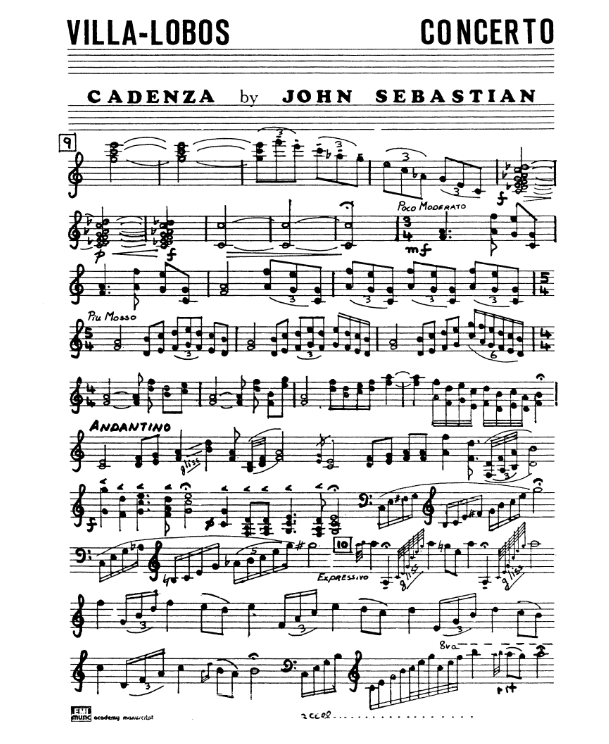
Sebastian recorded this work on a Heliodor LP with Stuttgart Radio Symphony Orchestra, with Hans Schwieger. I'm not sure if this has ever been transferred to CD. Here is a YouTube video of the LP:
This piece has been very lucky with recordings. The top modern exponent is Robert Bonfiglio; his recording on RCA with the New York Chamber Symphony under Gerard Schwarz is my favourite.
Villa-Lobos at the Hotel Bedford
"Visiting Villa-Lobos at the Hotel Bedford in Paris in May 1958, we found ourselves in the presence of a man of typically Brazilian cordiality who knew at once how to set his companions at ease."
- Pierre Vidal, the French journalist who wrote the liner notes for the great Villa-Lobos par lui-même record album from French EMI.In 1952 Villa-Lobos decided to make Paris his European headquarters, and he settled in to a suite in the Hotel Bedford, 17, rue de l’Arcade, in the 8th District. He was pleased and flattered to be offered the same suite used by the Emperor of Brazil, Pedro II, during his exile after 1889. He even used the Emperor's writing desk. In 1971 the Brazilian ambassador arranged for this plaque. It was still there when I made my pilgrimage in 2004, but I don't see it on Google Street View.
 |
| photo: Ed Tervooren |
This photo is from Lisa M. Peppercorn article "H. Villa-Lobos in Paris", Latin American Music Review, Vol. 6, No. 2 (Autumn - Winter, 1985), pp. 235-248.

It's so cool that the Hotel Bedford takes its musical heritage seriously. This photo is from a page about Villa-Lobos on their website. It was at the Hotel Bedford in 1954 that Villa-Lobos composed his ballet Gênesis; I wonder if that's what he's writing here.

It's interesting that Segovia lived for a time at the Bedford as well, and that the two spent time together there. I've been posting lately about these two great musicians. I knew they had met in Paris, but didn't realize they were hanging out there in the 1950s as well.
On February 20, 2016, pianist Coraline Parmentier gave a "Concert de piano en hommage à Villa-Lobos" at the Hotel Bedford. There's a YouTube video of her A Lenda do Caboclo, which I can't embed here.
Wednesday, April 27, 2016
The Harp Concerto
I'm not sure why Villa-Lobos's Harp Concerto isn't better known. I realize it will always be ranked well behind Ginastera's great concerto, especially in the great Argentine's Centennial year. And Villa's Harp Concerto isn't at the level of the Guitar Concerto, or the 2nd Cello Concerto. But it deserves a listen.
Here is Villa-Lobos between two great musicians for whom he wrote the Guitar and Harp Concertos, Andres Segovia and Nicanor Zabaleta.

Here is Villa-Lobos between two great musicians for whom he wrote the Guitar and Harp Concertos, Andres Segovia and Nicanor Zabaleta.
Subscribe to:
Posts (Atom)