Saturday, February 14, 2004

New VL CD release

New this month from Meridian Records in the UK:


O Violoncello do Villa
Complete works for violin, cello and piano
Vol 3


This disc features Villa's Piano Trios 2 and 3, played by Trio Villa-Lobos. The group is made up of Richard Milone, violin; Miriam Braga, piano; and Tânia Lisboa, cello. Braga and Lisboa have formerly teamed up on the Meridian release CDE 84357 O Violoncello do Villa Vol. 1, and were joined by violinist Yang Zhang in CDE 84391 O Violoncello do Villa Vol. 2.

While the piano trios are early works (the second was written in 1915 and the third in 1918), I've always enjoyed listening to them. Don't expect chamber music at the level of VL's string quartet cycle, or the chamber choros written in the 1920s. And don't expect the vitality of the great orchestral works written before the end of the teens (Amazonas or Uirapuru, both written in 1917, for example). In the piano trios Villa was relaxing and enjoying himself, perhaps since he only had the three instruments to keep track of. This is very mellow music.

Meridian is serving Villa-Lobos well. Besides the above three discs there is an excellent piano disc, DUOCD 89017, with Clélia Iruzun, containing three major works: Bachianas Brasileiras No. 4, Prole Do Bebe No. 1, and Choros No. 5. As well, there's another recent new release, CDE 84454, Tangos & Choros: Flute Music from Argentina and Brazil, that features Bachianas Brasileiras #6, and #5 in an arrangement for flute and guitar.


Monday, February 9, 2004

Washington DC Screening of Villa-Lobos: Uma Vida de Paixao

The Brazilian-American Cultural Institute in Washington DC will be screening the 2000 film Villa-Lobos: Uma Vida de Paixao by Director Zelito Viana, on Tuesday, February 24, 2004 at 7 p.m. at BACI, 4719 Wisconsin Avenue, N.W.


It's nice to hear the music of Villa-Lobos (the aria from Bachianas Brasileiras no. 5) when you visit the Institute's home page. Thanks to Wayne Landsman for the tip on this. I haven't yet heard about North American or European distribution of VHS of DVD for this film, but I'm hoping the English subtitles for the Washington screening indicates that something is coming soon.

Sunday, February 8, 2004

Nashville Symphony Bachianas Brasileiras

In the spring the Nashville Symphony will begin their recording sessions of the nine Bachianas Brasileiras. This query recently arrived from Wilson Ochoa, music librarian of the Nashville Symphony:

"We are performing and recording all 9 of the "Bachianas Brasileiras" in March, and I have been busy proofreading the parts to make sure we record these with no errors.

"I have some questions about the printed music conductor scores, and was wondering if you can shed some light on some problems I have encountered.

"In "Bachianas Brasileiras No. 2":

"In the third movement "Dansa": The Violin 2 is marked pizzicato at the beginning. Could this be a mistake? It is unplayable that way (too fast to be able to play it pizzicato), and should be arco to match the violas? (It is arco at rehearsal 15 when the same music returns.) The recordings I have play it arco.

"In the same movement, in the seventh measure, the Violin I is in octaves on the first beat of the measure, should they be in octaves on beat 2? Currently I have the upper part playing E, E, D (above the staff), and the lower part playing C, C, B (in the staff--and this would seem to clash with Violin 2, although Villa Lobos does do this sometimes).

"In the same movement, in the fifth measure after rehearsal 2, should Violin I be pizzicato (as at the beginning of the movement?) Also, the fifth measure of rehearsal 17, should that be pizzicato as well? In the same piece, last movement "Tocata", there is no marking as to when the Violins remove their mutes. Would that occur at rehearsal 3?

"In "Bachianas Brasileiras No. 8":

"In the second movement "Aria": after rehearsal 3, the third and the fifth measure, the strings and horns have a musical figure that sometimes has marked a glissando between beats 3 and 4. In the third measure, the strings have the glissando, and the horns do not. But in the fifth measure the horns have the glissando, but the strings do not. Then, at rehearsal 4, third measure, the strings have this and the horns do not. Should these all match? Should there be a glissando every time? Or is it correct the way it is printed? In the same movement, rehearsal 3, fourth measure, the strings have beat 3 slurred together, but the horns do not. Should these match? Is there a slur?

"Thanks for your help with this.

"Wilson Ochoa, Principal Music Librarian, Nashville Symphony" - wilson@nashvillesymphony.org

I'm hoping some of the readers of The Villa-Lobos Magazine might be able to help Wilson with these questions. If you're in Nashville this March, you'll be able to attend the concerts of all nine Bachianas. I'm not sure if live recordings will be made from the concerts given this March, or if the concerts will be preparations for studio recordings. In any case, you can get all the information from the Upcoming Villa-Lobos Concerts page, and at the website of the Nashville Symphony.

Saturday, February 7, 2004

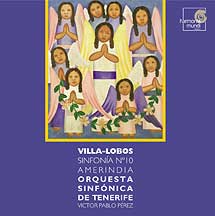
Symphony no. 10 on Harmonia Mundi

I'm back after a long break. Hope you're all still out there...

The BBC's Classical Review website is featuring the new CD from Harmonia Mundi of Symphony no. 10 'Amerindia', with the Orquesta Sinfonica De Tenerife conducted by Victor Pablo Perez.


The new Harmonia Mundi Cd of Symphony 10


After only a couple of VL symphony recordings until just before the turn of the millennium, we can now choose between labels, orchestras and conductors for more than a few of the eleven symphonies. The BBC review by Andrew MacGregor notes that there are three recordings of no. 10, one of which has not been released. This would be a key disc in the soon-to-be-completed Carl St. Clair Stuttgart project of the complete symphonies. Recently Bert Berenschot let me know about the latest release in that series: Symphony no. 7 and Sinfonietta no. 1.


CPO's new CD of Symphony 7


The first recording of no. 10 was of course the Koch International Classics recording by Gisele Ben-Dor and the Santa Barbara Symphony. This disc has been a favourite of mine since it was released in 2000.


Koch's Symphony no. 10 with Gisele Ben-Dor


The BBC page has short RealAudio clips from the first and fifth movements of the Tenerife CD that give you an idea of the kind of music to expect, if not the sound quality. I'm looking forward to listening to the new disc more closely.

Here, by the way, is Bert Berenshot's posting to rec.music.classical.recordings on the new cpo disc:

"Finally CPO released another cd in the Villa-Lobos cycle of 12 symphonies, conducted by Carl St. Clair. This time we get Symphony no.7 combined with the Sinfonietta no.1 (1916). The complexity of Symphony no. 7 dates almost audible from 1945, the same year Villa-Lobos wrote his most complex Piano Concerto (no. 1) and his most complex String Quartet (no. 9). All pieces contain more dissonant and even atonal sections he didn't write any more after 1930. Surely he did write them in the period 1917-1930 in pieces like Amazonas, Choros no. 8 and 11, the Trio and some others, but in a different way, more influenced by the 'primitivism' of those days. Symphony no. 7 is with 36 minutes longer than most of his symphonies and is a impressive piece starting with those orchestral glissandi we already know from the opening of Uirapuru and Symphony no. 11 and somewhere at the end of Genesis.

"It is combined with the early Sinfonietta no. 1 of 1916 which is much lighter and more transparant, composed for a Mozart-size orchestra and written in memoriam Mozart. It runs 23 minutes and is nice but still less typical Villa-Lobos.
So, now we still have to wait for the CPO release of no. 2 (a long piece of one hour, only recorded in the '40's by the Jansen Symphony of Los Angeles) and the choral 10th (Amerindia), already two times recorded by others the last years.

"See http://www.jpc.de/jpcng/cpo/detail/-/hnum/1561100/rk/classic/rsk/notepad for information and sound samples. Until February 15th they sell it cheaper. I suppose it takes some weeks before it will be available elsewhere.

"Bert B."

Thanks for this, Bert - as usual you're on the leading edge of the Villa-Lobos recording world.

Tuesday, October 7, 2003

Villa-Lobos on Letterman

Try to catch The Late Show with David Letterman on Tuesday night, October 7th. Dave's guest is the great soprano Renee Fleming. Word is that we'll hear her sing Bachianas Brasileiras no. 5. This from industry insider Lee Boyd, who emails me this additional information, which she heard on WQXR:

"Renee Fleming will be doing probably just the Aria, with the cellists organized by Edward Aron, who is an award-winning cellist from our very own town of New Castle, only he is from the Chappaqua side of the tracks. Aron also does some programming with the station, so he told them about his performance, which incidentally includes VL and Renee."

So make sure you catch tonight's program (and you'll also get to see Uma Thurman doing her Kill Bill promotion).

Tuesday, September 2, 2003

Upcoming Villa-Lobos Concerts

Since 1997 I've been keeping track of Villa-Lobos concerts around the world, that I've heard about from performers or presenters, or that I've come across on the web. You can find the Upcoming Villa-Lobos Concerts page at http://www.rdpl.org/villa/concerts.html. I've recently reorganized them by month in a convenient calendar format. Here, for example, is the page for September 2003, which includes concerts from Rio de Janeiro, Brooklyn, Teresopolis, Belo Horizonte, Sao Paulo, London and Delaware & Yellow Springs, Ohio.

Besides letting people know about concerts they may wish to attend, these pages now play another role: to document Villa-Lobos concerts from around the world over the past six years. I've analyzed the concerts by work, and will be keeping this information up-to-date in a spreadsheet linked to at the page above. It's also available in this cool new format from Macromedia called FlashPaper - here's the link: http://www.rdpl.org/villa/concerts/ConcertsSpreadsheet.htm.

Please let me know about any Villa-Lobos performances coming up in your neck of the woods.

Wednesday, August 20, 2003

ASV Choros Series

One of the major works by Villa-Lobos that isn't available on CD is the sixth Choros, a fun orchestral work that really swings. Thanks to a brand new CD on the ASV label, we'll all have a chance to hear it. Other under-recorded pieces included on this disc are the Introduction aux Choros for guitar and orchestra and the Choros no. 7 for chamber ensemble.


What's even more exciting about this release is that it's billed as the first in a new series of the Villa-Lobos Choros. It's great to see ASV paying some attention to the orchestral music of Villa-Lobos (their excellent series of piano music with Alma Petchersky continues with a well-chosen recital in the series' third volume). The orchestra featured is the Orquesta Filharmonica de Gran Canaria, under the direction of Adrian Leaper. I see by the Upcoming Concerts and Archived Concerts pages of the Heitor Villa-Lobos Website that Leaper conducted the following Villa-Lobos works in the Canary Islands: Choros 10 in March of 2003, Uirapuru in September of 2002, and Bachianas Brasileiras no. 2 in February 2001. That may indicate that other orchestral Villa-Lobos may be on its way. I'm anxious to hear this new release (to be shipped by Amazon.com later this week), and the upcoming releases from ASV.

Can't wait to hear Choros 6? Listen in to Cultura FM from Sao Paulo this Monday, August 25, at 11:00 a.m., Sao Paulo time (9 a.m. EDT), and you can hear it played by the Orquestra Petrobras Pro-Musica, conducted by Roberto Tibirica - listen here on the Internet.

Thursday, July 3, 2003

Orquestra Sinfônica Brasileira Website

The website of Rio de Janeiro's OSB, or the Brazilian Symphony Orchestra, as it's also known, is very fine. There's useful information on upcoming programs - for example, this October 18, 2003 concert:

18 October
Norton Morozowicz, conductor
Miguel Proença, piano

Villa-Lobos, Preludio da Bachianas Brasileiras no. 4; Saudades das Selvas Brasileiras, no. 1 & 2; Seis Cirandas (Theresinha de Jesus – A Condessa – Senhora Dona Sancha – O Cravo Brigou com a Rosa – Passa, Passa Gaviao); Valsa da Dor; Hommage à Chopin
Prokofiev, Concerto No. 1 for Piano and Orchestra, in D-flat Major, op. 10
Bartok, Concerto No. 3 for Piano and Orchestra

There's also plenty of historical information, including this picture from 1958:


Villa-Lobos' last concert with the BSO and Sônia Maria Strutt acknowledging the ovation to the execution of the Maestro's "Momo Precoce", on August 24, 1958


All in all a fine site. I even have one of the computer wallpapers decorating my Windows desktop.

Thursday, June 5, 2003

Villa-Lobos on Cultura FM - June 2003

Here are Villa-Lobos performances upcoming on Cultura FM from Sao Paulo. Listen here on the Internet. Times are local Sao Paulo times, one hour ahead of EST.

On Sunday, June 8 at 12:00 noon - on the program Acervo Cultura, the first program in the series "Os Choros de Villa-Lobos." Following at 1:00 p.m. is a program of music by the great Brazilian pianist Nelson Freiere. Recently I've been enjoying listening to Freiere's performance of Rudepoema.

The next day, June 9 at 4:00 a.m., you can hear the Quarteto Amazônia perform the 7th String Quartet. Later, at 10:00 a.m., you can hear the same ensemble in Quartet 11. Better yet, buy the whole set of quartets from Kuarup.

June 12 at 11:00 is the second program in the series "Os Choros de Villa-Lobos."

On June 16 at 11:00, pianist Nahim Marun and violinist Claudio Cruz perform Sonata Fantasia n° 2.

June 18 at 11:00 is the third program in the "Os Choros de Villa-Lobos" series.

On June 23 at 11:00 you can hear an important work by Camargo Guarnieri, the greatest composer of the generation following Villa-Lobos: his 3rd Symphony, performed by the Orquestra Sinfônica do Estado de São Paulo, conducted by Johh Neschling.

June 25 at 11:00 is the fourth "Os Choros de Villa-Lobos" program.

Monday, May 12, 2003

Red Deer - a Cultural Capital of Canada

This post isn't directly related to the life and works of Heitor Villa-Lobos, though after eight years of publishing the Heitor Villa-Lobos Website at Red Deer Public Library, there is a strong link between the great Brazilian composer and the city of Red Deer (pop. 70,000), which is halfway between the larger Alberta cities of Edmonton and Calgary.

Last week, Minister of Canadian Heritage Sheila Copps unveiled the names of the five Cultural Capitals of Canada for 2003, at a news conference in Vancouver. The five cities chosen are: Caraquet (New Brunswick), Red Deer (Alberta), Rivière-du-Loup (Quebec), Thunder Bay (Ontario) and Vancouver (British Columbia). There's more on this announcement at the Canadian Heritage site, and at the City of Red Deer site.

The key to Red Deer's success in the world of culture lies in the city's Community Culture Masterplan, and the long-standing grass-roots partnerships that underlie it. This intensely collaborative environment makes it so much easier for people and organizations to make important, lasting, sustainable cultural statements within a community and around the world. As someone who has the privilege of working in such an environment, I'm proud to celebrate this important national recognition of a great community.

Max Eschig Website

Most of Villa-Lobos's major works were published by Editions Max Eschig in Paris. Eschig finally has a website up [http://www.durand-salabert-eschig.com/english/homepage.html], and a very good one, with complete catalogues, lists of agents for sales and rental around the world, and some historical background.


Max Eschig is the most important person from the music publishing industry in the life of Villa-Lobos. It was Eschig more than anyone who helped make Villa's name in the wider world.


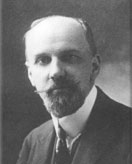
Max Eschig (1872-1927)

Friday, April 11, 2003

Tracking usage at the Heitor Villa-Lobos Website

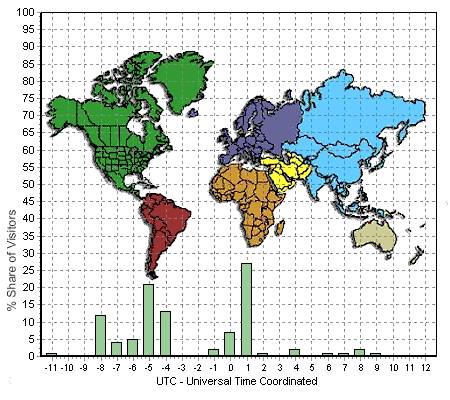
While I haven't had time yet to properly set this up, I have been tracking some usage at the Villa-Lobos Website (http://www.rdpl.org), using Sitemeter. Here are a couple of interesting graphs provided by this useful service; first is the Visitor Time Zone graph:


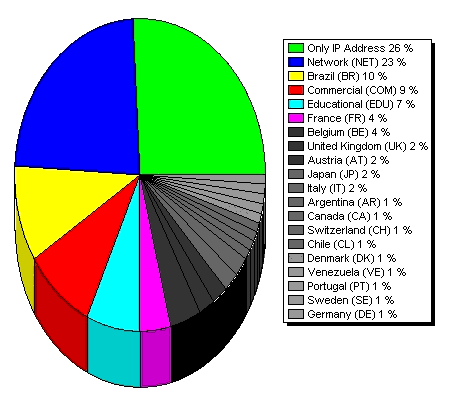
You'll see that people from around the world are visiting the site, with the largest numbers coming from the Central European, Brazilian and Eastern and Western North American Time Zones. The Organization Tracking graph adds detail:


Here you'll see Brazil, France, Belgium, the UK, Austria, Japan and Italy at the top of the country list (I expect most US and Canadian visitors come from the .net, .com and .edu domains).

These results show the widespread interest in Villa-Lobos - his appeal is international!

Tuesday, March 25, 2003

Andre Kostelanetz plays music of Villa-Lobos

In 1974 Columbia (CBS) records released an LP of music performed by the great master of light music, Andre Kostelanetz. All of the pieces were by Villa-Lobos, some in arrangements by Kostelanetz. The LP (M 32821, CBS 61564) shows up in many lists of favourite "easy-listening" classics on the Internet. The highlight for me is the Suite from Magdalena (Villa-Lobos's operetta/Broadway musical of 1948). For more information on the original work, see Ricardo Prado's excellent essay, in Lee Boyd's excellent translation.

Kostelanetz's version of the work points up the full-blown kitschy charm of Villa's music - this is definitely the master letting his hair down! Not profound music, but definitely fun. As Prado says, Villa-Lobos "re-fashioned" many of his favourite melodies - some famous and some lifted from obscure works of his past.

The Kostelanetz LP hasn't been reissued on CD (though I think it would sell well, judging by the recent mini-boom in Villa-Lobos recordings), so you'll need to search it out in libraries (the University of Alberta has a copy) or used-disc stores and websites. The only CD of the complete musical, which Prado praises highly, is hard to come by - I had an order in at amazon.com forever, and it was finally cancelled.


The Teatro Amazonas, a great opera house in the tropical rain-forest.


Your best bet for hearing this music: go to the VII FESTIVAL AMAZONAS DE ÓPERA at the great tropical opera house in Manaus. Magdalena will be performed on the 26th and 29th of April and the 1st of May, with Ligia Amadio conducting the Amazonas Filarmônica, the Coral do Amazonas, the Corpo de Dança do Amazonas and a Coral Infantil. A last minute trip to Brazil would be nice...

Thanks to Bert Berenschot for providing this amazingly entertaining music.

Villa-Lobos on Cultura FM - April 2003

It's a tradition at The Villa-Lobos Magazine for me to list interesting Villa-Lobos pieces coming up on Sao Paulo's Cultural FM. For the month of April I'm highlighting only one program - there are many other performances of works by Villa-Lobos, but most are easily available on CD. So here's the April listing - listen here on the Internet. Times are local Sao Paulo times, one hour ahead of EST.

On April 28 at 11:00 a.m., the rarely heard Ciranda das sete notas for bassoon and strings is performed by the great bassoonist Noel Devos, with the Orquestra de Câmara Brasileira conducted by Bernardo Bessler. The same program includes works by Brazilian composers of a new generation: Blauth (b. 1931), Nobre (b. 1939) and Lacerda (b.1927).

Speaking of Brenno Blauth, you can listen to a movement from his Concertino para oboe y cuerdas performed by Argentina's Camerata Bariloche, with oboist Andres Spiller. There are many other pieces by Latin American composers on the same page - check out this excellent site.

Wednesday, February 19, 2003

Villa-Lobos on Cultura FM - March

Here are radio programs of interest from Sao Paulo's Cutural FM for March - listen here on the Internet. Times are local Sao Paulo times, one hour ahead of EST.

At 11:00 on March 18, the Quatuor, 'Impressões da vida mundana' is performed by the Lontano Ensemble and the BBC Singers, under the direction of Odaline de la Martinez. This is from the 2002 Lorelt CD, which seems to be only available at the UK Amazon site.

At 11:00 on March 27, Eleazar de Carvalho conducts the Orquestra Sinfônica da Paraíba in Uirapurú.

At 15:00 on March 31st you can hear parts of a concert of music by Villa-Lobos and Hekel Tavares at the Theatro Municipal do Rio de Janeiro, with the Orquestra Sinfônica Petrobras Pró Música conducted by Roberto Tibiriça. The pianist is Arnaldo Cohen (piano).

Friday, January 31, 2003

Villa-Lobos in the Wikipedia

Wikipedia is a multilingual project to create a complete and accurate open content encyclopedia.

I've recently added a fairly comprehensive article on Villa-Lobos. I will be keeping an eye on the article, and hope to see readers of The Villa-Lobos Magazine and the Heitor Villa-Lobos Website make their own contributions to the main article or any related topics.

I hope that the Villa-Lobos community will be able to provide information on Villa-Lobos and Brazilian classical music to Wikipedia in other languges, especially Portuguese.

Thursday, January 9, 2003

José Vieira Brandão

October, 2002 saw the death of an important figure in the life of Villa-Lobos and in the musical life of Brazil. Thanks to Martin Anderson for giving me permission to re-print his obituary of José Vieira Brandão. The article appeared first in The Independent on October 18, 2002. The picture is from the Museu Villa-Lobos (Brandão in on the far left).

José Vieira Brandão
Brazilian composer and pianist
18 October 2002


José Vieira Brandão, composer, pianist, conductor and teacher: born Cambuquira, Brazil 26 September 1911; married Eunice Costa Pereira (four sons, one daughter); died Rio de Janeiro 27 July 2002.
It's a tough life being a composer in a country where a single towering figure epitomises its music both at home and abroad. Even now, Finnish composers still feel Sibelius looming over them (indeed, the late Einar Englund called his 1996 autobiography I skuggan av Sibelius – "In the Shadow of Sibelius"). For Brazilian musicians it is Heitor Villa-Lobos who hogs the limelight. But for José Vieira Brandão Villa-Lobos' pre-eminence presented an opportunity rather than a threat, and he became one of his closest musical companions.

Brandão's musical ability was evident in childhood, and at eight he moved south from Minas Gerais to Rio de Janeiro to continue his musical education, first studying piano privately and then at the Instituto Nacional de Música, graduating with a gold medal in 1929; three years later he was awarded the diploma of the Conservatório Nacional de Canto Orfeônico, and choral conducting was to become the other mainstay of his life as a practising musician.

His ability as a pianist was impressive enough for the French pianist Marguerite Long, on a visit to Brazil, to ask him to come to France to study with her, and he accepted. But it was not to be, as he later explained in an interview:

At that time I had met Villa-Lobos, when he started to introduce his ideas in musical education into the public schools in Brazil. My trip to France was already scheduled but I decided to stay here and work in his project.

His collaboration with Villa-Lobos was an almost permanent feature of his early life. As a youth he spent his afternoons at Villa-Lobos' house, playing his mentor's music on the piano, and was to give the premieres of many of his piano compositions; later, in 1942, he was the piano soloist in the first performances of the Chôros No 11 in Rio and the Bachianas Brasileiras No 3 in New York, both conducted by the composer.

He became Villa-Lobos' assistant in 1932, helping him in his ambitious reform programme for music education in Brazilian schools, later pushing the project forward himself. In 1934 he founded the Madrigal Vox do Conservatório Brasileiro de Música and led the group until 1943; in parallel he held positions as an assistant professor of music and then professor of arts, becoming a professor at the Conservatório de Canto Orfeônico in 1943, and remaining there until 1967. He was president of the Conservatório Brasileiro de Música from 1940 until his last years, and one of the founders of the Academia Brasileira de Música in 1945.

Vieira Brandão began to compose at the age of 15, but his composition didn't really pick up speed until after 1940; by the time of his death his catalogue contained some 100 works, written in a national-Romantic style. His choral music, the technique sharpened by years of practical experience, buzzes with Brazilian rhythms and forms an important contribution to the Brazilian choral tradition. Nor did he neglect his own instrument, the piano, and the musicologist and Vieira Brandão scholar Maria Teresa Madeira singles out the 4 Études, the two Serestas (1942) and the Fantasia Concertante for piano and orchestra (1937-59).

Martin Anderson


Thanks, Martin, for that beautiful tribute. It's our opportunity to learn more about this key figure in the Villa-Lobos world.

As I write this, I'm listening to the Brazilian String Quartet play Brandão's Miniatura. This lovely piece is the only work I've heard from what looks to be a significant body of music. It's on an excellent disc I received late last year, on the Albany label from New York. Entitled "Brazilian String Quartet", it includes music by Villa-Lobos and two other composers of the generations after Villa: Radames Gnattali and Cesar Guerra Peixe, performed by one of the premiere chamber ensembles of Brazil. I'm afraid it won't be easy for most of us to hear more of the music of Brandão, though. Amazon.com lists only the piece for String Quartet.

There is an opportunity to hear one of Brandão's chamber works coming up - I happened to mention it yesterday in a post to The Villa-Lobos Magazine. At 11:00 São Paulo time (10 a.m. EST) on February 5th, you can hear his Divertimento for flute, oboe, clarinet, trumpet and bassoon on Cultura FM. Listen here on the Internet.

I'll be on the lookout for more of this music, from online vendors in Brazil and around the world. I'll report my findings here.

Wednesday, January 8, 2003

January on Cultura FM

Happy New Year!

Here are radio programs of interest from Sao Paulo's Cutural FM for January - listen here on the Internet. Times are local Sao Paulo times, one hour ahead of EST.

At 11:00 on January 7, Janos Starker performs the Fantasia for cello & orchestra. Eleazar de Carvalho conducts the Orquestra Sinfônica da Paraíba. This is from the excellent Brazilian Festival '88: A Brazilian Extravaganza CD on the Delos label, still available from Amazon.com.

The following day, again on the Cirandas program at 11:00, you can hear three relatively unfamiliar works from the great Choros series: the epic number 12, along with two witty chamber pieces: number 7 and 4.

At 12:00 on January 12th, the program Acervo Cultura presents "As notas são": "Da música brasileira. Série de 13 programas dedicados à composição erudita do Brasil. Em destaque: A CRIAÇÃO E A CRÍTICA (VILLA-LOBOS E FRANCISCO MIGNONE OS CRIADORES, CARLOS MAUL, E DOIS ANÔNIMOS OS CRÍTICOS). Idealização e apres.: Sérgio Vasconcellos Correa. Apoio de produção: João Antonio Batista. Produção: José Roberto Prazeres - 1990." I'll try listening to this, but I'm not sure if my extremely limited Portuguese will allow me to understand much.

At 11:00 on January 13, you can hear one of the best of Villa's Symphonies, his Sixth. This performance by Carl St. Clair and the Radio Symphony Orchestra of Stuttgart is also one of the best in the excellent cpo series of complete symphonies.

At 15:00 on January 27, the great String Trio is performed by the Ensemble Capriccio, from a 2001 Paulus CD. Also on the programme is a work by a composer I don't know, Amaral Vieira. His Quintet for piano and strings is op. 297, so there's a lot of Vieira out there to listen for in the future. The Villa-Lobos String Trio is repeated at 11:00 on January 30, along with a very interesting group of other works: New York Skyline for piano, the Dança do índio branco and Improviso em homenagem a Villa-Lobos by pianist João Carlos Assis.

Looking ahead to February, there's a short piece I'm looking forward to hearing. It's the Divertimento by the late José Vieira Brandão. Brandão, a close associate of Villa-Lobos and an excellent composer in his own right, performed many premieres of works by Villa-Lobos. He died in October of 2002. The Divertimento is performed by a chamber group of excellent Brazilian players: Andréa Ernest Dias (flute), Luiz Carlos Justi (oboe), José Botelho (clarinet), Philipp Doyle (trumpet) and Noel Devos (bassoon). Listen at 11:00 on February 5th.

On February 28 at 11:00, the rarely performed Introdução ao Choros for guitar and orchestra can be heard. This is from a highly recommended Ondine CD with the Finnish guitarist Timo Korhonen.

Good listening!

Thursday, November 14, 2002

Villa-Lobos film in New York

This was quick: news from New York about an upcoming showing of Villa-Lobos: Uma Vida de Paixão, at the Leonard Nimoy Thalia, Symphony Space, 2537 Broadway. It's scheduled at 9 p.m., November 23, 2002 - check out the Symphony Space website for more information.

Villa-Lobos film in London

Distribution of the Zelito Vianna film Villa-Lobos: Uma Vida de Paixão has been slow outside of Brazil, where it was released in 2000, and a handful of Film Festivals since then (including Miami and Moscow). Londoners will have a chance to see the film on November 19th, at the Brazilian Embassy's Brazilian Contemporary Arts Cineclub, Room 101, Palingswick House, 241 King Street, London, W6 9LP.

I'm watching the web for any sign of the DVD being released in the rest of the world. I'd appreciate word from any readers of The Villa-Lobos Magazine about any video or DVD releases, or release in theatres outside of Brazil. Unfortunately, the official website from Mapafilm no longer seems to be available.

Those who have seen the film seem to rate it highly: the Internet Movie Database has 45 ratings, with an average of 8.4 out of 10.


[Picture: the movie poster from Mapa Filme - click here for a larger version - 128k]

The London Brazilian Embassy's website is excellent: there's lots of interest from the cultural side. Here's an upcoming concert I found out about from the site, which takes place on November 28, 2002 at Bolívar Hall, the Embassy of Venezuela, 54 Grafton Way, London W1T 5DJ. Nadia Myerscough, violin, and Clélia Iruzun, piano, will play the interesting early Villa-Lobos work, the Sonata-Fantasia No. 1, along with works by Albéniz, Ginastera, de Falla, Prokofiev, Bartok and Marlos Nobre. I've been listening to the works for piano and violin and piano trio recently, and find them absolutely charming. There's more information on the concert here, including this interesting tidbit: Ms. Iruzun will release a CD of Brazilian piano concertos on the Lorelt Label in early 2003.