Thursday, September 3, 2009

Review: French Flute Chamber Music

Mirage Quintet: French Flute Chamber Music (Naxos 8.570444)

This year is not only the Ano Villa-Lobos in Brazil (the 50th Anniversary of his death), but also the Ano da França no Brasil, the Year of France. Villa-Lobos had a close relationship with France; Paris was his second home in the 1920s and the 1950s. He had many close friends amongst the musicians of France: Edgard Varèse, Olivier Messiaen, Florent Schmitt.

This new CD of French Flute Chamber Music from Naxos contains music from many of the composers Villa hung out with in Paris, and more importantly, the music on this disc participates in a certain style and sound from that time that Villa made his own, in works like the Nonetto, the Choros series, and the great early piano works.

The 1970s pop/rock group E.L.O. (Electric Light Orchestra) was famously formed to "pick up where [The Beatles'] 'I Am the Walrus' left off." Similarly, all the works on this CD come out of the sound world created by a single piece: Maurice Ravel's 1905 Introduction et Allegro for Harp, Flute, Clarinet, and String Quartet. This lineup of composers comes from Ravel's generation, except for the youngster Francaix, who is 30-40 years younger than the rest. The pieces were all written in the 1920s or 1930s, all of them for flute, harp, and strings.

Though the music exists in that same sound world, subtle differences in the personalities of the composers emerge. Francaix is playful, Roussel muscular, and Schmitt nostalgic and a bit sentimental. Marcel Tournier's Suite, Op. 34 is a special treat. I knew, and enjoyed, the piece from a Hanssler Classic CD with the Linos Harp Quintet, but the Mirage Quintet give the work a forward momentum and depth that really makes it stand out. You can get a feel for this from the Mirage Quintet's YouTube video of the 3rd Movement (Lied: Assez Lent, Avec Melancolie) filmed during the CD recording in Toronto in 2007.


This recording took place under the watchful eyes and ears of the great team of Bonnie Silver & Norbert Kraft, who between them share producer, engineer, and editor functions. Kraft, by the way, is the very same guitarist who completely nailed the Villa-Lobos guitar music for Naxos in 2000. The sound on the new disc is predictably excellent, though some might argue that Robert Aitken's flute is too forward in the mix. It's hard to see how this music could be played or presented any better.

In 1957 Villa-Lobos wrote his Quintette Instrumental for Flute, violin, viola, cello, and harp, which looks back to the Ravel and Debussy models, and perhaps also to works like the Roussel Serenade and the Quintet by Guy Ropartz. But Villa's distinctive voice comes out very strongly in this late masterpiece. I would move the Villa-Lobos work to the top of the list of the pieces I've discussed in this review (all right, second after the Ravel!) Listen to the Quintette as played by the group mobius (also on Naxos, and available on the Naxos Music Library) and tell me if you agree.

Wednesday, September 2, 2009

Review: Klang der Welt - Brasilien

Here's a CD I took notice of back in July, when it showed up in the Naxos Music Library. Now that I've had a chance to listen more closely to it, I'm posting a fuller review here.

Klang der Welt: Brasilien

Heitor Villa-Lobos looms large in Brazil, and not just in the classical music world. In Brazilian popular music, jazz, and popular culture, and especially in this Ano Villa-Lobos (the 50th anniversary of his death), Villa-Lobos is everywhere. This makes it hard for the composers of Villa's generation, and those who followed him, to get noticed. This disc is a welcome introduction to some names that might not be well known to music lovers. Perhaps the new interest in Villa-Lobos in Brazil and around the world will be the tide that raises all boats.

The one fairly well-known work in this chronologically organized CD is Villa-Lobos's Quinteto em forma de Choros, written in 1928. It's a masterpiece, closely related to the Choros series that many (including myself) believe constitutes Villa's greatest achievement.

Luciano Gallet's Turuna for Clarinet, Violin, Viola, & Percussion is from 1926, and it's a real find. The work reflects Gallet's expertise in Brazilian folklore and popular music. It has the same fresh sound of the urban serenaders known as Choroes that permeates Villa-Lobos's music of the 1920s. The music really swings. But the Turuna shares with the Quinteto and the following work, Camargo Guarnieri's Two Songs for Flute and Voice, a sophisticated, modernist voice that relates to Villa-Lobos's strongest influences: Stravinsky, Debussy, and the many composers Villa met in Paris. You can hear in both the Gallet and Guarnieri, for example, the flute and clarinet sounds of Choros #02 of 1924. These works show that the international modernist style of Paris had found fertile ground in Brazil.

Francisco Mignone, who worked in both the nationalist and modernist styles and even flirted with serialism in the 1950s, wrote the Five Songs for Voice & Bassoon relatively late in a very long and productive career. The songs look back to the 1920s, and earlier, to the salon music of the late nineteenth century. There are few composers who write better for the bassoon - bassoonists should take up these songs in the same way they have adopted the witty Waltzes for Solo Bassoon.

Claudio Santoro's Mini Concerto Grosso is a gorgeous piece. It's a stylized work that looks back on neo-classicism in the same way that neo-classicism looked back on earlier music. It looks back to the new Brazilian style that Villa-Lobos took up in the 1930s. Santoro, like Mignone, had gone through a variety of styles (he shared a teacher, Hans Joachim Koellreutter, with Antonio Carlos Jobim, and also studied with Nadia Boulanger). Ronaldo Miranda's Variations also look back to an earlier period in Brazilian music: to a much-loved song by Anacleto de Medeiros, whose choros and schottisches from the turn of the century had a major influence on Brazilian popular music and art music alike.

Joao Guilherme Ripper was born in the year that Villa-Lobos died, and his star has risen very high in the last few years, with major triumphs in choral music and opera. Matinas, from 1996, is another strong work to close this enjoyable and illuminating programme from the very capable musicians of the Deutschen Oper Berlin.

Monday, August 31, 2009

A Musical Mandala

Violinist Gil Morgenstern presents a fascinating concert in his Reflections series: "A Musical Mandala: From Bach to Barkauskas and Back", on October 18th at the Rubin Museum of Art in New York City. This is a typical high-concept presentation for Morgenstern, who is accompanied by pianist Donald Berman, and one that I would dearly love to attend:
The mandala is used in many religious traditions as an artistic aid for meditation to advance practitioners toward a state of enlightenment. A Musical Mandala takes the music of Johann Sebastian Bach as its starting point and circles through works by Schumann, Ysaye, Bartok, Barkauskas, Villa-Lobos, and Kreisler. Join us as we meditate on Bach's enormous influence on enlightened composers and audiences over a period of more than 300 years.
The Reflections series then goes on the road, to the Bass Museum of Art in Miami Beach on November 18, to North Carolina and Pennsylvania, and to Florence, Capri, and Rome, Italy.

Maybe I'll catch the concert in Capri.

Villalobiana in Mexico City


The Escuela Nacional de Musica at UNAM in Mexico City will be marking "el cincuentenario luctuoso" ("mournful anniversary") of the death of Villa-Lobos on November 17 & 19th of this year. This call for participation goes out to those connected with the school. This promises to be a significant Villa-Lobos event.

Saturday, August 29, 2009

Villa-Lobos on Cultura FM: September 2009

Here are Villa-Lobos performances upcoming on Cultura FM from Sao Paulo. Listen here on the Internet. Times are local Sao Paulo times, one hour ahead of EST. Recommended: the Sunday series "O Brasil de Villa-Lobos" with Museu Villa-Lobos Director Turíbio Santos.

September 1:
07:00 DESPERTE COM OS CLÁSSICOS:
HAYDN - Allegro moderato do concerto em ré maior, op.101. Jacqueline Durpé (violoncelo). Orquestra Sinfônica de Londres. Reg.: Daniel Baremboim. / Johann Christian BACH - Sinfonia, op. 3 n° 5 em fá maior. Orquestra do Festival de Londres. Reg.: Ross Pople. / BRAHMS - Allegro Appassionato da sonata em fá menor, op. 120 n°1. Richard Stoltzman (clarineta). Richard Goode (piano). / VILLA-LOBOS -Bachianas Brasileiras n° 5. Maria Bayo (soprano). Orquestra Nacional de Lyon. Reg.: Emmanuel Krivine.

September 4:
23:00 NOTURNO:
VILLA-LOBOS - Plantio do caboclo. Lydia Kennedy e Frans Van Gurp (violões). John TAVENER - Aleluia. Coro Sinfônico de São Francisco. Reg.: Vance George.

September 6:
11:00 O BRASIL DE VILLA-LOBOS - por Turíbio Santos - Edição Especial:
Prelúdios para Violão Goran Sollscher (violão) / Suíte para orquestra de câmara nº 2. Orquestra da Universidade de São Paulo. Reg. Carlos Moreno
Fantasia para saxofone Theodore Kerkezoz (saxofone)

September 9:
13:00 DELICATESSEN com Teresa Lima:
Joseph HAYDN - Sinfonia Hob. I: 72. Sinfônica Bamberger. Reg.: Jonathan Nott. / Osvaldo LACERDA - Poemeto / Cantilena / Toccatina. Antonio Carlos Carrasqueira (flauta). Maria José Carrasqueira (piano). / VILLA-LOBOS - Pequena Suíte. Zygmunt St. Kubala (violoncelo). Rosana Civile (piano).

September 12:
10:00 CIRANDA - Academia Brasileira de Música:
José Alberto KAPLAN - Variantes para flauta, violão e orquestra. Regina Lima Machado (flauta). Eugênio Lima de Souza (violão). Orquestra da Universidade Federal da Paraíba. Reg.: Carlos Anísio. / Radamés GNATTALI - Trio para bandolim e dois violões / Joel Nascimento (bandolim), Luiz Otávio Braga e Bartolomeu Wiese (violões). Clovis PEREIRA - Três peças nordestinas. Quinteto da Paraíba. / VILLA-LOBOS - A prole do bebê nº 1. Nelson Freire (piano).

September 13:
11:00 O BRASIL DE VILLA-LOBOS - por Turíbio Santos - Edição Especial Quartour para flauta, oboé clarineta e fagote.Joachim Schmitz (flauta), Petra Fhuhr (oboé), Johannes Moog (clarineta), Urich Freund (fagote). Sonata fantasia n° 2 para violino e piano - Nngagul Tumaugelov (violino) Bojidor Noer (piano). Lenda do caboclo, e Alma brasileira. Sergio e Odair Assad (Violão). Ciranda das sete notas.Orquestra New Music Stagium. Reg. Antonio Plotino. Sino Vernizzi (fagote).

20:00 MUSICA CONTEMPORANEA - Concertos CPFL ao vivo. Apresentação: João Marcos Coelho.
O grupo Sonax constrói seus próprios instrumentos, e seus integrantes criaram coletivamente a suíte "Villa-Lobos Landscape", tendo como convidado o violeiro Paulo Freire.

September 14:
13:00 DELICATESSEN com Teresa Lima:
Ernesto NAZARETH - Confidências - Valsa. Izumi Tateno (piano). / Peter Joseph von LINDPAINTNER - Concerto em fá maior Op. 44. Albrecht Holder (fagote). Orquestra Filarmônica de Stuttgart. Reg.: Nicolas Pasquet. / VILLA-LOBOS - Segunda sonata para violoncelo e piano Op. 66. Tânia Lisboa (violoncelo). Miriam Braga (piano). Yang Zhang (violino).

23:00 NOTURNO:
Ferrucio BUSONI - Peças características para clarinete e piano. Dieter Klöcker (clarinete). Werner Genuit (piano). / VILLA-LOBOS - Estudos. Sérgio e Odair Assad (violão).

September 16:
07:00 DESPERTE COM OS CLÁSSICOS:
MOZART - Andante com cinco variações em sol maior, K. 501. Jeno Jandó e Zsuzsa Kollár (piano a quatro mãos)./ MILHAUD - Saudades do Brasil. Orquestra Nacional da França. Dir. Leonard Bernstein./ VILLA-LOBOS - Prelúdio das "Bachianas Brasileiras" nº 4. Orquestra de Câmara "Solistas de Londrina"./ GERSHWIN - Rhapsody in Blue. Leornard Bernstein (piano e regência). Orq. Filarmônica de Los Angeles.

September 20:
11:00 O BRASIL DE VILLA-LOBOS - por Turíbio Santos - Edição Especial: Sinfonia nº 1 e nº 6 de Villa-lobos Orquestra Sinfônica da Rádio de Stuttgart Carl St. Clair.

20:00 MUSICA CONTEMPORANEA - Concertos CPFL ao vivo. Apresentação: João Marcos Coelho:
"De Bach à Floresta Amazônica", de junho passado. Edna d'Oliveira (soprano) interpreta canções de Villa-Lobos acompanhada pelo notável violonista Sidney Molina.

September 22 (repeated September 23, 1:00)
14:00 PIANÍSSIMO - Apresentação do pianista e professor Gilberto Tinetti:
VILLA-LOBOS: CONCERTOS - CRISTINA ORTIZ

September 27:
11:00 O BRASIL DE VILLA-LOBOS - por Turíbio Santos - Edição Especial: Rudepoema . Nelson Freire (Piano). Prelúdio n° 2 para piano e violoncelo - Antonio Menezes (violoncelo), Cristina Ortiz (piano).

September 28:
13:00 DELICATESSEN com Teresa Lima:
CHOPIN - Balada n° 1 em sol menor Op. 23. Murray Perahia (piano). / Josef SUK - Fantastické Scherzo Op. 25. Orquestra Filarmônica Tcheca. Reg.: Jirí Belohlávek. / VILLA-LOBOS - Trio n° 1 em dó menor. Tânia Lisboa (violoncelo). Miriam Braga (piano). Yang Zhang (violino).

September 30:
20:00 O VIOLÃO NA ERA DO DISCO: Juliam Bream - com Sidney Molina :
Gravações dos álbuns, "Julian Bream Plays Villa-Lobos" (1971), "Together" (1971), "The Woods so Wild" (1972) e "Julian Bream 70s" (1973).

Thursday, August 27, 2009

Brubeck & Martins at Lincoln Center


Here's some exciting news: jazz legend Dave Brubeck & Brazilian conductor and pianist João Carlos Martins will be performing at New York's Lincoln Center this October. Martins, a former piano virtuoso who now conducts the Bachiana Filarmônica, will bring his orchestra with him from Brazil to Avery Fisher Hall. He'll conduct Bachianas Brasilieras #7, and he and Dave Brubeck will perform Bach together.
“The rapport between João Carlos and me was instant. And ever since that time we shared many a musical thought which is what the October 2nd concert is all about." - Dave Brubeck
Watch this excellent YouTube video to learn more about the close relationship these two great musicians have built together over the years:

Monday, August 24, 2009

Magnificat Alleluia at FIC 2009

The Festival Internacional de Corais (FIC 2009) website includes this page which includes the score, in various formats, for a choral arrangement of the 1958 Magnificat-Alleluia (originally written for mixed choir & orchestra). Here is a video (again, thanks to the FIC website) of the Orquestra Sinfônica e Coro de Câmara da Escola de Música da UFMG, directed by Vivian Assis. The soloist is Luciana Monteiro.

Sunday, August 23, 2009

Villa-Lobos at MIMO 2009


The Mostra Internacional de Música em Olinda (MIMO) is an annual festival in Olinda, Pernambuco, in the North East region of Brazil. This year's festival includes a number of concerts with music by Villa-Lobos, including concerts with the Quarteto Radamés Gnattali and the Orquestra Sinfônica de Barra Mansa.

Saturday, August 22, 2009

Festival Internacional de Corais

This international choral festival, which begins on September 18 in Minas Gerais, honours the legacy of Heitor Villa-Lobos. It's another major project during this Ano Villa-Lobos.

The festival has also organized two audio-visual exhibitions with the help of the Museu Villa-Lobos, one permanent, and another which goes on the road throughout Brazil beginning on Sept. 10. The FIC website has all sort of interesting information.

Here's something cool: every year (this is the 7th annual version) maestro Leonardo Cunha writes a theme song for the festival. This year's is called Mestre Villa:


The website includes PDF and MP3 versions of the music. Here are the lyrics of this piece, written by Fernando Brant.

MESTRE VILLA
(Leonardo Cunha e Fernando Brant)

a canção do povo
quem a fez foi Villa
que ouviu a alma do Brasil

mais que brasileira
é canção do mundo
foi o Mestre Villa quem criou

a cantiga, o choro, o violão
a seresta e vozes em coral
a ciranda, a dança e o lundu
floresta amazônica de sons

("olha a rosa amarela, rosa
tão bonita e tão bela, rosa
olha a rosa amarela, rosa
tão bonita e tão bela, rosa")

o Magnificat-Alleluia bate lá no coração
trenzinho atravessando o nosso interior
as Bachianas Brasileiras inventando um Brasil
que vive em nosso canto, em nossa voz.

In Google Translate's English version:

MASTER VILLA
(Leonardo Cunha & Fernando Brant)
the song of the people
who made it was Villa
who heard the soul of Brazil

more than Brazilian
the world is song
Villa was the Master who created

the song, the crying, the guitar
the singers and choral voices
the nursery rhymes, dance and lundu
rainforest sounds

( "look at the yellow rose, pink
so beautiful, so beautiful, pink
look at the yellow rose, pink
so beautiful, so beautiful, pink ")

Magnificat-Alleluia there beats the heart
interior train crossing our inner
the Bachianas Brasileiras inventing a Brazil
that lives in our corner, our voice.

Thursday, August 20, 2009

Music & Dictatorship in Europe & Latin America

I look forward to reading this really interesting book; I came across this Pre-Publication Announcement at the Interesting Music Stuff blog:
Music and Dictatorship in Europe and Latin America
Edited by Roberto Illiano and Massimiliano Sala
approx. 700 p., 210 x 270 mm, HB, ISBN 978-2-503-52779-6, EUR 125
Special pre-publication price: €105 valid until 31 October 2009
Series: Speculum musicae, vol. 14
Publication date: November 2009
The most interesting article for the Villa-Lobos scholar is T. Garcia's "Music and the Brazilian Estado Novo: Getúlio Vargas, Heitor Villa-Lobos and a National Music Education System," from which the following page is taken.


As I mentioned in a post earlier this year, we need a fuller discussion of Villa-Lobos's relationship with the darker side of the Vargas regime. It looks like this book might provide more information about both the particular case in Brazil and its context in the 20th century.

It's a coincidence, by the way, that I should come across the book A música nacionalista no govêrno Getulio Vargas twice in two days. This looks like a job for InterLibrary Loan!

Wednesday, August 19, 2009

The Yale Glee Club, Robert Goulet, and the Brazilian National Anthem

The Yale Glee Club is 150 years old this year, and naturally there are many interesting stories to be told. This post on the Yale Glee Club blog, "From Charlton Lyons - Reviews of the 1941 Tour," tells a great one about a performance in Rio de Janeiro with a special guest:
...the world famous composer, Heitor Villa-Lobos, who was not merely in the audience that night but who, by prearrangement, came up on the stage to conduct the Yale Glee Club in its performance of its first number, the Brazilian National Anthem. And it was during our singing of their National Anthem that Villa-Lobos turned to the audience to conduct the audience as well. The Yale Glee Club did know that country’s national anthem—we knew it very, very well and could sing it a splendid version of Portuguese, but the Brazilians did not. I remember the occasion perfectly—well, almost perfectly. I have no recollection of the near silence of the audience reported by the reviewer, a silence owing to the fact that only a few could sing it. But, singing my own head off, I would not have heard that silence anyway, would I? No! Certainly not!
It's a great story from the Glee Club point of view, but it must have been a bit of an embarrassment for Villa-Lobos. That same year he published
A Música Nacionalista no Govêrno Getúlio Vargas ca. 1941, in which he characterised the nation as a sacred entity whose symbols (including its flag, motto and national anthem) were inviolable. Villa-Lobos was the chair of a committee whose task was to define a definitive version of the Brazilian national anthem.
The quote is from the Wikipedia article on Villa-Lobos, this section of which is based on Simon Wright's 1992 Villa-Lobos. When I read the Glee Club story, though, it made me think about the famous National Anthem incident starring Canadian Robert Goulet (again thanks to Wikipedia):
On May 25, 1965, Goulet mangled the lyrics to the United States National Anthem at the opening of the Muhammad Ali-Sonny Liston heavyweight championship fight in Lewiston, Maine. Goulet had never sung the anthem in public before, and replaced the lyrics "dawn's early light" and "gave proof through the night" with "dawn's early night" and "gave proof through the fight." The gaffe was reported in newspapers nationwide the next morning, and Goulet was criticized in opinion columns for a lack of knowledge of the lyrics.
The best part of the story isn't included here. I remember hearing Goulet talk about how, at a nightclub gig soon after this incident, he began to sing "O Say Can You See..." as a joke. He assumed that everyone had heard what happened, and would treat it as a joke as well. When the crowd began to sing along, though, he had no choice but to continue as well, and mangled the words once again.

I love that story. Goulet, by the way, was born to French Canadian parents in Massachussets, but spent his formative years 600 km to the north (!) of Red Deer's Villa-Lobos Central Control, in Girouxville, Alberta.

But back to the Hino Nacional Brasileiro. The Orquestra Sinfonica do Estado do Sao Paulo and their conductor John Neschling have recorded a CD of the absolutely authentic versions of the National Anthem (in orchestral and choral versions), and other national songs:

01. Hino Nacional Brasileiro - versão instrumental
02. Hino Nacional Brasileiro - versão com coro
03. Hino da Independência
04. Hino da Bandeira Nacional
05. Hino da Proclamação da República

You can download the entire album for free, thanks to the Osesp website. While you're there, check out their many freely-available podcasts.

Brazilian Music MP3s

For a limited time this sampler album of eight MP3s can be downloaded for free from Amazon.com's MP3 store. The songs are by Grupo Batuque, Sabrina Malheiros, The Ipanemas, Joyce, Clara Moreno, Azymuth, Jose Roberto Bertrami and His Modern Sound, and Marcos Valle.

There's lots more information about these musicians and this music from the website of the great Far Out Recordings company.

These downloads are only available on for Americans, unfortunately.

About the New Villa-Lobos scores

The story of the newly-discovered scores of Villa-Lobos has some legs. AP has picked the story up, and I've seen it featured in a number of Portuguese and French music blogs. Here's some new information from Marcelo Rodolfo at the Museu Villa-Lobos in Rio - thanks, Marcelo!:
The great Brazilian soprano Vera Janacopulos, in order to help Villa-Lobos, asked him to arrange/transcribe to her songs by other composers and Guy de Ropartz was one of them.
Let's hope that the current crop of Brazilian sopranos are lining up to record these new songs!

P.S. Thanks to Vera Janacopulos, Heitor Villa-Lobos, and the estagiários (interns) who discovered these scores nearly 90 years after they were written, for leading me to the amazing music of Guy Ropartz.

Tuesday, August 18, 2009

Who is Guy Ropartz?

And why did Villa-Lobos orchestrate his music?

I hadn't come across Joseph Guy Ropartz before - his dates are 1864-1955, so he was in the generation before Villa-Lobos. The very informative Wikipedia article provide the following information:

Born in Brittany, Ropartz studied in Paris with such important teachers as Jules Massenet and César Franck. From 1919 to 1929 he was busy in Alsace, as the Director of the Strasbourg Academy, and of the Philharmonic Orchestra. In 1929 he retired to Brittany, and died there in 1955, four years before Villa-Lobos.

This short resume of Ropartz's life shows that it was very unlikely that Villa-Lobos's connection to him was personal (as so many of his connections were - think of his close relationships with Edgard Varese, Olivier Messiaen, Florent Schmitt). The newly-discovered orchestrations were dated 1921, and Villa didn't arrive in Paris until 1923. In spite of the difference in their ages and their musical interests, though, there is a connection between these two composers. A French blog post about the newly-found scores calls Ropartz "son homologue français," Villa's French counterpart.

The Wikipedia article points to the probable reason that Villa chose this composer to adapt:
Ropartz wrote that he was the son of a country "where the goblins populate the moor and dance by the moony nights around the menhirs; where the fairies and the enchanters - Viviane and Merlin - have as a field the forest of Brocéliande; where the spirits of the unburied dead appear all white above the waters of the Bay of the Departed." This interest in the world of folklore was shared by the composer of Amazonas and Uirapuru (1917), both of which are about the same fairy-world creatures of the forest that interested Ropartz. I very recently blogged about the mythological forest being that inhabits the First String Quartet, from the same period (1915).

The Wikipedia article includes this quote about Robartz by Rene Dumesnil in Le Monde. It could have been written about Villa-Lobos as well:
"There is with Ropartz a science of folklore and its proper use, which one admires; but more often than the direct use of popular motifs it is an inspiration drawn from the same soil which nourishes the work, like sap in trees."
I'm listening to Ropartz's First Symphony "On a Breton Chorale" on a Timpani recording with the Nancy Symphony, conducted by Sebastien Lang-Lessing (on the Naxos Music Library). This music sounds as connected to the folkloric world as any of Villa's works. "I am Folklore", Villa-Lobos famously said, and these motifs were completely internalized in his music, permeating his greatest works (any of the Bachianas Brasileiras, for example), whether or not they have a program.

An additional musical link between Ropartz and the earlier symphonic works of Villa-Lobos may exist because of their shared adherence to the compositional teachings of Vincent d'Indy, though I'm not well enough versed in musical theory to pull out those particular threads myself.

I predict that when more information is released about these new scores, it will turn out that the Ropartz works in question have folkloric themes.

Monday, August 17, 2009

Rediscovered Villa-Lobos scores

Hard on the heels of the newly-discovered Mozart scores comes the news about previously unknown Villa-Lobos works in Rio de Janeiro. They were discovered in the library of the Escola de Música da Universidade Federal do Rio de Janeiro (UFRJ).

These aren't new Bachianas Brasileiras, though (or the missing Choros or Symphony), but Villa-Lobos's orchestration of four pieces by the French composer Guy Ropartz (1864-1955). Still, it would be nice to hear these, or at least learn more about them. The full story is here.

A Ciranda do Villa

A 50-minute play for children entitled "A Ciranda do Villa" premieres in Sao Paulo this weekend.

The play, written by Evill Rebouças and directed by Gira de Oliveira, narrates the life of the composer, with a back-drop of Brazilian folk-song. During a dream, the young 'Tuhu' (Villa's nickname as a boy - it means 'Flame' in the Tupi language) travels to the five regions of Brazil, encountering figures from folklore (the prankster saci, the demon curupira and the werewolf lobisomem), each of whom has a song that turns up in Villa's later compositions.

This clever concept is brought to the stage by the Cia. Lúdicos de Teatro Popular. There are two performances, on Saturday the 22nd, and Sunday the 23rd, at the Teatro de Arena Eugênio Kusnet in Sao Paulo. Thanks to this story in the Guia da Folha Online for the head's-up on this.

The Saci, by the way, is featured in the last movement of the first String Quartet "Saltando Como Um Saci" - Jumping Like a Saci. You can imagine this Loki-like figure while you listen to the Bessler-Reis quartet play it online at Radio UOL.

[Pictured to the right, Saci Pererê - Mitologia brasileira, by artist André Koehne, from the Wikipedia Commons, under the Creative Commons Attribution ShareAlike 3.0 License.]

Friday, August 14, 2009

Wilfrid Mellers on Villa-Lobos

You can't always tell what kind of article you're going to get when you look at a citation in a database:
Review: Letters from (South) America
Wilfrid Mellers
Reviewed work(s): The Villa-Lobos Letters by Lisa M. Peppercorn; Villa-Lobos
The Musical Times, Vol. 138, No. 1858 (Dec., 1997), pp. 18-20
Villa's letters often illuminate his life, and occasionally illuminate his music. Peppercorn's book presents this as well as can be expected, but in the end these are not Mozart's letters to his family.

But Mellers is a really good music critic, and a really good writer. I ended up getting an awful lot of pleasure from this three-page review article, and I learned about Villa-Lobos's music as well.
"Villa-Lobos countered Latin exuberance with Latin passivity, accepting the chaos of the contemporary scene since anything was grist to his voracious mill. He was even less self-critical than were Milhaud and Koechlin: which is why his music impresses most when it is most fortuitous."
Meller's insights are thick on the ground here. I start to quote them, and then I realize I'd need to include the whole three pages. The Musical Times might not appreciate that. But here's a good one:
"Villa-Lobos was a crossover artist long before the genre had been invented. As a lad in the streets of Rio he joined with his mates in jam-sessions wherein any number of performers, using any instruments that came to hand, improvised at random, with no more than a pulse, a metrical pattern, a chord sequence, or a snatch of half-remembered tune to keep them going, if not together."
and here is Mellers' virtuoso list of Villa's influences:
"...traces of Renaissance ecclesiastical polyphony (at which some Amerindians became oddly proficient), of Spanish zarzuela, Portuguese fado, Italian romantic opera and popular song, French vaudeville and cafe-concert, plus a few pockets of familiar Teutonic classics and a substratum of Victorian and Edwardian British salon music. Entangled with this European detritus was a Negroid strain precipitated from the slave trade, including the germs of jazz: which in turn linked up with the mechanised media culture of the United States. Whereas in the work of Europeans such as Janacek, Bartok, and Stravinsky primitivism was absorbed into civilised traditions, in Latin America the sundry layers coexisted, side by side. So Villa-Lobos's imagination teemed with musical images of the Brazilian jungle, of the lost Indian cities, of Portuguese and Spanish colonisations, and of the North American skyscraper and roadhouse."
Wilfrid Mellers was an extraordinary scholar; read the obituary that was printed in The Times Online after his death in 2005. I was struck by how widespread Mellers' interests were, both as a writer and a composer. The only book of his that I know is the 2001 Singing in the Wilderness: Music and the Ecology in the 20th Century, which includes a chapter on Villa-Lobos. I look forward to reading more Mellers. Just the titles are great enough:

Thursday, August 13, 2009

Bachianas in Aspen


The InstantEncore website has added lots of new music this summer. Here's a recent concert that you can stream online - it's from August 8th, and it features cellos from the Aspen Festival Orchestra, soprano Carla Janzen, and mezzo-soprano Jazmina MacNeil. The programme includes Bachianas Brasileiras #1, BB#5 (with Janzen), and music by George Benjamin, Anne Wilson, Julius Klengel, and Astor Piazzolla (arranged by Derek Snyder).

Harvey Steiman reviews this concert at MusicWeb International's website. Apparently there were 37 cellists on stage for the event, which was billed as "A Recital with Cellos." Like Steiman, I was impressed by the playing of the cellos in the Villa-Lobos works, and by the moving piece by Anne Wilson called "Lament (In Memory of Matthew Shepard)".

I listened to this concert on the new Aspen Music Festival iPhone application, powered by InstantEncore. This free app is a winner - I'll be listening to lots of music from Aspen while riding my bike this summer & fall.

Tuesday, August 11, 2009

Villa-Lobos & His Contemporaries


This week the School of Music at UFRJ in Rio de Janeiro presents a music festival entitled "Villa-Lobos e seus contemporâneos" - Villa-Lobos & his contemporaries. Concerts from August 10-14 include some very rarely-performed works such as Choros #03, the Quarteto simbolico, and the Fantasia em três movimentos em forma de choros.

The juxtaposition of these works with the music of Stravinsky, Bartok, Berg, and Webern will help to show the avante garde nature of Villa's music from the teens & 20s. This series is yet another example of how seriously everyone is taking the Ano Villa-Lobos in Brazil. You can't walk down the street in Rio de Janeiro or Sao Paulo without coming across a Choros or Bachianas!

It's fitting that UFRJ celebrates Villa-Lobos, since he's an alumnus of sorts. In 1903 the composer, busy with his work as a musician at bars & restaurants, registered for some music courses at the University:

“Villa-Lobos foi aluno da escola em 1903 em um curso noturno, porque ele trabalhava tocando em bares e restaurantes e, por isso, só conseguia estudar nesse curso noturno”, conta o diretor da Escola de Música da UFRJ, André Cardoso. [from a story about UFRJ music school's 160th Anniversary at the O Globo website. There's a cool video on this page: it takes a while to load, but it's worth waiting for.]

[Pictured above: the cover of this month's VivaMúsica! magazine.]

Friday, August 7, 2009

August is Villa-Lobos String Quartet Month

This began as a comment to my review of the new Dorian box-set of the complete String Quartets, but I think it deserves its own post.

August 2009 is indeed a big month for the 17 String Quartets of Villa-Lobos. Besides the release of the superb box-set of the Cuarteto Latinoamericano, and their Mexico City performance of the complete cycle later this month, we have another performance of all of the string quartets. This one is at the Museu Villa-Lobos in Rio de Janeiro, and it's by the Quarteto Radamés Gnattali, on August 12-13, 20-21, and 27-28.

Actually, I was wrong about the August concerts. I can't imagine how I screwed this up. Cariocas will have to wait until November for their complete cycle.
The Quarteto Radamés Gnattali will perform the complete string quartets on the following dates:
  • At Museu Villa-Lobos: November 10, 13, 24 and 28
  • At Sala Guiomar Novaes (a small auditorium located at Sala Cecília Meireles): November 16, 18 and 21
Thanks to Marcelo Rodolfo from the Museu Villa-Lobos for the correction and the new information.

The Gnattali Quartet website includes streaming audio of the Poco Animato movement from the sixth quartet from their Quadro Brasil CD.

Complete String Quartets box set from Dorian

"The writing is crazy, but it has a point. It's the added salsa and when you play the quartets you have to make them spicy." - first violinist Saúl Bitrán
From 1995 to 2001, the Cuarteto Latinoamericano recorded all 17 of the Villa-Lobos string quartets. These were released on the Dorian label on six individual CDs, with two or three pieces on each disc, often with early, middle, and late works mixed together for variety. The performances were hailed by most critics as the definitive performances, which is saying quite a bit. Villa's string quartets were already well-served on CD, with complete cycles by the Bessler-Reis quartet on (the late, lamented) Brazilian label Kuarup, and by the Danubius Quartet on Marco Polo. There were also recordings of individual works by the Brazilian String Quartet (#01, 06, & 17); the Stuyvesant Quartet (#06); Quadro Brasil (#06); Quarteto Brasileiro da UFRJ (#06, 11, & 17, on separate discs); and the Hollywood String Quartet (#06 again!).

As good as some of those other performances are, the Cuarteto Latinoamericano own these works; they are the best advocates I know for this amazing music.

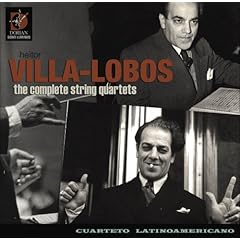
Now Dorian has put together a box-set of the six CDs, remastered and nicely packaged (in the thinner style which takes up less shelf-space - an important factor for my Villa-Lobos CD collection!) The Dorian CDs always sounded great, and their remastering for this set polishes things up so you feel even more in the presence of the musicians. Dorian has added a seventh disc: a DVD of the group performing #01, and an interview with the musicians talking about Villa-Lobos and his music. There's a really excellent booklet with valuable notes by Juan Arturo Brennan. The pictures chosen for the set (especially the one on the cover of the booklet, which is reproduced above) give a feel for the genial composer writing for this most genial musical form.

The interview is amazing, and I plan on watching it again more carefully. The members of the Cuarteto Latinoamericano - the three Bitrán brothers (Saúl, Arón, & Alvaro) and Javier Montiel - have lived with these works for a long time, and are very thoughtful about the music not just in terms of technique and musicality, but as part of a broader idea of Latin American culture. It's interesting to compare this interview (done in 2009, I presume, or late 2008) with the one the Cuarteto gave to Ken Smith more than a decade ago (published as "Spicing up the harmonies," in The Strad, January 1997, p. 27.) I've learned so much about Villa's music from this article. These musicians who lived so long with this music have the confidence to look at it critically, and to make adjustments that the busy Villa-Lobos might have made if he had time for a second thought:
The first violin has long sections of melody in parallel fourths which work fine on the piano but are incredibly awkward on the violin. I think that he wrote too fast and never revised, because if he thought for a minute about some of his intervals, he would have changed them. This is the major problem with the quartets, because people who don't take the time to revoice [redistributing lines among parts] some passages will play them badly.
This reminds me of things Carl St. Clair said about awkware passages in the scores of the Symphonies, and that Kenneth Schermerhorn said about the Bachianas Brasileiras, whose scores were littered with errors. Andres Segovia said the same thing:
Others have written things that were impossible. Villa-Lobos, for example, was a good friend of mine, but in composing for the guitar, he would write a chord that was possible, then another chord that was also possible. But to go from the first chord to the second was impossible [laughs].
[Interviewed by Allan Kozinn, in The Guitar Player Book by Mike Molenda]

Having recorded the entire cycle of 17 string quartets and performed the cycle five times (with another coming up in Mexico City later this month), these musicians rate this music very highly. In the DVD interview Saúl Bitrán puts these works in the same league as the cycles by Bartok and Shostakovich, and says that Villa-Lobos' string quartets are much more creative and much more original than the two great 20th century series.

The string quartets include some avante-garde features (especially #03 from 1916, which was the musical centrepiece of the 1922 Semana de Arte Moderna in Sao Paulo):
Back in 1916, before Bartok or Shostakovich, he wrote a complete movement with left-hand pizzicatos and double harmonics; things no one else had ever thought of. [Arón Bitrán, from the Smith interview]
If they flirt with the exoticism which most people connect with Villa-Lobos they do so only to a certain extent. You might not recognise the string quartets as being by the same composer as the Sixth or Tenth Choros. At the end of the cycle, the string quartets become more neo-classic and less emotional. The final works, written when Villa-Lobos was ill, are meditative and suffused with "saudade", the Brazilian version of nostalgic sadness. It's really sad that Villa didn't get a chance to finish his 18th String Quartet, which he was working on when he died. Only sketches remain (they're in the Museu Villa-Lobos).

Keep an eye on the Cuarteto Latinoamericano - their excellent website is a good way to do this. It includes a concert calendar that shows how busy these four musicians are. This Sunday, August 9th, 2009, for example, they're in Santander, Spain, playing Villa's first quartet, along with Turina's fourth and the Spanish composer Agustin González Acilú's sixth quartets. This is the group's 30th anniversary year; let's hope they're around for a long, long time to come.

Tuesday, August 4, 2009

Villa-Lobos on Cultura FM - August 2009

Here are Villa-Lobos performances upcoming on Cultura FM from Sao Paulo. Listen here on the Internet. Times are local Sao Paulo times, one hour ahead of EST.

August 6:
13:00 DELICATESSEN com Teresa Lima:
CHOPIN - Noturno Op. 62 n° 1. Vladimir Horowitz (piano). / MOZART - Sinfonia n° 38 em ré maior K 504. Orquestra de Câmara da Europa. Reg.: Nikolaus Harnoncourt. / VILLA-LOBOS- Suíte Popular. Quinteto Villa-Lobos.

August 7:
23:00 NOTURNO:
Joaquín TURINA - Oração do Toureiro, opus 34. Orquestra Cidade de Granada. Reg.: Juan de Udaeta. / VILLA-LOBOS - Estudos 1 a 7 Narciso Yepes (violão).

August 9:
11:00 O BRASIL DE VILLA-LOBOS . Por Turíbio Santos
Bachianas Brasileiras nº 4; Bachianas Brasileiras nº 8; Choros nº 1 Villa-Lobos (violão).
Orquestra da Radiodifusão Francesa. Reg. Heitor Villa-Lobos.

August 12:
13:00 DELICATESSEN com Teresa Lima:
GLAZUNOV - Prelúdio e duas mazurkas Op. 25. Stephen Coombs (piano). / VILLA-LOBOS - Estudos para violão 1 a 5. Alexander-Sergei Ramirez (violão). / MEDTNER - Sonata n° 1 em si menor Op. 21. Manoug Parikian (violino). Hamish Milne (piano).

August 13:
07:00 DESPERTE COM OS CLÁSSICOS:
Pjotr Iyich TCHAIKOVSKY - Dumka (Cena Rústica Russa), op. 59. Lang Lang (piano)./ Heitor VILLA-LOBOS - Bachianas Brasileiras n° 2. Orquestra Filarmônica Real Britânica. Reg.: Enrique Bátiz. / Jean SIBELIUS - O Cisne de Tuonela. Orquestra de Filadélfia. Reg.: Eugen Ormandy. / Wolfgang Amadeus MOZART - ária "Prigionier che fa ritorno, do oratório "Betulia Liberata", K. 118. Nathalie Stutzmann (contralto). Moscou Virtuosi. Dir.: Vladimir Spivakov. / Hekel TAVARES - Modinha, primeiro movimento do concerto para piano em formas brasileiras. Arnaldo Cohen (piano). Orquestra Sinfônica Petrobrás Pró-Música. Reg.: Roberto Tibiriçá.

August 15:
09:00 O PRAZER DA MÚSICA com Marcelo Jaffè:
50 anos sem Villa Lobos.

August 16:
11:00 O BRASIL DE VILLA-LOBOS Por Turíbio Santos:
Sonata nº 2 para violoncelo e piano; Trio nº 1 em dó menor. Prelúdio nº 14. Tânia Lisboa (violoncelo) e Mirian Braga (piano).
22:00 KALEIDOSCÓPIO com Almeida Prado:
Bruno MANTOVANI - Concerto para Violoncelo e Orquestra. Orquestra Sinfônica da Rádio de Saarbrucken. Reg. Günther Herbig../ Philippe SCHVELLER - Concerto para violoncelo e Orquestra. Orquestra Filarmônica da Rádio França. Reg. Alexander Briger. Jean Guihen (solista). / Heitor VILLA-LOBOS - Choros nº 10 - Simon Bolívar Symphony Orchestra of Venezuela, Schola Cantorum de Caracas. Reg. Eduardo Mata

August 18:
12:00 CONCERTOS DO MEIO-DIA com o Maestro Walter Lourenção:
Terceira Suíte de "Descobrimento do Brasil" de Heitor VILLA-LOBOS pelo maestro Roberto Duarte.

August 19:
13:00 DELICATESSEN com Teresa Lima:
VILLA-LOBOS - Capriccio em C maior Op. 49. Marcio Carneiro (violoncelo), Werner Genuit (piano). / Edvard GRIEG - Balada para piano em sol menor Op. 24.

August 20:
21:00 SALA DE CONCERTO:
Heitor VILLA-LOBOS - Uirapuru. Orquestra Sinfônica Simon Bolívar da Venezuela. Reg.: Eduardo Mata. / Carlos CHÁVEZ - Suite de Cavalos de Vapor. Orquestra Sinfônica Simon Bolívar da Venezuela. Reg.: Eduardo Mata. / Alberto Ginastera - Estância. Orquestra Sinfônica Simon Bolívar da Venezuela. Reg.: Eduardo Mata. / Silvestre REVUELTAS - La Noche de los Mayas. Orquestra Sinfônica do estado do México. Reg.: Enrique Batiz. / Manuel PONCE - Concierto del sur. Sharon Isbin (violão). Orquestra Filarmônica de Nova York. Reg.: José Serebrier.

August 21:
23:00 NOTURNO:
VILLA-LOBOS - Canção do Amor. Renée Fleming (soprano). Orquestra da Rádio de Msocou. Dir.: Alfred Heller

August 22:
10:00 CIRANDA - Academia Brasileira de Música:
VILLA-LOBOS - Choros 10. Schola Cantorum de Caracas. Orquestra Sinfônica Simon Bolívar da Venzeuela. Reg.: Eduardo mata. / GUERRA PEIXE- Prelúdios Tropicais. Martha Marchena (piano).

August 23:
11:00 O BRASIL DE VILLA-LOBOS . Por Turíbio Santos.
Concerto nº 5 para piano e Orquestra; Sinfonia nº 4. Orquestra da Radiodifusão Francesa. Reg. Heitor Villa-Lobos. Felicia Blumental (piano) Obras do Guia Prático. Orquestra Villa-Lobinhos. Reg. Sergio Barbosa

August 25:
13:00 DELICATESSEN com Teresa Lima:
MEDTNER - Sonata n° 2 em sol maior Op. 44. Manoug Parikian (violino). Hamish Milne (violino). / VILLA-LOBOS - Quarteto de cordas n° 6. Quarteto Radamés Gnattali.

August 27:
23:00 NOTURNO:
Francis POULENC - Valsa e Pastoral. Marcelo Bratke (piano). / Sergio BARBOZA - Supite Ugupu. Turíbio Santos (violão). / VILLA-LOBOS - O canto do capadócio. / Berceuse. Rebecca Rust (cello). David Pater (piano).

August 30:
11:00 O BRASIL DE VILLA-LOBOS . Por Turíbio Santos.
Quartetos nº 1 e nº 2. Quarteto Bessler Reis; Sexteto Místico. Quinteto Villa-Lobos e convidados. Valsa da Dor. Arnaldo Estrela (piano)

Monday, July 27, 2009

More about arrangements

I found The Rehearsal Studio blogger Stephen Smoliar's comments about Villa-Lobos (which I referenced in my previous post about Miles Davis' Sketches in Spain) very enlightening. He has another Villa-Lobos post which goes into the arrangement issue in more detail. Writing about the Bachianas Brasileiras in general, and BB#5 in particular, Smoliar says
I like to consider any arrangement as a window into the arranger's own approach to listening, in the same spirit as the Villa-Lobos compositions (which are decidedly not arrangements). Nevertheless, every arrangement can never be more than an experiment; and not all experiments turn out for the best.
The Gil Evans arrangement of O Canto de Nossa Terra, the second movement of Bachianas Brasileiras #2, is definitely an arrangement in this sense. Evans was in a listening groove at the time: the source music for Sketches in Spain (both the Villa-Lobos and the Rodrigo Concierto de l'Aranjuez) was obviously important to Evans during the six months he and Davis worked on the recording. While part of my excitement about Song of Our Country on Sketches in Spain comes from just hearing Miles Davis' trumpet in these tunes, I do feel that there's something special about Evans' take on Villa-Lobos.

There's an interesting twist on the BB#2 arrangement, since the orchestral version we all know is itself an arrangement by Villa-Lobos. Three of the piece's movements, including O Canto de Nossa Terra, were originally written for cello and piano (the fourth was originally for solo piano). Here are Ricardo Santoro and Flávio Augusto playing the original piece:


There are two ways one can proceed from here. One relates to musical craft, while the other is more philosophical. Like Bach himself, Villa-Lobos was a practical musician. Both arranged and re-arranged their own music and others'; both had jobs that required them to write prodigious amounts of original music. Especially as he moved into the 1930s and his new job as head of Music Education in Rio de Janeiro state, Villa immersed himself in the folk music of Brazil. Villa's two streams of source music - Bach and Brazilian folk music - were transformed, in the 1930s and 1940s, into the Bachianas Brasileiras series and the Guia Pratico.

The second way of looking at the Bachianas comes from a source much closer than 18th century Germany: Jorge Luis Borges, who wrote this in Buenos Aires in 1935:

I sometimes think that good readers are poets as singular, and as awesome, as great authors themselves.

and

Reading, meanwhile, is an activity subsequent to writing - more resigned, more civil, more intellectual.

We can think, then, of Villa-Lobos reading Bach, and Gil Evans reading Villa-Lobos, and we can see both as being more resigned, more civil, more intellectual than the original compositions.

It was Ned Rorem who compared Villa-Lobos to Borges' Pierre Menard, Author of the Quixote, who told the "author" of the story,

"Thinking, meditating, imagining,... are not anomalous acts - they are the normal respiration of the intelligence. To glorify the occasional exercise of that function, to treasure beyond price ancient and foreign thoughts, to recall with incredulous awe what some doctor universalis thought, is to confess our own languor, or our own barbarie. Every man should be capable of all ideas, and I believe that in the future he shall be."

Sketches of Spain / Sketches of Brazil

There were two major musical milestones in November, 1959. In Rio de Janeiro, Heitor Villa-Lobos died, on November 17, at his home at Rua Araújo Porto Alegre 56, apartment 54. Meanwhile, in New York, Miles Davis arrived at Columbia Studios to record Gil Evans' arrangement of a suite of music including Rodrigo's Concierto de l'Aranguez, which eventually was released as Sketches of Spain. As this classic LP celebrates its 50th Anniversary in the Ano Villa-Lobos, it's interesting to note the connections between these two events.

[picture of Miles Davis: one of Robert W. Kelley's Life Magazine photos taken in May 1958, from the Google Life Archive © Time Inc.]

First of all, run or cyber-hurry, don't walk, to your nearest music seller to buy the 50th Anniversary Enhanced 2 CD Legacy Edition of Sketches of Spain. It includes various takes of the original five tracks, plus different versions of songs not included on the original LP.

The most important of these is Song of Our Country, Gil Evans' version of O Canto de Nossa Terra, the second movement of Bachianas Brasileiras #2. This is amazing, awesome, as complete a reworking of Villa-Lobos as the Bachianas was a reworking of Bach. In the words of blogger Stephen Smoliar,
Villa-Lobos is far better served by Evans' treatment than he ever was by the overabundance of hack adaptations (anyone remember Johnny Mathis?) of the aria from the fifth Bachianas Brasileiras suite.
The LP was controversial when it was released. I believe it's stood the test of time, and it's a legitimate classic now. It's #356 in the Rolling Stone 500 Greatest Albums of All Time (a list where Miles does well, though very few other jazz artists show up at all).

In honour of both events, Robert Irving III is launching Sketches of Brazil, an orchestral homage to Miles Davis & Gil Evans, and to Heitor Villa-Lobos. The work will be launched at a free concert on Thursday, August 13, 2009, at 6:30 p.m., in Millennium Park, Chicago. In Irving's words,
As Brazilian music was developed via African and European influences, it possesses a unique blend of subtle sophistication that is seamlessly juxtaposed with moving rhythmic undercurrents. I have sought to develop compositions that likewise, unite these seemingly divergent roots.
I hope that Irving and his Sonic Portraits Orchestra end up in the recording studio with Sketches of Brazil. Based on Irving's previous award-winning work with Miles Davis, this may well end up becoming one of the most important legacies of the Ano Villa-Lobos.

Wednesday, July 22, 2009

Classical Music Cover Art

I've really enjoyed reading (looking at?) Classique: Cover Art for Classical Music, a book by Dr. Horst Scherg. I remember the golden days of the classical LP cover well: the '60s and '70s at least. Browsing these covers is both an aesthetic exercise and a nostalgic one. It's about the music one remembers and the whole range of design from perfection through kitsch to the bizarre, and in some cases, even perverse. During the height of the LP era, I worked in the Audio-Visual Department of Edmonton Public Library, and I remember checking out probably half of these LPs, though I haven't listened to anywhere close to that many, even in CD transfers.


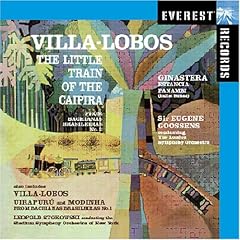
Scherg features a few Villa-Lobos covers. I wasn't surprised to see the Leopold Stokowski album of Uirapuru and Prokofiev's Cinderella on Everest: it's a classic. Another Everest LP cover in the book is Eugene Goossens' Little Train of the Caipira, with its charming jungle train painting. By the way, the latter LP has been released on CD with the Villa-Lobos pieces from the Stokowski LP included: it's a bargain and a must-have for Villa-Lobos lovers.

There are also a couple of covers of LPs with Villa-Lobos as conductor: the great disc of The Forest of the Amazon with Bidu Sayao, and one of the Bachianas Brasileiras albums with the French National Orchestra. I haven't seen either of these particular covers, even on eBay.

But my all-time favourite classical LP cover is this one of the EMI recording of Albert Roussel's Le festin de l'Araignee. If this ever shows up on eBay, I'm on it!

Monday, July 20, 2009

Heitor Villa-Lobos, Author of the Nisi Dominus

In his entertaining Lies: A Diary, 1986-1999, Ned Rorem writes this entry, dated "Nantucket, 20 November, [1989]":
In a rented car that brought us here yesterday the radio played a Vivaldi Psalm for alto, in several movements, called Nisi Dominus. But one of the movements isn't Vivaldi's, it's by Villa-Lobos. Sly fox: his famous fifth Bachianas Brasileiras isn't filched from Bach at all, but note for note from Vivaldi. Yes of course it's his too, like Borges's Don Quixote.
I guess Rorem means the fourth movement "Cum dederit", from Psalm 126. Listen for yourself:


Rorem's Borges reference is to the 1939 story "Pierre Menard, Author of the Quixote", an early masterpiece of post-modernism.

Brazilian Modernism


This short film helps to place Villa-Lobos in the Modernist movement which he was such an important part of in the 1920s. It's especially nice to see the great paintings of Tarsila do Amaral and Cândido Portinari, who were the Modernist equivalents of Villa-Lobos in the visual arts.

This is from a series on art history by Fulvio Pacheco.

Sunday, July 19, 2009

Complete String Quartets from Dorian

A new box set from Dorian includes all of the Cuarteto Latinoamericano Villa-Lobos String Quartets that were recorded in the 1990s on six CDs. It also includes a DVD. There's an excellent new Naxos podcast about the set which includes a nice selection of excerpts and very perceptive comments about Villa's music and his life.

That's one of the cool things about the Villa-Lobos string quartets. Like Beethoven's string quartet series, the 17 works by Villa-Lobos are spread throughout his life, and represent a kind of musical arc.

The Cuarteto Latinoamericano's recordings are the best available (though the cycle by the Bessler-Reiss Quartet is excellent as well). The group really know these works, and are well-served by Dorian's recording and production. The Cuarteto Latinoamericano continue to play the Villa-Lobos quartets around the world: they'll be playing the complete cycle at the Sala Ponce in Mexico City on August 22-30, 2009.

Monday, July 13, 2009

Villa-Lobos on the Kindle DX


It looks like people are using the Kindle DX, Amazon's new 9.7" wireless reading device, to read scores at the piano. There are scores of each of the pieces in the Prole do Bebe series for sale in the Kindle Store, at US$2.36 each. These scores are in the public domain in the U.S., though not in other parts of the world.

There's an interesting blog post about using the Kindle to read scores here; it includes some thoughtful comments.

It's unfortunate that the Kindle isn't yet available in Canada. I'll be one of the first to buy one here once Amazon signs up a Canadian wireless provider. Kindle's ability to load PDF format files and its high resolution greyscale screen makes it a natural for score reading, and in 2010 Villa-Lobos scores go into the public domain.

Kindle + imslp.org = an awesome score-reading platform. (I'm spending too much time tweeting!)

Rio's Theatro Municipal @ 100

A while ago I posted about the Centennial of the Theatro Municipal in Rio de Janeiro. Here is an album on Facebook, with some pictures of the ongoing restoration project, including this cool picture from the very top:


The actual Centennial date is July 14th.

Friday, July 10, 2009

Dancing Bachianas


The Cisne Negro Cia. de Danca will be presenting Forrolins, choreographed by Dany Bittencourt, in three shows at the Theatro Municipal in Sao Paulo this July. The ballet is based on Bachianas Brasileiras #4. This production was premiered in Ballet Nacional do Chile in 2008; the music was adapted by André Mehmari.

Thursday, July 9, 2009

Klang der Welt - Brasilien

Here's a new addition to the Naxos Music Library: a disc from a label I hadn't heard of before, New Classical Adventure from Germany. The disc is the Brazilian entry in the Klang der Welt series, with instrumentalists from the Deutschen Oper Berlin and soprano Adriane Queiroz.

The disc includes an excellent version of Villa's Quinteto em forma de Choros, a work which has been well-served on CD. More interestingly, it includes a group of chamber works by composers from Villa-Lobos's generation and the generations that followed him.

Two of Villa's contemporaries on the disc are the fairly obscure Luciano Gallet, and Francisco Mignone, who is actually fairly well represented on CD. From the generation following Villa, there are Camargo Guarnieri and Claudio Santoro, two of the best-known composers in Brazil after Villa-Lobos. Finally, a generation or two later, we have Ronaldo Miranda (born in 1948), and João Guilherme Ripper (born in 1959).

Actually, the generation before Villa-Lobos is also represented on this disc. Ronaldo Miranda's work is Variações sérias sobre um tema de Anacleto de Medeiros, from 1991. It makes use of a very well known, and very lovely, melody by the great Choros musician who was born in 1866, and died in 1907. Anacleto was an important influence on Villa-Lobos, so this piece brings us full circle. While listening to this disc, I learned a lot about the context of Villa-Lobos's music and his legacy. This is an enjoyable programme - highly recommended.

Descobrimento do Brasil at MoMA


Every summer the Museum of Modern Art in New York presents Premiere Brazil, an exhibition of Brazilian film. This year, one of the featured films will be the classic 1937 film by Humberto Mauro O Descobrimento do Brasil, with music by Villa-Lobos. The film will be presented on July 23 at 4:30 p.m.

If you make it to MoMA that day, make sure you stick around for the MoMA Thursday Nights event:

Davi Vieira presents Hip Hop Axé, an Afro-Pop-Brazilian Sound

Robinho Cerqueira, guitar and vocals; Chris Eddleton, drums; Olivier Glissant, keyboard; Zé Grey, bass and vocals; Fabiana Masili, vocals; David Schommer, percussion and vocals; Davi Vieira, percussion and vocals

Wednesday, July 8, 2009

Tuesday, July 7, 2009

Concert in Memory of Maestro Silvio Barbato

A special concert in the Brazilian Senate will be held in memory of Silvio Barbato on July 9th in Brasília. Barbato was one of 228 people killed in the crash of Air France Flight 447 last month. The concert will include Bachianas Brasileiras #5, along with the National Anthem and Gounod's Ave Maria. This sad occasion will also be a chance to celebrate the musical legacy of a great conductor.

I'm planning my own private memorial: it's been a while since I watched the DVD of Villa-Lobos: Uma Vida de Paixao, for which Maestro Barbato served as Musical Director. It's a great blessing that, though we've lost a great musician there is some recorded music, and this great film, to remember him by.

Girl in the Clouds

If I had to choose one Villa-Lobos work to hear it would be this one: A Menina das Nuvens (Girl in the Clouds), the 1958 "Musical Adventure in Three Acts." This piece received high praise from Prof. Tarasti:
"It represents the concentrated late Villa-Lobos, with a harmonically and melodically innocently simple texture extraordinarily well suited to a fairy tale opera meant for children."
This work has never been recorded, and I know of only two performances. One was soon after Villa-Lobos's death, in 1960 in Rio de Janeiro. The other was at the Americas Society in New York in 1989, conducted by Alfred Heller. It's too bad Alfred didn't arrange for a recording of this performance - I wonder if by any chance there might be a bootleg recording out there.

It was great to hear, then (from Prof. Eduardo W. Dias) that a new production is being planned in Belo Horizonte in September 2009. Roberto Duarte will be conducting the Orquestra Sinfônica de Minas Gerais at the Palácio das Artes in Belo Horizonte. I hope that a recording might follow.

Kerkezos Plays Villa-Lobos


Theodore Kerkezos plays the second & third movements of the Villa-Lobos Fantasia for Saxophone & Strings with the Iasi Philharmonic in Moldova. Kerkezos recorded one of the best versions of this work on Naxos in 2002.

Friday, July 3, 2009

Gilberto Mendes on Villa the Modernist

The Brazilian composer Gilberto Mendes is quoted in Neo-Avant-Garde (ed. by David Hopkins), p. 166:
"Villa-Lobos... whose work Mendes likened to that of another typically American composer, Charles Ives, was intent on creating 'sound events', exploring 'the combinatory possibilities of the new sound he was inventing' - where the folkloric element was one among others. And in his best compositions he explored effects, expecially in timbre and instrumentation, that were to become dear to the neue Musik of later decades."
Mendes counted Villa-Lobos among those who,
"...each in his own way, helped to destroy the tonal system and consequently the predominance of melody, giving rise to the music of this second half of the century, made on the basis of noise, electronic sound, microtonal, non-discursive, made up of moments." (p. 177)
There is an interesting generational dynamic between Villa-Lobos and the composers who followed the master, with a natural reaction against Villa's nationalist music of the 1940s in favour of the International Style. It looks like Mendes, who studied with Boulez and Stockhausen, came around in the end, and he adds some lustre to Villa's modernist credentials.

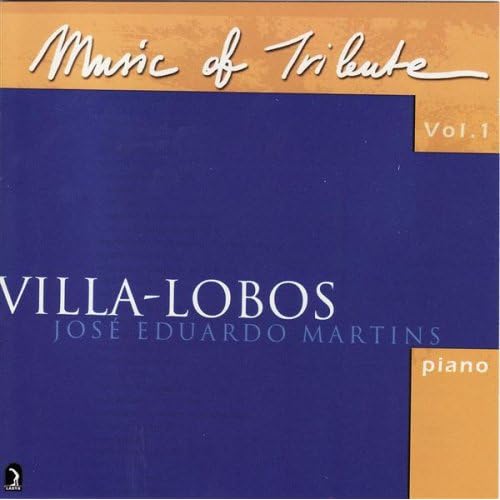
Mendes' best tribute to Villa-Lobos was his piano piece Viva Villa!, which was written in 1987, in celebration of the Villa-Lobos Centennial year. It's included in José Eduardo Martins' disc Music of Tribute v. 1. Those who can read Portuguese should check out the book O antropofagismo na obra pianística de Gilberto Mendes, by Antonio Eduardo Santos. It's available in a Google Books preview; the chapter on Viva Villa! begins on p.108.

The Peacock and the Araponga

David Hurwitz writes about Sibelius's Swanwhite (1908):
"The opening movement, 'The Peacock,' has castanets imaginatively imitating the bird's clacking beak. Even more interesting is the pedal point on the note E that runs through the entire piece in oboes, clarinets, and harp. Brazilian composer Heitor Villa-Lobos coincidentally used exactly the same technique in the second movement of his Bachianas Brasileiras No. 4 (1936), where the obstinately repeated pitch also represents a stylized birdcall."
from Sibelius Orchestral Works: An Owner's Manual, p. 181. Villa-Lobos's bird is the Araponga, and the repeated note in BB#4 is a beautiful effect in the orchestral adaptation, but especially in the original piano version. The bird-call is is in si bémol: B flat.

Wednesday, July 1, 2009

George Rochberg & Villa-Lobos

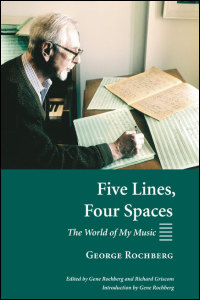
In his book Five Lines, Four Spaces: The World of My Music, George Rochberg writes about his 1991 work Muse of Fire for flute and guitar:
There is one long, continuous tune in which both join in the traditional pattern of flute carrying the ecstatic melodic release and guitar accompanying with running arpeggiated harmonic figures progressing through tonal motions that verge on a kind of 'south of the border' pop tune. (Inspired perhaps by distant associations with Villa-Lobos's Brasileiras, of which I was once very fond?)
Rochberg wrote this work for guitarist Eliot Fisk and flautist Paulo Robison. Later, Fisk
...had played some solo guitar pieces of Villa-Lobos whose 'impassioned romanticism' gave me the direct impetus to set about writing the Bouquet. (p. 182)
It's interesting that Villa's music had this particular resonance in Rochberg's music. I look forward to hearing these works. The disc Eden: Out of Time includes Muse of Fire played by Fisk and Robison, as well as Fisk's American Bouquet, Tin Pan Alley melodies for solo guitar.

Philippe Bertaud plays Choros #01


Philippe Bertaud's new instructional video "Philippe Bertaud on the Music of Heitor Villa-Lobos" includes this assured performance of Choros #01.

Academy of Santa Cecilia


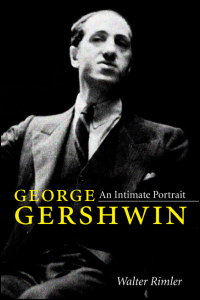
In his new book George Gershwin: An Intimate Portrait, Walter Rimler writes about how George Gershwin,
"...along with Brazilian composer Heitor Villa-Lobos, had been elected to honorary membership in the Academy of Santa Cecilia, Rome. George was informed of this in a letter dated February 9, 1937, from composer Alfredo Casella who addressed his as 'Dear Master' and asked for a new piece for September's Venice Fifth International Music Festival."
I don't remember hearing about this honour for Villa-Lobos, or a commission for a new work from the Academy. I'll look into the standard references and check this out.

I've often been struck by the similarities between Villa-Lobos and George Gershwin. Both had a special connection to popular music, and both had formative artistic experiences in Paris in the 1920s. Both created a kind of "national style" for their respective countries. But perhaps most importantly, both loved billiards and big cigars.

Intimate Voices

In November 2009 the University of Rochester Press will publish Intimate Voices: The Twentieth-Century String Quartet, Volume 1: Debussy to Villa-Lobos, edited by Evan Jones, ISBN: 9781580462297. The book is in the Eastman Studies in Music series, and will be available at Amazon on November 15. The chapter on Villa-Lobos is written by Prof. Eero Tarasti. It's good to see Villa-Lobos has finally made the A-list in a mainstream classical music text. He's in good company:
Debussy
Ravel
Sibelius
Bartók
Hindemith
Schoenberg
Berg
Webern
Prokofiev
and in the second volume:
Shostakovich
Britten
Ligeti
Berio
Xenakis
Scelsi
Cage
Babbitt
Carter
Mel Powell
Shulamit Ran
An interesting subtext of my Villa-Lobos career (which began with the creation of the Villa-Lobos Website in 1995) has been the slow but steady rise of Villa's reputation. Since then an explosion of recordings and live performances has raised his profile, and the music is speaking for itself.

Sunday, June 28, 2009

Concerts in New York

The new Performance History Search feature at the New York Philharmonic's website is really useful. There were impressive Villa-Lobos concerts in the 1950s especially, that sometimes included works that are rarely programmed today.

A "Villa-Lobos" search returns 36 works, and it's interesting to look at some of the programmes. Here's one from the Subscription Series at Carnegie Hall in March of 1957 (the 28th & 29th) that featured the Schola Cantorum:
Villa-Lobos / Bachianas Brasileiras No. 1
Schmitt / Salammbo, Suite No. 2
Villa-Lobos / Choros No. 6
Intermission /
Guarnieri / Abertura Concertante
Villa-Lobos / Mandu-çarará
I wish we'd see more performances (and recordings) of the cantata Mandu-çarara. This concert was conducted by the composer.


And here's one from the New York World's Fairgrounds on September 1939, conducted by Walter Burle Marx. [pictured above: a photo of the Perisphere by Alfred Eisenstaedt taken at the Fair in July 1939, from the Life Magazine archive © Time Inc.]

Liszt / A Faust Symphony
Intermission /
Mignone / Maracatu de Chico Rei
Villa-Lobos / Caixinha de boas festas (Magic Windows)
Villa-Lobos / Choros No. 10 (Rasga o Coracao)

Saturday, June 27, 2009

Happy Father's Day, Epaminandos Villalba

I've always had a soft spot for Heitor's father Raúl Villa-Lobos, partly because he was a librarian, and partly because he introduced his son to music before his untimely death in 1897, when Heitor was a teenager. I came across this work by the elder Villa-Lobos, a scholar who worked at the National Library in Rio de Janeiro: it's a naval history called "A Revolta da Armada da 6 de septembro 1893".

You can see the work scanned by Google from a book in the Harvard Library, thanks to the archive.org website.

You'll notice that Raúl's book is published under the name "Epaminandos Villalba." Heitor Villa-Lobos paid tribute to his father throughout his life by using the pseudonym "Epaminandos Villalba Filho" (filho being the Portuguese version of Jr.) The early piano piece Tristorosa, written in 1910, was published under that name. Later, Heitor used the pseudonym for the texts of a number of works he published in the 1920s, 30s, and 40s.

This post is a little late; Father's Day has passed, but I liked the title.