News about Heitor Villa-Lobos on the web and in the Real World.
Blogging Villa-Lobos since October 2001.
Wednesday, June 15, 2011
Ivan Pires's Music for Children
Tuesday, June 14, 2011
South of the Border with Disney
In 1942 Disney released the 30-minute film "South of the Border with Disney". There's a great clip of Villa-Lobos conducting a huge choir of school children at the Vasco da Gama stadium in Rio (at the 4 minute mark).
At one point Disney and Villa discussed including a "Little Train" segment for a sequel to Fantasia. Sadly, the project never worked out.
Wednesday, June 1, 2011
New Villa-Lobos Book from Germany
Tuesday, May 31, 2011
The Four Maestros
NOTE: I screwed up the caption of this excellent photo the first time around. Thanks to Roberto for this corrected version:
Villa-Lobos and his famous cello in a group that includes Maestros Tabarin, Souza Lima and Franklin de Mattos. This 1931 photo was taken at Hotel where Villa-Lobos was living at the time, in São Paulo. Franklin de Mattos, a great friend of Villa-Lobos is from Botucatu, one of the destinations of the Caravana Villa-Lobos, the road trip on the Trenzinho do Caipira that Villa led through the back-woods of Brazil. This photo is from a great website maintained by Prof. Roberto Vicençotto Ribas. Lots of other great photos there.
Uirapuru from Madrid
I've been waiting for this to show up on YouTube. It's another part of a concert in San Lorenzo del Escorial from April 17, 2011, with Jordi Francés Sanjuán conducting JORCAM (Joven Orquesta de la Comunidad de Madrid). This is the 2nd half of the great early ballet score, Uirapuru. YouTube also has videos of Bachianas Brasileiras #8 from the same concert. This is an excellent performance by these young musicians, and the HD version of the video is stunning.
Monday, May 16, 2011
Maria Lúcia Godoy Podcast
A Arte de Maria Lúcia Godoy
A consagrada soprano Maria Lúcia Godoy nos oferece sua interpretação de algumas das mais tradicionais modinhas mineiras, reunidas no álbum Cantares de Minas. O programa apresenta ainda algumas das obras vocais, entre serestas e modinhas, de Heitor Villa-Lobos. Um repertório inteiramente adequado à voz da cantora.
No programa
Seleção de modinhas mineiras – Cantares de Minas
Seleção de modinhas e serestas de Heitor Villa-Lobos
Friday, May 13, 2011
Tribute to Arminda
THE PROGRAM
Tuesday: 17/05, 16 hours - Roundtable:
"Project Mini-Concert Didactic Museum of Villa-Lobos - 25"
Participants: Turibio Santos, guitarist, former director of the Villa-Lobos, Jayme Vignoli, composer, arranger; Josimar Carneiro, composer, arranger, Luis Carlos Barbieri, guitarist, music producer, Charles Smith, professor, guitarist; Monica Mangia, guitarist ; Ronildo Candide, cellist. Mediation: Marcia Ladeira, museologist.
Wednesday: 18/05, 16 hours - Lecture:
"The Muse and the Museum" - Tribute to Arminda Villa-Lobos, founder and first director of the Villa-Lobos
Participants: Ely Gonçalves, first museologist of the Villa-Lobos and Rui Mourao, writer, director of the Conspiracy Museum, former Coordinator of the National Museum of the National Foundation Pro-Memory.
Thursday: 19/05, 16 hours - Roundtable:
"Mindinha Villa-Lobos - Affective Memory"
Participants: Alceo Bocchino, conductor, composer; Herminio Bello de Carvalho, a poet, composer, Célia Maria Machado, Harper, Noel Devos, bassoonist; Turibio Santos guitarist, former director of the Villa-Lobos.
Mediation: Valdinha Barbosa, researcher.
Music Participation: Marcio Malard, cello / Wagner Tiso, piano
Valdinha Barbosa / Marcia Slope
Educational Action of MVL
(21) 2226-9818
(21) 2226-9020
mvl.educa @ museus.gov.br
I recently came across this letter from Mindinha to Marguerite Long, the great French pianist who was a great friend of Mindinha and Heitor, and an advocate for Villa-Lobos's music. The letter was written on June 2, 1962.
Very, very dear friend,This heartbreaking outpouring of grief to a close friend is from "Marguerite Long: a life in French music, 1874-1966," by Cecilia Dunoyer, p. 180
I never forget you. You are always in my thoughts. My soul is empty without the presence of our unforgettable Villa-Lobos, but in spite of everything, my health is fine…. The government created the Villa-Lobos museum… and I am in charge of a radio program for the Ministry of Education called 'Villa-Lobos, his life, his work.' …I insist on writing to you about this because I cannot have a program about Villa-Lobos without having your contribution… It would make me very happy and the program would be all the better for it. It is because of the deep friendship he had with you… for his sincere admiration for your art, well, everything, that I hope to hear from you soon…. You can understand how I feel, without the one who represented everything to me: my immense love, my mentor, my friend, and how difficult it is to live.
Thursday, May 5, 2011
Trenzinho Funk
Xplau's Villa-Lobos Remix 5.0 project includes this new look at the famous "Little Train" movement of Bachianas Brasileiras #2. It's my favourite in a whole series of remixes of works such as Uirapuru, the 16th String Quartet, and Genesis. For more, go to the Villa-Lobos Remix Myspace Page, and website. And if you're in New York later this month, you can see the US premiere on May 14 at Symphony Space Music, with guests Sonia Rubinsky & the Colorado Quartet.
Tuesday, May 3, 2011
OSB Concerto Manifesto
The first movement of Bachianas Brasileiras #4, played by former members of the Orquestra Sinfônica Brasileira (OSB) in their "Concerto Manifesto". Notice the SOS/OSB shirts all of the musicians are wearing. More on the story here, and at Slipped Disc.
Wednesday, April 20, 2011
Villa-Lobos Conducts Villa-Lobos
Tuesday, April 5, 2011
OSESP Benefit Concert for Japan
Monday, April 4, 2011
Villa-Lobos inJazz
"Villa-Lobos inJazz" is a project of Octavio Garcia, based, as he says, "on the deepest roots of our culture."
projeto VILLA-LOBOS INJAZZ crowdfunding catarse from otavio garcia on Vimeo.
Sunday, April 3, 2011
The Cool Composer Challenge
Saturday, April 2, 2011
A Arte de Cristina Ortiz
Cristina Ortiz, one of Brazil's great pianists, is featured on a weekly program on Radio MEC FM, called "A Arte de Cristina Ortiz". The program is on every Sunday at noon (11am EDT - 9am here in Red Deer), so you can listen to the Radio MEC live stream. Episodes are also available, a couple of weeks later, as podcasts. Listen to this program from January 23, 2011, which features the 3rd Villa-Lobos Piano Concerto from the complete set on Decca, with the Royal Philharmonic Orchestra, conducted by Miguel Gomez-Martinez.
There's lots of Villa-Lobos included in this series - go here for the complete list - but Ortiz plays much more than Brazil's favourite composer. Check out her Chopin, Schumann, or Stenhammar.
Monday, March 28, 2011
Villa-Lobos por uma Soprano
Ivy Goulart is a Brazilian documentary film-maker who lives in New York. His new film "Villa-Lobos por uma Soprano" (Villa-Lobos by a Soprano), from the evidence of the trailer, looks like it will provide some new insights into a composer whose reputation continues to grow world-wide. The 35-minute film features soprano Stela Brandão. You can watch the trailer at YouTube, or at the Goulart Films website. I'll post information about screenings or DVD availability when I find out more. I'm anxious to see the whole film!
Saturday, March 12, 2011
Victory Symphony in Caracas
Conductor Roberto Tibiriçá has sent me the links to new high-quality versions of video from his January 2011 concert with the Orquesta Sinfónica de la Juventud Venezolana "Simón Bolívar". Here is the rarely-played 4th Symphony (the "Victory", written in 1919). Villa-Lobos piled on the orchestration in this piece, which calls for a "fanfarra" of brass instruments, and a "conjunto interno" with even more brass. In this performance the Banda Sinfónica Juvenil Simón Bolívar provides more-than-capable support.
Having to bring this many musicians on-stage (and asking the percussionists to play such instruments as pratos, bombo, tambor, caixa clara, sinos, sistro, pandeiro, guizos, chocalho, and others) helps to explain why this work isn't in the standard repertoire. But an exciting performance like this one points to a bit of a re-examination of the symphonies, which have always been damned with faint praise, especially in comparison with the orchestral Bachianas Brasileiras, Choros, ballets, and tone poems.
The highlight of that concert, though, was a real eye-opener: the pretty much never-performed secular cantata Mandú Çárárá, written in 1939. Unlike the symphony, this is one of Villa's greatest works, nearly on the same level as Choros #10 and the Nonetto. And once again, it's presented to best effect with the same high-flying orchestra, this time with the Sistema Nacional de Coros FESNOJIV (which includes a charming children's choir). So here is the official video (much better than the shaky camera version I posted last month).
The last piece from the concert is the overture to Lo Schiavo, by Carlos Gomes.
Friday, March 11, 2011
Partimpim Dois: O Trenzinho do Caipira
Adriana Calcanhotto is a Brazilian singer and composer with an alter-ego, Adriana Partimpim, in whose guise she performs and records music for children. The second Parimpim album was released in 2009, and it includes an amazing version of O Trenzinho do Caipira from Bachianas Brasileiras #2. With words by the great Brazilian poet Ferreira Gullar, and support from a very tight band, this is a really exceptional version of a piece that's become a Brazilian pop/jazz standard, almost a second national anthem. And it has an exceptional video (unfortunately embedding is disabled, but I encourage you to trek on over to YouTube to check it out). I love the references to things Villa-Lobos loved: kites, trains, children, and cats.
You can listen to the album at this flash-based site; click on Partimpim Dois: CD.
Thursday, March 10, 2011
Villa Lobos, o maestro

I just came across a new children's book from Brazil: Villa Lobos, o maestro, written by Lúcia Fidalgo, with illustrations by Fabiana Salomão (published by Ed.Paulus in 2011). There are a couple of charming illustrations from the book at Salomão's blog.
I'm not sure of the best way to buy this book outside of Brazil. The ISBN is 9788534928540, and here's an online store that stocks it.
Ivy Improta
Here's some information on Ivy Improta, which comes from a 2003 article by Bruce Gilman about the pianist's grandson, musician Gabriel Improta:
Ivy Improta was a child prodigy who Villa-Lobos brought to Rio de Janeiro from the interior São Paulo for studies with Tomás Teran. She worked with Villa-Lobos throughout her career and became recognized as the classical pianist who toured extensively, unveiling Brazilian classical music both solo and with orchestras. Tomás Teran introduced her to Eurico Nogueira França, a pianist, teacher of music history, and music journalist for Correio da Manhã, Jornal do Brasil, and O Estado de S. Paulo. He was a close friend of Villa-Lobos, and together they worked to establish the Academia Brasileira de Música (Brazilian Music Academy). When Ivy was 20 years old, they were married; their best man was Villa-Lobos.Teran was a close friend of Villa's, and the composer dedicated many great works to him. By the way, he was one of Tom Jobim's teachers.
I've never seen any Villa-Lobos recordings by Ivy Improta, which is a shame. She played the piano in the premiere of the Fantasia Concertante for piano, clarinet, and bassoon (a work which was dedicated to the pianist Eugene List.) This seems to be the only picture of her on the web:
Make sure you listen to that podcast before it's gone (probably in a couple of weeks). Can anyone tell me more about this excellent musician?
Tuesday, March 8, 2011
Chiquinha Gonzaga
There are some good resources about Chiquinha online, from a basic English Wikipedia page to the official site (in Portuguese) at http://www.chiquinhagonzaga.com. The picture to the left, which shows Chiquinha at the time of her first success as a composer in 1877, is from that excellent site. Also there are links to YouTube videos and PDF versions of sheet music.
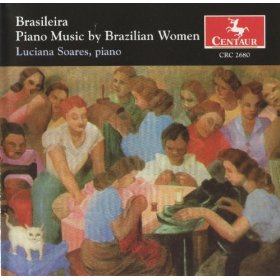
A CD I highly recommend is Luciana Soares' Brasileira: Piano Music by Brazilian Women, on the Centaur label, from 2007.
Besides three pieces by Chiquinha, there are works by Nininha Gregori, Kilza Setti, Maria Luiza Priolli, Adelaide Pereira Silva, Clarisse Leite, Maria H. Rosas-Fernandes, and Branca Bilhar. The disc is available at The Naxos Music Library, catalogue #CRC2680.
Monday, March 7, 2011
De Batutas e Batucadas
With the recent interest in Villa-Lobos at the Rio Carnaval, it might be a good to remind people of this excellent flash-based site: De Batutas e Batucadas. It tells the fascinating story about the 1940 encounter between Leopold Stokowski and Villa-Lobos. Villa was Stokowski's entrance to the world of popular Brazilian music, and especially to the Choroes and the Samba.
The site includes streaming audio of the most important result of this project: Columbia's album Native Brazilian Music. Highlights include the ground-breaking Pelo Telofone, with Donga and Pixinguinha, and a couple of Macumbas with amazing rhythms. There are also some cool pictures, such as this one from the 1940 Sodade de Cordao, the Carnaval school visited by Villa-Lobos.
Thursday, March 3, 2011
Bloco Feitiço do Villa's Samba
It's Carnaval time in Brazil, and everyone will be humming this great samba, from the Bloco Feitiço do Villa. There's lots more information in an earlier post.
I love the allusion to the last great Villa-Lobos samba, from the samba school Mocidade Independente de Padre Miguel's entry in the 1999 Carnaval, "Villa Lobos e a Apoteose Brasileira." Watch highlights here:
Thursday, February 24, 2011
The Martyrdom of the Insects in Ohio
Here's something most of us have never heard before. O Martírio dos Insetos is a very clever piece for violin & orchestra written by Villa-Lobos in 1925 (his modernist period). This is the U.S. premiere, recorded at last week-end's concert at Miami University in Oxford OH. Daniel Guedes is the violinist, and Ricardo Averbach conducts the Miami University Symphony Orchestra.
Though this is possibly the first performance of the piece since its premiere in 1948, there's an easily available score for the violin & piano adaptation made by the composer.
Saturday, February 19, 2011
Another video from the Manaus Yerma
Wednesday, February 16, 2011
Roberto Szidon Plays Rudepoema
Roberto Szidon plays Rudepoema, from a 1993 concert in Greece. Szidon recorded this great work for DGG in 2005.
Friday, February 11, 2011
New CD reviews
I've been busy lately writing notices for the Naxos Customer Review Team, all of which you can read here. They include Andres Villamil's Chicaquicha, guitar music from Colombia which includes some pieces which sound to my ear to be influenced in a major way by Villa's Preludes and Etudes. Also Manuael Blancafort's Piano Music, volume 5 - the end of a great series from Naxos and a great achievement for the pianist Miquel Villalba. Blancafort and his Catalan compatriots Albéniz, Montsalvatge, and Mompou have the same mix of local folklore and Debussy/Ravel influences in their piano music as Villa-Lobos. I was really impressed with these CDs, along with new recordings from Anna Vinnitskaya, and Edward Gardner & the BBC SO. As usual, Naxos continues to produce and distribute some amazing CDs.
Wednesday, February 9, 2011
Villa-Lobos at the 2011 Carnaval
A Bloco de carnaval is a street Carnival group. A brand-new group is Bloco Feitiço do Villa, which will be parading on the morning of March 5, 2011 (Villa's 124th Birthday), in front of the UFRJ Music School.
"Feitiço do Villa" means, I believe, "The Charm of Villa", though Google Translate for some reason gives "Groundhog Villa", which is charming in its own way. The focus of the group is a common theme here at The Villa-Lobos Magazine: the importance of Villa-Lobos and classical music to popular music and the Samba. Here are the words of the block's Samba:
Eu vou juntar
Chopinho com ChopinNão importa o amanhãHoje eu só quero Bach
Vou misturarCartola com RavelVilla-Lobos com NoelPra ver que bicho dá
Eu vou provarQue batuta batucaQue fagote no pagodePode dar um bafafá
Se Noel RosaÉ um clássico natoVilla-Lobos é de fatoUm artista popular
Hoje tudo é fantasiaHoje tudo é ilusãoE na foliaClara Nunes, quem diria,Canta em duo com Bidu Sayão
Nosso bloco desfilaCom magia quase sobrenaturalQue legalÉ o Feitiço do VillaEncantando de alegria o carnaval
I'll join
Chopinho with Chopin
No matter what tomorrow
Today I just want to Bach
I will mix
Cartola with Ravel
Villa-Lobos with Noel
To see what kind of animal gives
I'll prove
That baton Batuca
What bassoon at the pagoda
Can you give a brouhaha
If Noel Rosa
It's a classic native
Villa-Lobos is in fact
A popular artist
Today everything is fantasy
Today everything is illusion
And in the revelry
Clara Nunes, who would say,
Sing a duet with Bidu Sayao
Our block parade
With almost supernatural magic
That's cool
It's Groundhog Villa [sic]
Enchanting joy of the carnival
Tuesday, February 8, 2011
48th Festival Villa-Lobos
The Museu Villa-Lobos has been presenting annual Festivals featuring the music of the Maestro for nearly half a century. This video shows how relevant Villa's music remains today, and it also highlights the vitality of the classical music scene in Brazil. Kudos to the Museu for this awesome Festival.
Sunday, February 6, 2011
Mandu Çarará in New York
From the New York Philharmonic Archives, the program of an important concert conducted by Villa-Lobos. This was the first (and the last?) North American performance of the secular cantata Mandu Çarará that included a full orchestra. Also included was an important work by Villa's close friend Florent Schmitt.
Thursday, February 3, 2011
Blue Rose Duo Villa-Lobos CD
Blue Rose Duo is cellist Lars Hoefs and pianist Rose Chen. Their new Villa-Lobos CD from Wanderlust Music contains all of Villa's music for cello and piano except for the 2nd Sonata (the score for the 1st Cello Sonata is lost). The disc was recorded in California a year ago, and it's available from various web sources, including Amazon.com (Mp3 download) and CDBaby.
Villa-Lobos was a professional cellist before he became known as a composer, and many of his earlier works were written or arranged by him for cello and piano. The most substantial pieces on the disc are the 1913 Pequena Suite, and the three movements that Villa originally wrote for cello and piano that were incorporated into his orchestral suite Bachianas Brasileiras #2. But the emotional centre of the disc is the Song of the Black Swan (O Canto do Cisne Negro). This beautiful piece was originally a portion of the symphonic poem Naufragio de Kleonicos, written in 1916. The following year Villa-Lobos arranged the song for cello and piano, and it's taken off in the cello repertoire in recent years. I count 16 performances in the Villa-Lobos Website Concerts Database, and 20 recordings! The present recording of this piece is very good indeed, right up there with the recording by Antonio Meneses and Celina Szrvinsky on Avie.
The other smaller pieces on the disc certainly show Villa's gift for melody, though none is as striking as the Black Swan. You'll often see these pieces arranged for other combinations; Robert Bonfiglio arranged a number of them for harmonica and orchestra for his RCA CD of the Harmonica Concerto, for instance. There's a premiere recording of "Improviso #7", written for violin and piano from 1915, played here in a version for cello and piano that's very effective. There are no Improvisos #1-6, by the way; no wonder Villa's catalogue was in such a messed-up state until David Appleby and the Museu Villa-Lobos began organizing things.
Lars Hoefs adds so much value to this disc with his excellent liner notes. This is a first-class production all around, and one of the standout Villa-Lobos discs of the past few years.
Wednesday, February 2, 2011
Mandú Çárárá in Caracas
I normally don't post shaky web-cam YouTube videos here at The Villa-Lobos Magazine, but this is really exceptional.
Mandú Çárárá is probably the greatest Villa-Lobos work that nobody knows. It's a Secular Cantata from 1939 which is unavailable on CD. This exciting performance is from last weekend's final performance of the 4th annual Festival Villa-Lobos in Caracas. Roberto Tibiriça conducts the amazing Sinfónica de la Juventud Venezolana Simón Bolívar & Coro Sinfónico Juvenil de Venezuela. I'm hoping that the other major work from that concert (Symphony #04) shows up on YouTube soon.
Outstanding!
Magdalena video
This is my favourite piece from Magdalena, Villa-Lobos's 1948 Broadway show. This video is from the June 2009 production in Campinas, featuring soprano Graziela Sanches. There's more from this production at YouTube.
This show had an influence on musicals in the late 40s and into the 50s; I suspect that Leonard Bernstein knew the work well.
Saturday, January 29, 2011
New Choral CD from Hänssler Classic
I'm looking forward to this disc, due next month from Hänssler Classic. Marcus Creed conducts the SWR Vokalensemble in an exciting programme of choral works, including some World Premiere recordings. Here are the works included:
- Cor dulce, cor amabile
- Jose
- As Costureiras
- Bachianas brasileiras No. 9 (version for chorus)
- Choros No. 3, "Picapau" (version for a capella)
- Preces sem palavras
- Duas lendas amerindias em nheengatu
- Ave Maria (version for 4 part choir)
- Bazzum
- The Well-Tempered Clavier, Book 1: Prelude and Fugue No. 8 in E flat minor / D sharp minor, BWV 853 (arr. H. Villa-Lobos for choir)
- Na Bahia tem (version for male chorus)
- Bendita sabedoria
Cia. Bachiana Brasileira Plays BB#3
Pianast Flávio Augusto and the Orquestra Bachiana Brasileira, under the direction of Ricardo Rocha, play the least often performed work in the Bachianas Brasileiras series. It's one of the two great piano concertos of Villa-Lobos, along with Choros #11. None of the five works Villa titled Piano Concertos is at this level.
Wednesday, January 26, 2011
Mandu Çarárá in Caracas
The 4th Annual Festival Villa-Lobos in Caracas continues with an important concert conducted by Roberto Tibiriça. The Sinfónica de la Juventud Venezolana Simón Bolívar and the Coro Sinfónico Juvenil de Venezuela will perform two rarely played works: the 4th Symphony and the 1939 Cantata Mandu Çarará.
The latter work is especially in need of more performances and a good new recording. In the words of Fabio Zanon, "It's a mystery why a work so spectacular is practically unknown."
Thanks to Eugenia Meijer Werner for the heads-up on this.
Thursday, January 20, 2011
The Brazilian Guitar Quartet Plays Villa-Lobos
The Brazilian Guitar Quartet included an arrangement of the entire Bachianas Brasileiras #1 in a previous CD "Essencia do Brasil" which I thought worked out very well. The new BGQ Plays Villa-Lobos CD, which will be released later this month, includes a wide selection of music originally written for piano and chamber ensemble, arranged by Tadeu do Amaral for four guitars. The music is selected and presented to show off Villa's music and the group's musicianship to best advantage. There are a variety of infectious rhythms, some sweet and sad melodies, moments of modernist angularity, and transcendent beauty from one of Villa's greatest chamber works.
While Villa-Lobos often composed at the piano, and he wrote a host of amazing, idiomatic pieces for the instrument, his native instrument was the guitar. His nickname as a member of a choroes group as a young man was "classical guitar". His few pieces for guitar loom so large in the music for guitar, and he often imitates the guitar in his piano works and even his orchestral music. When he wrote music for harp (besides his 1953 Harp Concerto, he wrote some very important chamber works with harp, especially in the 1920s) he was often thinking of the guitar: "I played the harp from my experience with the guitar", he once said. I mention the harp because the four guitars of the BGQ often evoke this instrument in Amaral's Villa-Lobos arrangements.
It's interesting, then, to listen to the BCG version of the early modernist piano work Suite Floral, written under the influence of Debussy, Faure, and Ravel. The sound of the guitars evokes the sound-world of Parisian chamber music with harp as much as it does the piano music of the impressionist masters. This is definitely transatlantic music, though, since Brazilian rhythms are an important part of the work. Another piece on this disc which stands out is Amaral's adaptation of the Twelfth String Quartet, one of Villa's greatest chamber works, a piece of great subtlety and power. This disc is very highly recommended!
Friday, January 7, 2011
Villa with a Reggae Beat
The "Trenzinho caipira" movement of Bachianas Brasileiras #2 is one of the most commonly arranged pieces by Villa-Lobos, especially in Brazil. I think this reggae version, by the Orquestra Brasileira de Música Jamaicana, is very successful.
Tuesday, January 4, 2011
Soni Ventorum plays Villa-Lobos
Bill McColl sent me this email before Christmas:
Nine woodwind pieces are now available for free download in mp3 format. The material consists of live location recordings and out-of-print commercial recordings by the Soni Ventorum Quintet. (The Trio performance has been running for a long time in ogg format on the Wikipedia site.)Thanks so much for this, Bill! These performances include all of Villa's chamber music for winds:
Visitors to this site scroll down to find Villa Lobos:
http://soniventorum.com/soniventorum_archives.html
The group had a long connection with the works of Villa Lobos and a great devotion to them. A high point was meeting Mindinha in Rio.
- Choros #02 for flute and clarinet
- Trio for clarinet, oboe, and bassoon
- Choros #07 for flute, oboe, clarinet, alto saxophone, bassoon, violin, and cello
- Quinteto em forma de choros
- Quartet for flute, oboe, clarinet, and bassoon
- Duo for oboe and bassoon
- Bachianas Brasileiras #6 for flute and bassoon
- Fantaisie Concertante for clarinet, bassoon, and piano
Thursday, December 30, 2010
Through the Night
For the next seven days you can listen to a March 2010 concert of Brazilian music by the Orchestra della Svizzera Italia [pictured above], conducted by Emmanuel Siffert. Alvaro Pierri is the soloist in the Villa-Lobos Guitar Concerto, and the concert also includes the amazing Saudades do Brasil by Darius Milhaud. Listen until January 6, 2011.
Sunday, December 26, 2010
Harp Concerto from RAI
Friday, December 17, 2010
Villa-Lobos Guitar at Keith's Classical Corner on WGBH
Thursday, December 16, 2010
Música Erudita Brasileira
Tuesday, December 14, 2010
The end of an era in the Villa-verse
Villa: Fantaisie onirique
Villa: Fantaisie onirique is a theatre/dance project of Théâtre du Lierre, based on the music of Villa-Lobos. The show runs from December 15-19. You can watch a video of the production here.
Wednesday, December 8, 2010
Sergio and Odair Assad Concert from NPR
Sergio and Odair Assad play Albeniz, Piazzolla, and Villa-Lobos's A Lenda do Caboclo. This NPR concert is from August 2010; you can hear the second half (Gnattali, Jobim, Gismonti, and Sergio Assad) at NPR.org.
Monday, December 6, 2010
Fernando Salis Projection on Christ the Redeemer
Film-maker and communications professor Fernando Salis created this amazing projection onto the famous statue of Christ the Redeemer high above the city of Rio de Janeiro, all to the music of Villa-Lobos (the fourth movement of Bachianas Brasileiras #7 "Fuga: Conversa"). This October 2010 project, part of a campaign against child abuse, shows the power of Villa-Lobos to move and to represent the Brazilian people.
Thursday, December 2, 2010
A New Villa-Lobos Score
Big news from Rio de Janeiro: a new Villa-Lobos score which was considered lost has been performed as part of the 48th Annual Festival Villa-Lobos, organized by the Museu Villa-Lobos.
Cânticos Sertanejos, a work from 1907, is for flute, clarinet, and strings. The score is held by the Museu, and is © 2010 by the Academia Brasileira de Musica. The resurrection of this work is due largely to the efforts of Maestro Roberto Duarte, who edited and revised the work and conducted its first performance at the Festival last month. The musicians at that performance were: Marcelo Bomfim (flute), Cristiano Alves (clarinet), Quarteto Rio de Janeiro (Felipe Prazeres, violin I; Gustavo Meneses, violin II; Ivan Zandonaide, viola; Marcus Ribeiro, cello), Adonhiran Reis, Flávio Santos, Thiago Lopes, Carlos Mendes and Flávia de Castro (violins), Ana Luiza Lopes (viola), Fabio Coelho (cello) and Ricardo Cândido (bass). What a thrill it must have been to be involved in this historic event!
Thanks to the Museu's Marcelo Rodolfo for sending me this information so promptly. I feel privileged to present this exciting news to so many Villa-Lobos fans around the world.
Wednesday, December 1, 2010
Choros #09 in Caracas
Choros #09 is one of Villa's great orchestral works, and one of the most obscure. This performance is from the 4th Annual Festival Villa-Lobos in Caracas, Venezuela. The Sinfónica de la Juventud Venezolana "Simon Bolívar" is conducted by Roberto Tibiriça.
Saturday, November 27, 2010
IV Festival Villa-Lobos in Caracas
Wednesday, November 24, 2010
Feldkirch Festival 2011

The theme of the 2011 Feldkirch Festival, to be held in the Austrian town from May 25 to June 5, is the music of Brazil and Cuba, and a number of important Villa-Lobos pieces will be featured. Two great Brazilian instrumentalists headline the show: pianist Cristina Ortiz and cellist Antonio Meneses. It's especially nice to see the 4th Piano Concerto, which is rarely on concert programs, and also the cello & piano version of Bachianas Brasileiras #2.
Thanks to a tweet from MOMOtheShiba for the news on this.
Tuesday, November 23, 2010
Almeida Prado, 1943-2010
Here is a fitting tribute: cellist Antonio Meneses plays Preambulum.
Concerto Grosso in Newton Center MA

On December 5th, the Charles River Wind Ensemble will be playing the amazing but rarely performed Concerto Grosso for Woodwind Quartet and Wind Orchestra. Actually, this is the first time I've come across a performance in more than 15 years of maintaining the Villa-Lobos Concerts database.
Bruce Gelin from the Ensemble writes about this piece:
This work is a wonderful example of his mature style, and though it has no specific "nationalistic" or Brazilian references, it's immediately recognizable as pure Villa-Lobos. The virtuoso solo parts for clarinet, oboe, flute, and bassoon are complemented by a large wind organization, deployed with restraint and selectivity to produce subtle tone colors. Our rehearsals of this piece have had to deal with the typically poorly edited score, requiring a lot of back-and-forth to try to get a fully coherent rendition. But it's going to be a real treat, and a good playing of a rarely heard composition.Good luck with this, Bruce, and with the rest of your programme, which includes so many interesting works!
By the way, there are two very good performances of the Concerto Grosso available on CD, from Naxos and Albany, and both are available at the Naxos Music Library.
Wednesday, November 17, 2010
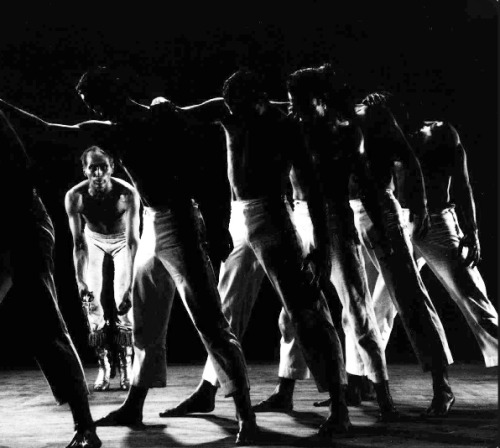
Villa-Lobos's Funeral
This is from "Velório do Maestro Villa-Lobos" on the UOL Website.
Monday, November 15, 2010
The Emperor Jones
Monday, November 8, 2010
OSESP European Tour 2010
You can follow the tour on Tumblr, and via Twitter. Here's a snippet of Choros #06 from the Innsbruck concert that took place earlier today:
Wednesday, October 27, 2010
48º Festival Villa-Lobos
The 48th annual Festival Villa-Lobos, organized by the Museu Villa-Lobos in Rio de Janeiro, takes places next month, from the 12th to the 28th of November. The Festival's new website includes programming information. It's an impressive line-up; highlights include:
- the jazz group Rabo de Lagartixa
- Quarteto Radamés Gnattali
- the choros group Os Matutos
- the great Quinteto Villa-Lobos
- a showing of Zelito Viana's film Villa-Lobos, uma vida de Paixão
- Joel Nascimento
- Wagner Tiso and the group Uakti
- and many, many others
Monday, October 25, 2010
A new resource for Classical Music from Latin America
By the way, I'm a big fan of Alondra de la Parra and her recent Sony CD Mi Alma Mexicana/My Mexican Soul - I strongly recommend it!
Sunday, October 17, 2010
Trio for Oboe, Clarinet and Bassoon on the Road
Wednesday, September 29, 2010
New Reviews
Alicia de Larrocha playing Manuel de Falla, on a new disc from Newton:
A new Naxos compilation of Ginastera ballets, conducted by Gisele Ben-Dor:
Friday, September 24, 2010
Marcelo Bratke at the Penitenciária Feminina do Butantã
"Elas chegaram a cantarolar quando toquei as Cirandinhas do Villa-Lobos, não esperava que isso pudesse acontecer....Senti aqui uma energia diferente. Elas me ajudaram a tocar." (They began to sing when I played the Cirandinha of Villa-Lobos; I did'nt expect this to happen.... I felt a different energy here. They helped me play.)
Here is a video with some highlights from that concert. The piece being played is Caixinha de Musica Quebrada, from Bratke's latest Villa-Lobos CD.
Bratke will bring his Cinemusica Villa-Lobos and Brazil project to London, when he performs Brazilian music in front of a film by Mariannita Luzzati, at Southbank Centre on December 2nd.
Friday, September 17, 2010
Guitar Concerto video with Turibio Santos
Recently posted on YouTube, an impressive performance of the Guitar Concerto with Turibio Santos.
Wednesday, September 15, 2010
Choros no5 from Obrigado Brazil
Kathryn Stott and Yo-Yo Ma play an arrangement of Choros #05 (from the Obrigado Brazil album).
Tuesday, August 17, 2010
Sonia Rubinsky Contest Ends
This 8-CD set is available at a bargain price [Amazon.com - HBDirect]; it's an indispensable part of any good Villa-Lobos collection.
Thursday, August 5, 2010
Sonia Rubinsky Contest, v.7 winner & v.8 review
Congratulations to Joe Michels of Troy NY, the penultimate winner of a CD from Sonia Rubinsky's complete set of Villa-Lobos's Piano Music on Naxos.
The winner of Volume 8 will be drawn on Friday, August 6.
The final disc in the series was recorded, once again, in L'Eglise Saint-Michel in Paris, this time in April 2007. The focus of this disc is the world of children and Brazilian folklore. The final two volumes (#10 and 11) of the piano albums of the Guia Pratico require a high level of virtuosity from the pianist. As James Melo points out in his liner notes, the last album is dedicated to the great Polish pianist Mieczyslaw Horzowski. It's too bad, by the way, that Hozowski hasn't left any significant Villa-Lobos recordings behind; the only one I know of is on a BBC Classics CD with 2 short pieces.
The 11th Album of Guia Pratico, by the way, is much later than the first ten. It was published in 1949, nearly 20 years after the bulk of the collection came out, during Villa's musical education phase. Rubinsky handles everything Villa-Lobos throws her way, and that's not inconsiderable. Rubinsky also handles the simpler, more delicate early Suites Infantils very well. I find some of these early pieces quite impressive; they speak to the innocence and purity of childhood.
Tuesday, August 3, 2010
A New Complete Villa-Lobos Piano Series
It's great to finally hear the first disc in Marcelo Bratke's Complete Solo Piano Works of Villa-Lobos series on Quartz. It includes the Cirandas, Cirandinhas, and Caixinha de Musica Quebrada. You can order the CD or download the disc on the Quartz site (the Download is only £5.99), and read the excellent liner notes by Bratke and journalist Celso Masson.
Monday, August 2, 2010
Brasil: Folclore de Norte a Sul
Brazilian Classics at Carnegie Hall
Brazilian Classics: from Villa-Lobos to Tom Jobim. A great lineup for this November 24, 2010 concert at Carnegie Hall.