Tuesday, May 31, 2011

The Four Maestros


NOTE: I screwed up the caption of this excellent photo the first time around.  Thanks to Roberto for this corrected version:

Villa-Lobos and his famous cello in a group that includes Maestros Tabarin, Souza Lima and Franklin de Mattos.  This 1931 photo was taken at Hotel where Villa-Lobos was living at the time, in São Paulo. Franklin de Mattos, a great friend of Villa-Lobos is from Botucatu, one of the destinations of the Caravana Villa-Lobos, the road trip on the Trenzinho do Caipira that Villa led through the back-woods of Brazil. This photo is from a great website maintained by Prof. Roberto Vicençotto Ribas.  Lots of other great photos there.

Uirapuru from Madrid


I've been waiting for this to show up on YouTube. It's another part of a concert in San Lorenzo del Escorial from April 17, 2011, with Jordi Francés Sanjuán conducting JORCAM (Joven Orquesta de la Comunidad de Madrid). This is the 2nd half of the great early ballet score, Uirapuru. YouTube also has videos of Bachianas Brasileiras #8 from the same concert.  This is an excellent performance by these young musicians, and the HD version of the video is stunning.

Monday, May 16, 2011

Maria Lúcia Godoy Podcast

Soprano Maria Lúcia Godoy (b. 1929) is an outstanding singer of the generation after Bidu Sayão. She specialized in the music of Villa-Lobos; among her famous recordings are Bachianas Brasileiras #5, Forest of the Amazon, and Serestas.  You can listen to a podcast from the Radio MEC program A Música Clássica no Brasil, in which Godoy sings a selection of Serestas, and some traditional songs from Minas Gerais (she grew up in Belo Horizonte, and graduated from the Universidade Federal de Minas Gerais).

Dom, 27/02

A Arte de Maria Lúcia Godoy

A soprano brasileira interpreta tradicionais modinhas mineiras e composições de Heitor Villa-Lobos


"Cantares de Minas" (1985), álbum da cantora Maria Lúcia Godoy

A consagrada soprano Maria Lúcia Godoy nos oferece sua interpretação de algumas das mais tradicionais modinhas mineiras, reunidas no álbum Cantares de Minas. O programa apresenta ainda algumas das obras vocais, entre serestas e modinhas, de Heitor Villa-Lobos. Um repertório inteiramente adequado à voz da cantora. 

No programa
Seleção de modinhas mineiras  – Cantares de Minas
Seleção de modinhas e serestas de Heitor Villa-Lobos

Friday, May 13, 2011

Tribute to Arminda

Arminda Neves d'Almeida Villa-Lobos was Villa's devoted companion from 1936 to Villa's death in 1959, and the first Director of the Museu Villa-Lobos from 1960 until her death in 1985. Villa called her "Mindinha".

Next week the Museu VL will be presenting three programs in tribute to Mindinha.  Here is what's happening (in Google translation):

THE PROGRAM
Tuesday: 17/05, 16 hours - Roundtable:
"Project Mini-Concert Didactic Museum of Villa-Lobos - 25"
Participants: Turibio Santos, guitarist, former director of the Villa-Lobos, Jayme Vignoli, composer, arranger; Josimar Carneiro, composer, arranger, Luis Carlos Barbieri, guitarist, music producer, Charles Smith, professor, guitarist; Monica Mangia, guitarist ; Ronildo Candide, cellist. Mediation: Marcia Ladeira, museologist.
Wednesday: 18/05, 16 hours - Lecture:
"The Muse and the Museum" - Tribute to Arminda Villa-Lobos, founder and first director of the Villa-Lobos
Participants: Ely Gonçalves, first museologist of the Villa-Lobos and Rui Mourao, writer, director of the Conspiracy Museum, former Coordinator of the National Museum of the National Foundation Pro-Memory.
Thursday: 19/05, 16 hours - Roundtable:
"Mindinha Villa-Lobos - Affective Memory"
Participants: Alceo Bocchino, conductor, composer; Herminio Bello de Carvalho, a poet, composer, Célia Maria Machado, Harper, Noel Devos, bassoonist; Turibio Santos guitarist, former director of the Villa-Lobos.
Mediation: Valdinha Barbosa, researcher.
Music Participation: Marcio Malard, cello / Wagner Tiso, piano
Valdinha Barbosa / Marcia Slope
Educational Action of MVL
(21) 2226-9818
(21) 2226-9020
mvl.educa @ museus.gov.br

I recently came across this letter from Mindinha to Marguerite Long, the great French pianist who was a great friend of Mindinha and Heitor, and an advocate for Villa-Lobos's music.  The letter was written on June 2, 1962.
Very, very dear friend,

I never forget you. You are always in my thoughts. My soul is empty without the presence of our unforgettable Villa-Lobos, but in spite of everything, my health is fine…. The government created the Villa-Lobos museum… and I am in charge of a radio program for the Ministry of Education called 'Villa-Lobos, his life, his work.' …I insist on writing to you about this because I cannot have a program about Villa-Lobos without having your contribution… It would make me very happy and the program would be all the better for it. It is because of the deep friendship he had with you… for his sincere admiration for your art, well, everything, that I hope to hear from you soon…. You can understand how I feel, without the one who represented everything to me: my immense love, my mentor, my friend, and how difficult it is to live.
This heartbreaking outpouring of grief to a close friend is from "Marguerite Long: a life in French music, 1874-1966," by Cecilia Dunoyer, p. 180

Thursday, May 5, 2011

Trenzinho Funk


Xplau's Villa-Lobos Remix 5.0 project includes this new look at the famous "Little Train" movement of Bachianas Brasileiras #2. It's my favourite in a whole series of remixes of works such as Uirapuru, the 16th String Quartet, and Genesis. For more, go to the Villa-Lobos Remix Myspace Page, and website. And if you're in New York later this month, you can see the US premiere on May 14 at Symphony Space Music, with guests Sonia Rubinsky & the Colorado Quartet.

Tuesday, May 3, 2011

OSB Concerto Manifesto


The first movement of Bachianas Brasileiras #4, played by former members of the Orquestra Sinfônica Brasileira (OSB) in their "Concerto Manifesto". Notice the SOS/OSB shirts all of the musicians are wearing. More on the story here, and at Slipped Disc.

Wednesday, April 20, 2011

Villa-Lobos Conducts Villa-Lobos

The greatest recording project of the music of Villa-Lobos comes from France in the 1950s. Though the recorded sound was thin, Villa-Lobos was at the helm, and he was given plenty of time to prepare his excellent musicians.  Released on 10 LPs in 1958, "Villa-Lobos par lui-même" was by far the best way to learn about the music of the legendary Brazilian composer in the 20th Century, especially after the set was released in a set of six compact discs just after the Villa-Lobos Centennial in 1987.

The set included all nine of the Bachianas Brasileiras (the 4th and the 9th in their orchestral versions). A highlight was the 5th, with the great soprano Victoria de los Angeles outstanding in both movements.  But there was so much more here: the four suites of the Discovery of Brazil and the 4th Symphony were two interesting orchestral works that weren't likely to show up in concerts or recordings. Though it was a shame that the full set of Choros weren't included - it was only recently with the complete Choros series from OSESP and John Neschling that we realized how great a series it is - there was one standout. The 11th Choros is one of the two great concertante works for piano by Villa-Lobos (the other is BB#3), and the great Magda Tagliaferro Aline van Barentzen [thanks for the correction, Harold!] is splendid as a soloist. [Tagliaferro shines in Momoprecoce].

The set seems to be still available at most outlets, and at a very good price. But now there's a new version - perhaps re-mastered - coming out. I've seen it at a number of UK web stores, usually for about £15 for 6 CDs. That's an amazing bargain.  If only they've somehow improved the sound! [I just saw this set on Amazon.com - to be released May 31, 2011.]

Even though we have new sets of Bachianas Brasileiras, the Choros, and the Symphonies, in excellent recordings with superb sound, there will still be a place for these Paris recordings. New generations of conductors especially should pay special attention to Villa-Lobos's own recordings. They represent the true spirit of his music, no matter how imperfectly he was able to communicate it to his French musicians.

Tuesday, April 5, 2011

OSESP Benefit Concert for Japan


The Orquestra Sinfônica do Estado de São Paulo (OSESP) has organized a concert to benefit the victims of the Japanese earthquake and tsunami.  It will be held on April 11, one month to the day after the disaster, and will include Japanese and Brazilian musicians. The concert features Toru Takemitsu's Requiem, as well as music by Villa-Lobos: Bachianas Brasileiras #5 and #9, and choral works performed by Coro da Osesp. Wagner Polistchuk conducts. There's more information here.

Monday, April 4, 2011

Villa-Lobos inJazz

Villa-Lobos has often been used as source material by jazz musicians - Miles Davis, Wayne Shorter, George Benson, David Sánchez, Kenny Dorham, The Modern Jazz Quartet, among others.  In Brazil, jazz musicians treat Villa-Lobos tunes as standards, like the Great American Songbook.  Projeto B is an excellent example of Brazilian musicians re-thinking Villa-Lobos in a jazz idiom.

"Villa-Lobos inJazz" is a project of Octavio Garcia, based, as he says, "on the deepest roots of our culture."


projeto VILLA-LOBOS INJAZZ crowdfunding catarse from otavio garcia on Vimeo.

Sunday, April 3, 2011

The Cool Composer Challenge

O.K. Here’s the Cool Composer Challenge. Can you come up with a picture of a composer cooler than this one of Heitor? Post a link to the picture in a comment below, tweet with the #coolcomposers hashtag, or send me an email. I'll post all the pictures at The Cool Composer Challenge page at The Villa-Lobos Website.

Saturday, April 2, 2011

A Arte de Cristina Ortiz


Cristina Ortiz, one of Brazil's great pianists, is featured on a weekly program on Radio MEC FM, called "A Arte de Cristina Ortiz". The program is on every Sunday at noon (11am EDT - 9am here in Red Deer), so you can listen to the Radio MEC live stream. Episodes are also available, a couple of weeks later, as podcasts. Listen to this program from January 23, 2011, which features the 3rd Villa-Lobos Piano Concerto from the complete set on Decca, with the Royal Philharmonic Orchestra, conducted by Miguel Gomez-Martinez.

There's lots of Villa-Lobos included in this series - go here for the complete list - but Ortiz plays much more than Brazil's favourite composer. Check out her Chopin, Schumann, or Stenhammar.

Monday, March 28, 2011

Villa-Lobos por uma Soprano


Ivy Goulart is a Brazilian documentary film-maker who lives in New York.  His new film "Villa-Lobos por uma Soprano" (Villa-Lobos by a Soprano), from the evidence of the trailer, looks like it will provide some new insights into a composer whose reputation continues to grow world-wide.  The 35-minute film features soprano Stela Brandão.  You can watch the trailer at YouTube, or at the Goulart Films website.  I'll post information about screenings or DVD availability when I find out more.  I'm anxious to see the whole film!

Saturday, March 12, 2011

Victory Symphony in Caracas


Conductor Roberto Tibiriçá has sent me the links to new high-quality versions of video from his January 2011 concert with the Orquesta Sinfónica de la Juventud Venezolana "Simón Bolívar". Here is the rarely-played 4th Symphony (the "Victory", written in 1919). Villa-Lobos piled on the orchestration in this piece, which calls for a "fanfarra" of brass instruments, and a "conjunto interno" with even more brass. In this performance the Banda Sinfónica Juvenil Simón Bolívar provides more-than-capable support.

Having to bring this many musicians on-stage (and asking the percussionists to play such instruments as pratos, bombo, tambor, caixa clara, sinos, sistro, pandeiro, guizos, chocalho, and others) helps to explain why this work isn't in the standard repertoire.  But an exciting performance like this one points to a bit of a re-examination of the symphonies, which have always been damned with faint praise, especially in comparison with the orchestral Bachianas Brasileiras, Choros, ballets, and tone poems.

The highlight of that concert, though, was a real eye-opener: the pretty much never-performed secular cantata Mandú Çárárá, written in 1939.  Unlike the symphony, this is one of Villa's greatest works, nearly on the same level as Choros #10 and the Nonetto.  And once again, it's presented to best effect with the same high-flying orchestra, this time with the Sistema Nacional de Coros FESNOJIV (which includes a charming children's choir).  So here is the official video (much better than the shaky camera version I posted last month).


The last piece from the concert is the overture to Lo Schiavo, by Carlos Gomes.

Friday, March 11, 2011

Partimpim Dois: O Trenzinho do Caipira


Adriana Calcanhotto is a Brazilian singer and composer with an alter-ego, Adriana Partimpim, in whose guise she performs and records music for children.   The second Parimpim album was released in 2009, and it includes an amazing version of O Trenzinho do Caipira from Bachianas Brasileiras #2.  With words by the great Brazilian poet Ferreira Gullar, and support from a very tight band, this is a really exceptional version of a piece that's become a Brazilian pop/jazz standard, almost a second national anthem.  And it has an exceptional video (unfortunately embedding is disabled, but I encourage you to trek on over to YouTube to check it out).  I love the references to things Villa-Lobos loved: kites, trains, children, and cats.

You can listen to the album at this flash-based site; click on Partimpim Dois: CD.


Thursday, March 10, 2011

Villa Lobos, o maestro


I just came across a new children's book from Brazil: Villa Lobos, o maestro, written by Lúcia Fidalgo, with illustrations by Fabiana Salomão (published by Ed.Paulus in 2011).  There are a couple of charming illustrations from the book at Salomão's blog.

I'm not sure of the best way to buy this book outside of Brazil.  The ISBN is 9788534928540, and here's an online store that stocks it.

Ivy Improta

I've been enjoying one of the Podcasts in the series Música e Músicos do Brasil, from Radio MEC-FM.  The February 12, 2011 program features the Brazilian pianist Ivy Improta.  This was a name I wasn't familiar with, but I was very impressed with her performances of Brazilian music by Villa-Lobos, Guarnieri, and others.  I was especially impressed with her Valsa da Dor, and a swinging Alma Brasileira (Choros #05).

Here's some information on Ivy Improta, which comes from a 2003 article by Bruce Gilman about the pianist's grandson, musician Gabriel Improta:
Ivy Improta was a child prodigy who Villa-Lobos brought to Rio de Janeiro from the interior São Paulo for studies with Tomás Teran. She worked with Villa-Lobos throughout her career and became recognized as the classical pianist who toured extensively, unveiling Brazilian classical music both solo and with orchestras. Tomás Teran introduced her to Eurico Nogueira França, a pianist, teacher of music history, and music journalist for Correio da Manhã, Jornal do Brasil, and O Estado de S. Paulo. He was a close friend of Villa-Lobos, and together they worked to establish the Academia Brasileira de Música (Brazilian Music Academy). When Ivy was 20 years old, they were married; their best man was Villa-Lobos. 
Teran was a close friend of Villa's, and the composer dedicated many great works to him.  By the way, he was one of Tom Jobim's teachers.

I've never seen any Villa-Lobos recordings by Ivy Improta, which is a shame.  She played the piano in the premiere of the Fantasia Concertante for piano, clarinet, and bassoon (a work which was dedicated to the pianist Eugene List.)  This seems to be the only picture of her on the web:

Make sure you listen to that podcast before it's gone (probably in a couple of weeks).  Can anyone tell me more about this excellent musician?

Tuesday, March 8, 2011

Chiquinha Gonzaga

Today is the 100th Anniversary of International Women's Day, and it's also Carnaval season, so that points to one amazing person: the composer and feminist pioner Chiquinha Gonzaga.  As I've posted previously, Chiquinha was born early enough to fight against slavery in Brazil (it was abolished in 1888), but lived long enough (1935) to be a major influence, friend and mentor to Villa-Lobos.

There are some good resources about Chiquinha online, from a basic English Wikipedia page to the official site (in Portuguese) at http://www.chiquinhagonzaga.com.  The picture to the left, which shows Chiquinha at the time of her first success as a composer in 1877, is from that excellent site.  Also there are links to YouTube videos and PDF versions of sheet music.

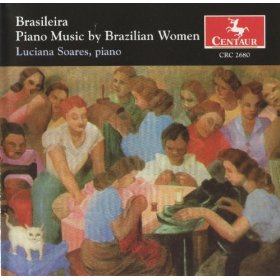
A CD I highly recommend is Luciana Soares' Brasileira: Piano Music by Brazilian Women, on the Centaur label, from 2007.


Besides three pieces by Chiquinha, there are works by Nininha Gregori, Kilza Setti, Maria Luiza Priolli, Adelaide Pereira Silva, Clarisse Leite, Maria H. Rosas-Fernandes, and Branca Bilhar. The disc is available at The Naxos Music Library, catalogue #CRC2680.

Monday, March 7, 2011

De Batutas e Batucadas


With the recent interest in Villa-Lobos at the Rio Carnaval, it might be a good to remind people of this excellent flash-based site: De Batutas e Batucadas.  It tells the fascinating story about the 1940 encounter between Leopold Stokowski and Villa-Lobos.  Villa was Stokowski's entrance to the world of popular Brazilian music, and especially to the Choroes and the Samba.

The site includes streaming audio of the most important result of this project: Columbia's album Native Brazilian Music.  Highlights include the ground-breaking Pelo Telofone, with Donga and Pixinguinha, and a couple of Macumbas with amazing rhythms.  There are also some cool pictures, such as this one from the 1940 Sodade de Cordao, the Carnaval school visited by Villa-Lobos.

Thursday, March 3, 2011

Bloco Feitiço do Villa's Samba


It's Carnaval time in Brazil, and everyone will be humming this great samba, from the Bloco Feitiço do Villa. There's lots more information in an earlier post.

I love the allusion to the last great Villa-Lobos samba, from the samba school Mocidade Independente de Padre Miguel's entry in the 1999 Carnaval, "Villa Lobos e a Apoteose Brasileira." Watch highlights here:

Thursday, February 24, 2011

The Martyrdom of the Insects in Ohio


Here's something most of us have never heard before. O Martírio dos Insetos is a very clever piece for violin & orchestra written by Villa-Lobos in 1925 (his modernist period). This is the U.S. premiere, recorded at last week-end's concert at Miami University in Oxford OH. Daniel Guedes is the violinist, and Ricardo Averbach conducts the Miami University Symphony Orchestra.

Though this is possibly the first performance of the piece since its premiere in 1948, there's an easily available score for the violin & piano adaptation made by the composer.