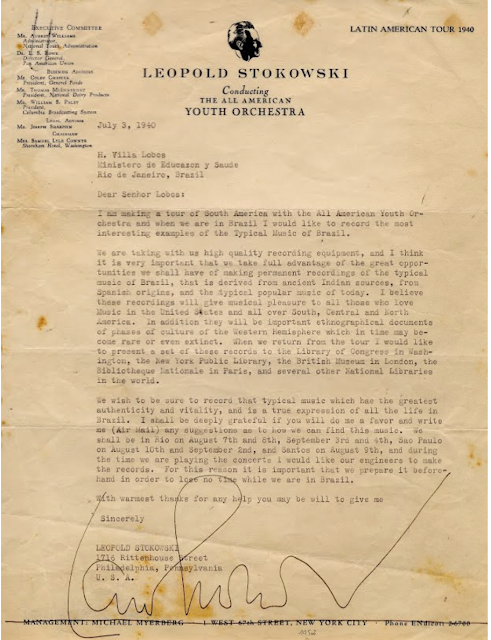
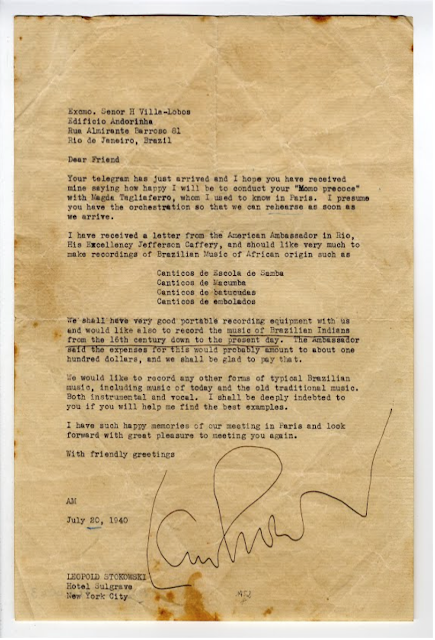
Villa-Lobos complied with the conductor’s request and turned for help to his friends, the sambistas Donga, Cartola, and Zé Espinguela, who rounded up the cream of Rio’s musicians. Perhaps only a man of Villa-Lobos’ stature and his close connections to the choro and samba worlds could have assembled such a dream team for Stokowski.
It's quite remarkable that everything happened so quickly: from the first letter at the beginning to July to the recording session in early August! Soon after Stokowski arrived in Rio de Janeiro aboard the S. S. Uruguay, the great musicians gathered by Villa-Lobos and his colleagues boarded the ship in the harbour, and recorded this wonderful music.
The Columbia album cover, released in 1942:

and the Thomaz Ambrosio illustration of Heitor Villa-Lobos, Leopold Stokowski & Donga based upon it.
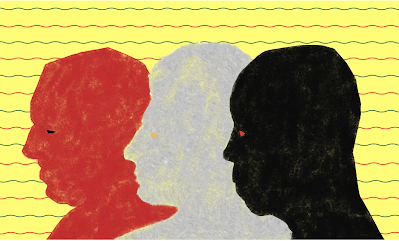
In 2007, the Library of Congress added "Native Brazilian Music" to its 2006 National Recording Registry.
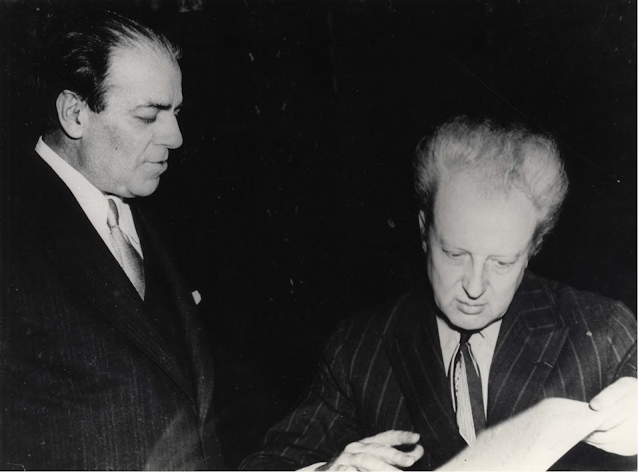
Villa-Lobos made many friends over the years in the world of music, but one of his closest was Leopold Stokowski. Here are the two in New York, in 1945.
This is great: Kirill Petrenko conducts the Berlin Philharmonic in Villa-Lobos's Bachianas Brasileiras no. 4, recorded at the Philharmonie Berlin, 2020. Ever since I started writing about Villa-Lobos on the web, nearly 30 years ago, I've been waiting for major orchestras to begin programming works other than BB#5. Maybe number 4 will be a break-through piece for our Villa.
The novelist Erico Verissimo is well-known & well-regarded in Brazil, to judge by his Wikipedia article, though there don't seem to be many of his works available in English translations. I know him as a friend of Heitor Villa-Lobos. He sometimes acted as Villa's translator and was always a strong supporter of the composer, whom he called "the greatest minstrel of our people."
Erico Verissimo by Leonid Streliaev
Erico Verissimo is introduced as Villa's translator early in Zelito Viana's wonderful 2000 film Villa-Lobos:Uma Vida da Paixão:
Here are Villa & Erico together, in a photo from Instituto Moreira Salles's Erico Verissimo archives:
I love this story that Verissimo tells in his Cronica; Villa-Lobos is speaking to an American audience: "He didn't have a clear theme for his talk, telling stories about music and musicians, not bothering about coherence."
After a time, he seemed somewhat at a loss and tired of all this talk. He glanced behind him, and off to the sides, as if he were looking for something, and cried out, "I want a piano! Bring me a piano!" Lukas Foss got up from his chair and went off to find a grand piano, which eventually was brought onto the stage.
'Still with his cigar between his teeth, our Villa sat down at the noble instrument, played a few chords, looked at the audience, and said, "I'll play Brahms" ... He begins to play a passage from a sonata, and then comments "and the piano won't budge." He addresses himself to the Apassionata and lightly plays the opening phrase.
'Turning to the audience, "I play Beethoven, but the piano doesn't stir." After that comes Schumann, Schubert, Chopin. And, according to the Maestro, the piano continues not to "budge." Finally the speaker cries out, "I'll play Villa-Lobos!" His hands romped over the keys, producing a passage from his "Rudepoema." He got up and pointed to the piano, exclaiming. "It budged! It budged!"'
The indispensable series The Music of Brazil, from Naxos Records, continues with a very valuable new disc: the three violin sonatas that Villa-Lobos wrote between 1912 and 1920. The first is one of his earliest works, and it shows the composer (25 years old at the time) still working in a conservative French style; César Franck's Violin Sonata is his primary model, as it had been for so many young composers. Villa gave it the title Violin Sonata (Fantasia) No. 1 ‘Désespérance’, which looks backward and forward at the same time. The romantic subtitle was soon to be passé for Villa-Lobos, in favour of more modern, and modernist, branding; Villa-Lobos became obsessed with the new, even the avant garde, for much of his life. At the same time, though, the composer was settling into fantasia as a composing trope, again for much of his career. His orchestral works especially eschewed structural integrity in favour of a free development of ideas - the more ideas, the better. This is one of the first fantasias of many in Villa-Lobos's large catalogue of works. Luckily for us, Villa-Lobos has a great melodic gift, and a knack, even this early, in changing things up just before we tire of them. The first violin sonata is easy on the ears.
There's a significant development as a composer, though, by the time of the 2nd sonata, from 1914. Villa-Lobos was a professional cellist with an already-long resumé by his mid-20s, so the string writing is solid. He adds a much more impressive piano part in Violin Sonata no. 2, though. Villa composed at the piano, and though he was never himself a virtuoso pianist, he ended up as one of the great piano composers of the 20th century. This work is an important stage in that development.
It's the 3rd Violin Sonata, though, from 1920, that's really something special. Villa-Lobos had written his great piano series A prole do bebe, book 1, in 1918, following it up with the second book in 1921, the same year in which he wrote his great work Rudepoêma. So we have assured string writing with a much more interesting piano part. This work is an important marker on Villa-Lobos's voyage to full modernism, which was to be marked by his starring role in the Semana do Arte Moderna in 1922.
The team of violinist Emmanuele Baldini and pianist Pablo Rossi play these works with style and finesse. They give the first sonata a proper dose of salon music sentimentality, as befits a work with the subtitle Désespérance’. Most importantly, they don't give it more weight than it can bear; there are small hints of Villa's heroic future here, but anything more would be anachronistic. The second sonata is played with some freedom, even a bit of swing, which helps to keep Villa-Lobos's Vincent d'Indy structure from sounding too four-square. And they let loose in the superb third sonata, giving us a hint of the modernistic furor the music of this period would cause at the Semana do Arte Moderna in São Paulo, Brazil's version of the Rite of Spring riot of 1913.
In this 1957 photo from the Museu Villa-Lobos photo archive, Heitor Villa-Lobos demonstrates a "Pio instrument." I'm not at all sure what this instrument is, and I would appreciate help from readers of The Villa-Lobos Magazine. Is is some sort of wire with an electro-acoustic pickup, using a Pio capacitor? Is Villa-Lobos dabbling with the same infernal electronica that got Bob Dylan into so much trouble at the Newport Folk Festival on July 25, 1965?
Villa-Lobos mostrando o instrumento ‘Pio’
Villa-Lobos has a long history of innovative instrumentation, going back to Amazonas in 1917. This large orchestral work calls for both a violinophone and a sarrusophone, still rarely used at the time.
In a review of a 1930 concert conducted by Villa-Lobos, Mario de Andrade mentions Villa's innovative use of a violinophone in Bach's Brandenburg Concerto no. 1, rather than the violino piccolo Bach asked for, tuned a minor third or fourth higher than a regular violin. This is hardly Historically Informed Practice by today's standards, but Andrade was impressed: "The effect was very curious, especially the timbre in the second movement, marrying admirably the timbre of the violinophone with that of certain wind instruments."
Violí Stroh = Violinophone (ca. 1900) Compagnie française du gramophone. Museo de la Música de Balcelona
In 1945 The New Yorker reported on Villa-Lobos's use of "piano stuffers" onstage in Choros no. 8, at a Philharmonic-Symphony concert conducted by Artur Rodzinski. This was written in 1925, so Villa-Lobos was well ahead of John Cage in the use of a Prepared Piano.
When Villa-Lobos attended the 1939 World's Fair in New York, he must have been impressed with the new Hammond Novachord, the world's first commercial polyphonic synthesizer, which was demonstrated there. In 1945 one of these amazing instruments must have made its way to Rio de Janeiro, since Villa used it in three scores from that year: Madona, the Seventh Symphony, and the Fantasia for Cello & Orchestra. Watch this wonderful performance of Madona; you'll see three keyboard instruments: a piano, a celesta and, a novachord?
In his orchestral score Ruda: Song of Love, written for La Scala in 1951, Villa-Lobos calls for a "solovox". This is an electronic organ manufactured by Hammond in the 1940s. Villa-Lobos also used a solovox in his opera Yerma, from 1955, The Emperor Jones ballet in 1956, and his late masterpiece from 1958, Floresta do Amazonas, which I wrote about yesterday. Speaking of which, there's a photograph from the recording of that work in New York in late 1958 that shows an instrument with a second small keyboard underneath the main keyboard. This looks a lot like a solovox!
Check out the instrument at the top left, with two rows of keys. A solovox?
Here's an example of a solovox to compare. When it comes time to record, you can only use the instruments that are available!
In 1958, at the Manhattan Towers Hotel in New York, Heitor Villa-Lobos conducted Bidu Sayão and the Symphony of the Air & Chorus in his late masterpiece Floresta do Amazonas. I was pleased to see some photographs of the recording from the wonderful photo archives of the Museu Villa-Lobos Website.
These are not the usual snapshots, but professional photographs that really give a feeling for what it was like to be there during these historic sessions. Here's a lovely picture of the great Bidu Sayão:
This shot shows what a big undertaking this was. With Villa-Lobos, less is not usually more; more is barely enough. By the way, wasn't Villa lucky to get so many of his large-scale works recorded, and in many cases by excellent musicians.
Villa-Lobos's close friend Walter Burle-Marx, the composer and conductor, was an advisor on this project. Here he is with Villa-Lobos; I don't imagine too many conductors bring a guitar to the podium with them. This is all about authenticity for Villa!
What a lovely photograph of Villa-Lobos and Bidu Sayão! These two shared a special musical bond; they go way back! I've seen this one photograph very often over the years. I wish I know who took these shots.
Here's the back-end of the mass of musicians assembled to record Floresta do Amazonas. I'm a bit puzzled by it; I only see one celesta in the score. It's been suggested that perhaps they doubled the instrument to allow it to cut through the orchestra and chorus.
Floresta do Amazonas began as a film score, for the MGM feature Green Mansions, starring Audrey Hepburn & Anthony Perkins, and directed by Hepburn's husband at the time, Mel Ferrer. The Hollywood experience wasn't a success for Villa-Lobos, but I believe he had some respect for the veteran film composer Bronislaw Kaper, who understood the studio system better, and who used some of Villa's music in his own eventual score. Everything worked out in the end, though; Foresta do Amazonas turned out to be one of Villa's late masterworks. Here are Bronislaw & Heitor together in Hollywood:
The United Artists recording on LP is a collector's item; you can buy a re-mastered CD here. There are also a number of very good new recordings on CD and the streaming services. Here is the Symphony of the Air recording via YouTube:
According to Gunter Herbig, "Playing classical guitar music on the electric guitar is a process of reinvention, re-telling and re-imagining." The Five Guitar Preludes of Villa-Lobos, core to the classical guitar repertoire, are a perfect test-bed for such reinvention. Villa-Lobos made his name rejiggering various types of music: from the Amazon rainforest and West Africa, the salons of Rio's high society and the street musicians of the working classes, the orchestras of the opera pit and the cinemas. Most famously, he brought Bach's music to Brazil, running it through the kaleidoscope of his endlessly inventive mind, and turning out his fetching Bachianas Brasileiras, as well as the 3rd Guitar Prelude, "Homenagem a Bach".
In many ways the transition of the Villa-Lobos Preludes from acoustic to electric guitar is analogous to the shift to the piano from clavier or harpsichord in Bach's keyboard works. In both cases you gain colour, forcefulness and sustain, while perhaps losing delicacy, balance, and certainly a boat-load of authenticity. It will be interesting to see if Herbig's experiment is broadly accepted in the CG (Classical Guitar) community, or if it results in the same type of controversy that Bob Dylan caused when he "went electric" at the Newport Folk Festival on July 25, 1965.
It's the Preludes that are the most successful works on the disc, I think. These are strong works - as great as any of Villa's non-orchestral pieces - and are up to the inevitable jostling that comes when their story is re-told. I would count all five as virtually unqualified successes. I love all five of these works so much, whether they're played on an acoustic guitar or, as they are increasingly, in José Vieira Brandão's arrangements for piano. The movements of the folkloric Suite popular brasileira are slight, and seem less happy in their shiny new garb. Like the Suite, Tristorosa is an early work, but originally written for piano. Thus in some ways it has less far to go, sonically, than the early guitar works, on the way to the electric guitar. The least successful piece here is the Choros no. 1, which sounds brash and wobbly on the electric guitar. This perfect evocation of 19th century chorões is too wraith-like, too spiritual, for such an insistent instrument, or such an insistent approach.
Villa-Lobos wrote his Bachianas Brasileiras no. 5 for soprano and eight cellos, but at the same time prepared a version for soprano and guitar. One of my favourite versions of this oft-recorded work is that of soprano Salli Terri and guitarist Laurindo Almeida, from 1958. There's a much different sound world here, with Gunter Herbig and his vocalist Alda Rezende. There's an appealing late-night jazz club feel, and, unlike many (perhaps most) of BB#5 versions, it's like we're listening to something new. Another successful experiment, I think.
Finally:
Guitar: Gretsch‚White Falcon G7593
tuned at A = 432Hz
Amp: Fender Hot Rod Deluxe
Over the 25 years or so I've been listening to and writing about Villa-Lobos, I've never seen an album with technical information that looks like this! Such fun!
Listen to Alda Rezende and Gunter Herbig perform Bachianas Brasileiras no. 5, from this fascinating new album:
In March of 1927, the American pianist Aline Van Barentzen performed, in the Salle Gaveau in Paris, a new work dedicated to her by Heitor Villa-Lobos: the Second Book of A Prole do Bébé. Along with Rudepoema, dedicated to Arthur Rubinstein and also played in Paris that year, these nine short pieces represent some of the most important modernist works of the entire piano repertoire. It's marvellous to hear this music, recorded in 1956 for Pathé, in a fine re-mastering. Barentzen recorded the eight pieces of the First Book as well; these are much better known, but less adventurous in terms of harmony and rhythm. Though the subject of this music relates to childhood, this is way too virtuosic to be undertaken by any child who isn't a full blown prodigy. As can be expected, Van Barentzen has complete control over these pieces; she must have consulted with Villa when he first presented them to her in 1925, and again thirty years later, when both pianist and composer spent a lot of time in the Pathé recording studios.
Program: Museu Villa-Lobos
Two years later, in 1958, Van Barentzen recorded Villa-Lobos's Choros no. 5, subtitled Alma Brasileira, the Soul of Brazil. The following year the composer was gone. This is a very fine version of a very special work, with the tricky rhythms properly lined up, but always sounding surprising. There's more rubato here than you'll hear in most performances today, but the composer is almost looking over her shoulder (he was in Parisian recording studios throughout the late 1950s). Outstanding Villa-Lobos!
I'm most interested in the Villa-Lobos, of course, but there is much more very fine playing on this two-disc set from APR. As I mentioned, the 1950s Pathé recordings sound great; we have here pieces by Liszt (Un Suspiro is quite lovely) and Chopin (the D-flat major Nocturne is a stand-out). The earlier recordings are understandably less easy on the ears: I wasn't especially convinced by Van Barentzen's Brahms, recorded by HMV in the 1940s. The most interesting recording from a historical perspective goes all the way back to June of 1928. In his informative and entertaining liner notes, Jonathan Summers tells a great story about how this recording came about:
Barentzen’s first recording happened in unusual circumstances. She met Piero Coppola, conductor and director of French HMV, at a reception at the French piano firm of Gaveau in June 1928. He asked if she knew Falla’s Noches en los jardines de España, as Ricardo Viñes who was due to make the premier recording of the work in three days time was ill. Barentzen told Coppola she knew it, although in fact she did not. She learnt it in the three days and was later told by de Falla that he was very pleased with the recording.
While sonically limited, the freshness of the piano playing and the sitcom circumstances make this a must-listen. What a fascinating release!
Almeida Prado: Piano Concerto no. 1; Aurora; Concerto Fribourgeois
The latest release in the marvellous Naxos series The Music of Brazil features the great composer José Antônio de Almeida Prado (1943-2010). One of the most important recording projects of Brazilian music in the past decade was Aleyson Scopel's survey of Almeida Prado's complete Cartas celestes for the Grand Piano label. Though these works were mainly for piano solo, there were three in the official series of 18 that added other instruments (#7 is for two pianos and symphonic band, #8 for violin and orchestra, and #11 for piano, marimba and vibraphone). As well, after he completed the first work in the series, in 1975, he wrote Aurora, for piano and orchestra, which he called an "unofficial Cartas celestes, because it’s not numbered in the same series, but does share the same universe, the same heart, the same élan." What a marvellous work this is, especially as well played as it is by Sonia Rubinsky, the pianist known to most of us as a Villa-Lobos specialist.
There are two other important works for piano and orchestra here: the Piano Concerto no. 1 is the only numbered piano concerto by Almeida Prado. It's a one-movement work from the early 1980s that takes a four-note motif and mashes it about in the Beethoven manner. Rubinsky's virtuosity is required, and in evidence, here, as are the Minas Gerais Philharmonic's players' considerable skills. Fabio Mechetti's task is to ensure both a steady pulse and a sense of coherence across a complex of shifting rhythms, timbres and other sound events.
My favourite piece, though, is the Concerto Fribourgeois, written in 1985 to celebrate the 300th anniversary of Bach's birth. It's a post-modern take on neo-classicism, with appearances of musical guests both unlikely (Stockhausen, Messiaen and, once again, Beethoven) and likely (Bach himself, of course, including the famous B-A-C-H motif, but also Villa-Lobos in his Bachianas mode). This is as much fun listening to as it was, I am sure, to play. Bravo to these fine musicians, and to Naxos for this well-researched and beautifully recorded program.
Here's a short documentary on Almeida Prado from 2019, featuring Sonia Rubinsky and Fabio Mechetti.
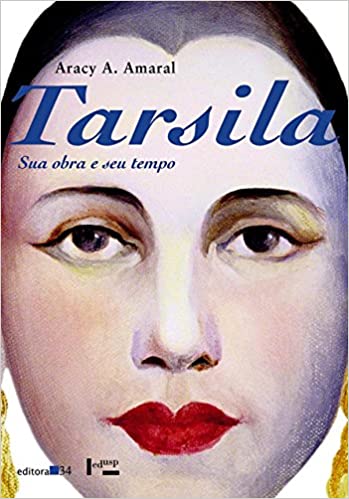
This letter from Heitor Villa-Lobos to Tarsila do Amaral and Oswald De Andrade is from Aracy A. Amaral's 1975 book Tarsila: sua obra e seu tempo. It's a missive from Paris, the world centre of Modernism, to two of the top Brazilian modernists. Villa-Lobos never gets enough credit for his leading edge avant garde musical theory and practice, perhaps because of his transition to more conservative musical styles in the 40s and 50s.
Villa-Lobos wrote Choros No. 3, "Pica-pau"in 1925, and dedicated it to Tarsila & Oswald. It was premiered in São Paulo that year, and made a big splash in Paris at the famous Salle Gaveau concert in December of 1927.
Here's where Villa-Lobos lived in Paris in the 1920s: Place Saint-Michel, in the Latin Quarter near the Pont Saint-Michel. I'm trying hard to learn my arrondissements: this is on the border between the 4th and the 5th.
Felicia Blumental plays Villa-Lobos's 5th Piano Concerto, with the composer conducting the Vienna Symphony Orchestra. This is from the Grosser Musikvereins-Saal on May 25, 1955. Blumental commissioned the work, and played the premiere in London a few weeks earlier. The two came together later in the 50s to record the work in Paris, with the Orchestre National de France, for Pathé-Marconi, the 10-LP collection known in the CD era as Villa-Lobos Par Lui-Même.
A new video from Simone Menezes: she conducts the Porto Alegre Symphony Orchestra in a relatively unknown work by Heitor Villa-Lobos, his Sinfonietta no. 1, "In memory of Mozart", from 1916. This piece has become Menezes' calling card in concerts in Europe and the Americas. More information about Menezes and her Villa-Lobos Project here.
Thanks once again to Rodrigo Roderico, whose YouTube Channel is the best source for Villa-Lobos video content!
One of the best of the scholarly works that were published in the wake of Villa-Lobos's Centennial in 1987 was Gerard Behague's Heitor Villa-Lobos: The Search for Brazil's Musical Soul, which was published in 1994 by the Institute of Latin American Studies at the University of Texas at Austin. You can borrow this book for free online, from the Open Library project of the Internet Archive. And now, thanks to their National Emergency Library project, the limit on the number of people who can borrow each book has been removed until June 30, 2020. This very fine publication is only one of an amazing 14 million titles in the project! Go to www.archive.org/NEL to learn more.
Photo: Instituto Moreira Salles, which holds the Eric Verissimo archives
Villa-Lobos & Erico Verissimo in California, 1944. The Brazilian novelist Verissimo acted as translator for Villa-Lobos during this trip, which the composer made to present his music in Los Angeles, & to accept an honorary degree from Occidental College. Belying their apparent friendship here, the two clashed. This report details some of the issues involved:
Director Zelito Viana begins his 2000 biopic Villa-Lobos: Uma Vida da Paixão, with a very funny series of scenes between Verissimo & Villa-Lobos. Watch here, beginning around 2:30 (then watch this very fine film all the way through!)
OK, this might be an indication that my Villa-Lobos obsession has crossed some sort of line. This is a Maguey for cigar belonging to Heitor Villa-Lobos, from the collection of the Municipal Theatre of Rio de Janeiro. Maguey is Agave americana, the century plant. It's a source of fibre, so perhaps this is what Villa's cigar holder is made of. It's pretty rare to see a picture of Villa-Lobos without his faithful cigar.
Photo: João Lima
You can see Villa-Lobos is using a cigar holder in this marvellous portrait by Sabine Weiss.
From the same collection: a gold-plated cufflink which belonged to Francisco Mignone.
On September 15, 1951 Heitor Villa-Lobos spent the day with photographer Arnold Newman at the New Weston Hotel in New York. Villa-Lobos is one of the most photogenic of composers, but these shots are among the most impressive ever taken of him.
My favourite Newman portrait is this one of the composer at rest. Villa is in charge here, and Newman gives him his own space.
Then the great portrait photographer takes over, and does some serious psychological searching with this close-up.
It's a tribute to Villa's worldwide fame that he attracted so many fine portrait photographers. Among my favourites: Erich Auerbach; Genevieve Naylor; Roger Viollet; Constantin Joffe & Luis Lemus from Vogue; and Thomas D. Mcavoy, J. Siegelman & most especially W. Eugene Smith from Life Magazine.
Another audio recording of rare Villa-Lobos from the Internet Archive: this time it's his Symphonic Poem Gênesis, written in Paris in 1954. Claudio Santoro conducts the Orchestre National de L'Ile de France. This is from a Festival of Paris concert in August 1987.
As it happens, you can hear more Villa-Lobos from the same year, the same orchestra, and the same conductor. Santoro conducted another Villa-Lobos rarity in Paris, Erosão, on March 3, 1987. Unfortunately, Santoro died only two years later, on March 27, 1989. This is a very fine work, by the way; it was commissioned by the Louisville Orchestra in 1950.
This is very exciting: the Internet Archive has a recording of the 1951 premiere performance of the Ninth Symphony of Heitor Villa-Lobos performed by The Philadelphia Orchestra, conducted by Eugene Ormandy. This is the only recording of this interesting and surprising work that I know of, other than those from the complete symphony series from Stuttgart & São Paulo. Here is what Fábio Zanon said about it, in his liner notes to the recent Naxos recording from São Paulo.
In his Ninth – just like Beethoven in his Eighth – Villa-Lobos makes use of disguise. We are presented here with agitated propulsion, the thick layer of orchestral activity that flows in a seemingly uncontrolled manner, but this is his shortest symphony, more economic in terms of ideas and, although the orchestration sounds chimerical in comparison with the likes of Haydn, pre-Beethoven symphonies are his formal inspiration.
This is very cool: a letter from the Canadian pianist Ellen Ballon to Heitor Villa-Lobos, setting out the arrangements for her commission for his 1st Piano Concerto, in 1945. This is from the new Museu Villa-Lobos website.
Ballon played the world premiere of the work in 1947 with the Dallas Symphony under Antal Dorati, while the Canadian premiere took place at Plateau Hall in Montréal in 1953, with the OSM under Désiré Defauw. She did indeed record the work for the first time, for London in 1949, with the Orchestre de la Suisse Romande under Ernest Ansermet.
Another great photo from the new Museu Villa-Lobos website. Villa-Lobos with Arminda & the great pianist Guiomar Novaes, at the Hotel Alrae in New York, 1958. The Alrae, on East 64th Street, reopened in 1984 after a complete renovation as the Hôtel Plaza Athénée.
Creative Commons Atribuição-Sem Derivações 3.0 Não Adaptada - Museu Villa-Lobos
The print behind Villa is Charles de Montfort's Place Gaillon Hotel de Lyon.
Guiomar Novaes plays the first movement of Bachianas Brasileiras no. 4.