In the past week I've reviewed a couple of fairly recent Villa-Lobos CDs:
This superb CD of Brazilian songs by Cristiane Roncaglio from 2014 includes some great modernist songs from the 1920s, plus lots of interesting popular and art songs from Brazil.
And an excellent CD of Bassoon Concertos by Matthias Racz, including the Ciranda das sete notas.
News about Heitor Villa-Lobos on the web and in the Real World.
Blogging Villa-Lobos since October 2001.
Thursday, March 3, 2016
Monday, February 29, 2016
Katrina Krimsky's new Villa-Lobos/Barber CD
I'm looking forward to this CD, coming April 8, 2016. The Samuel Barber Piano Sonata, written in 1949 is such a great work, and a great test of a pianist's abilities and musicianship. The two sets of Villa-Lobos Prole do Bebe bring their own challenges of virtuosity and style. I'm so pleased to see the second set included, since it's much less popular than the first. I'll review the disc as soon as it's available.
[Not sure if this is the same 2007 CD recorded in November 2007 and released by Charmed Quarks.]
Wednesday, February 24, 2016
Great Villa-Lobos works you don't know: Nonetto
Everyone knows Villa-Lobos, right? Bachianas Brasileiras no. 5, or at least its Aria, sung by every soprano, and played in arrangements for everything from accordians to xylophones. The guitar music played by every single guitarist in the YouTube world, from Julian Bream to your 8-year-old nephew to the handsome new guys like Milos and Mickael Viegas. The Little Train movement from BB2, which is so well-known, though not as famous as it would have been if Walt Disney had put his animators on it during Fantasia. I'm still mad about that lost opportunity.
Then there's the next layer down: nearly all the rest of the Bachianas, which are very popular on disc and in performance. The string quartets are all awesome; it's so great that quartets around the world are following the Cuarteto Latinoamericano's lead and programming them. Choros no. 10 at The Last Night of the Proms a few years ago knocked everybody's socks off. The piano music has a big discography, though I'd love to see more in performance, from Prole do Bebe encores up to the scary Rudepoema (though only for pianists with very high self-esteem). Even the Symphonies are becoming appreciated, thanks to a great new Naxos series of recordings from Sao Paulo.
But what about unknown Villa-Lobos in the layers below? Are there great works hidden down there where only Villa-Lobos fanatics with lighted coal-miners' helmets go? Yes! I'll be your guide in a series of posts exposing the pre-Cambrian layer of great Villa-Lobos music that everyone should know, but only the Villa-Lobos illuminati appreciate.
Exhibit A: the Nonetto. This work was begun in Rio in 1923, and finished in Paris in 1924. It's subtitled "Impressão rapida de todo o Brasil" - "Rapid Impression of Brazil", and was designed to show off Villa's awesomeness as a complete package: exoticism plus leading-edge modernism. Villa-Lobos was a master of self-promotion; to the Paris musical press he described the Nonetto as "Nova forma de composicao que exprime o ambiente sonoro e os ritmos mais originais do Brasil." (A new form of composition which expresses the noise environment and the most original rhythms of Brazil). This sentence packs some audacious claims: "A new form" puts him firmly in the modernist camp; "the noise environment" implies a radical naturalism; and "the most original rhythms of Brazil" sets in motion a lifelong claim where Villa-Lobos himself is the true representative of the country of Brazil, not just musically, but somehow the soul of the country itself. Here is a very self-assured young composer!
Does Villa-Lobos deliver? If he does in any piece, it's in the Nonetto. This is a large-scale work pushing out from a chamber-music frame. There are nine players in theory: flute, oboe, clarinet, saxophone (actually saxophones; the player alternates between an alto and baritone saxes), bassoon, celesta, harp, piano and percussion (which actually requires 3 people). Plus a mixed choir. It fills a large stage! Here's what it looks like on the page:
Then there's the next layer down: nearly all the rest of the Bachianas, which are very popular on disc and in performance. The string quartets are all awesome; it's so great that quartets around the world are following the Cuarteto Latinoamericano's lead and programming them. Choros no. 10 at The Last Night of the Proms a few years ago knocked everybody's socks off. The piano music has a big discography, though I'd love to see more in performance, from Prole do Bebe encores up to the scary Rudepoema (though only for pianists with very high self-esteem). Even the Symphonies are becoming appreciated, thanks to a great new Naxos series of recordings from Sao Paulo.
But what about unknown Villa-Lobos in the layers below? Are there great works hidden down there where only Villa-Lobos fanatics with lighted coal-miners' helmets go? Yes! I'll be your guide in a series of posts exposing the pre-Cambrian layer of great Villa-Lobos music that everyone should know, but only the Villa-Lobos illuminati appreciate.
Exhibit A: the Nonetto. This work was begun in Rio in 1923, and finished in Paris in 1924. It's subtitled "Impressão rapida de todo o Brasil" - "Rapid Impression of Brazil", and was designed to show off Villa's awesomeness as a complete package: exoticism plus leading-edge modernism. Villa-Lobos was a master of self-promotion; to the Paris musical press he described the Nonetto as "Nova forma de composicao que exprime o ambiente sonoro e os ritmos mais originais do Brasil." (A new form of composition which expresses the noise environment and the most original rhythms of Brazil). This sentence packs some audacious claims: "A new form" puts him firmly in the modernist camp; "the noise environment" implies a radical naturalism; and "the most original rhythms of Brazil" sets in motion a lifelong claim where Villa-Lobos himself is the true representative of the country of Brazil, not just musically, but somehow the soul of the country itself. Here is a very self-assured young composer!
Does Villa-Lobos deliver? If he does in any piece, it's in the Nonetto. This is a large-scale work pushing out from a chamber-music frame. There are nine players in theory: flute, oboe, clarinet, saxophone (actually saxophones; the player alternates between an alto and baritone saxes), bassoon, celesta, harp, piano and percussion (which actually requires 3 people). Plus a mixed choir. It fills a large stage! Here's what it looks like on the page:
On the front page of the score, the Max Eschig editors invite interested parties to come to their offices at 48 rue du Rome in Paris to check out "les instruments de percussion et de batterie qui ne sont pas d'un usage courant dans les orchestres." It's all part of the marketing of the exotic in the arts, which was big in Paris, from Japanese painting and African sculpure to African percussion and the sounds of the Balinese gamelan. Villa-Lobos jumped head-first into the mix, beginning with his tall tales of travels in the jungle, encounters with Indians and strange animals and plants (man-eating plants!). The Nonetto, which was premiered at a famous concert in May 1924, was an important milestone in Villa's acceptance as a composer.
Here is the roll call of the batterie:
But this is a 'rapid impression' of all Brazil: there's the urban life of the choroes here as well as the jungle. Villa had brought this sound to his music in such works as the Suite populaire bresilienne of 1912, the First String Quartet of 1915, and the Choros no.1 of 1920, dedicated to Ernesto Nazareth. It would play a key role in the whole series of Choros, the bulk of which were written in the 1920s. Indeed, you could call the Nonetto an honorary Choros.
In some ways Nonetto is a dress rehearsal for Choros no. 10 of 1926, which adds a full orchestra (and an extra harp) to the chorus, piano, celesta, harp, and huge percussion complement of the earlier work. But whereas Villa-Lobos brings actual Indian motifs to bear in Choros 10, in Nonetto, there are African and Portuguese elements but no aboriginal ones. "Zango! Zizambango! Dangozangorangotango!" sings the Nonetto choir, in a made-up African language, to the beat of the Brazilian Batuque dance that originated in Cape Verde.
So what does it all sound like? Listen to this important 1954 Capitol release featuring Roger Wagner's Chorale & Concert Arts Ensemble. In a review in The Musical Quarterly, critic Richard Goldman said "The Nonetto is sub-titled 'Quick Impression of All Brazil,' a country apparently settled by Stravinsky and the random survivors of an orchestral shipwreck some time after 1920." The conductor Ricardo Rocha said "The Nonetto I call ‘a musical Guernica, but with humor…"
What do you think?
Saturday, February 20, 2016
Mickael Viegas CD released
The new Villa-Lobos 2 CD set by Mickael Viegas is now available on Spotify. It's also now streaming on Naxos Music Library.
Read more about this fascinating project at my post of a few weeks ago.
Thursday, February 18, 2016
Villa-Lobos and Waldemar Henrique songs
Here's a new CD of Brazilian art songs from baritone Renato Mismetti and pianist Maximiliano de Brito, from Pleorama. It includes some of Villa-Lobos's best songs, and a good selection of songs by Waldemar Henrique, from the generation after Villa-Lobos. There's more information, and clips, at the Pleorama site. Love the album design!
Here's one of my favourite Villa-Lobos songs, Estrella é lua nova:
Thursday, February 4, 2016
Villa-Lobos and Marian Anderson, pt. 2
On March 14, 1945, Villa-Lobos was the guest of honour at a reception at the Waldorf Astoria Hotel in New York. The guest list was impressive; here are the names David Appleby lists in his Villa-Lobos biography:
And here, along with Mindinha, is a friend Villa-Lobos made in Rio de Janeiro in the late 1930s, soprano Marian Anderson. I've seen this picture on the web before, but didn't know when it was taken. Judging from Villa's outfit, we have the answer.
Back in 2009 I posted about Villa's relationship with Anderson. The two had become close back in Brazil and they kept up a correspondence, and would run into each other over the years as international musicians tend to do. I wish that Anderson had recorded some Villa-Lobos songs, especially the Poema da Itabira, which was dedicated to her.
#BlackHistoryMonth
Marian Anderson, Bidu Sayao, Walter Damrosch, Arthur Rodzinski, Leopold Stokowski, Benny Goodman, Aaron Copland, Carleton Sprague Smith, Duke Ellington, Cole Porter, Fiorello La Guardia, Sigmund Romberg, George Szell, Joseph Szigetti, Arturo Toscanini, Ezio Pinza, Claudio Arrau, Morton Gould, Yehudi Menuhin, Eugene Ormandy, Jose Iturbi, Deems Taylor, Nelson Rockefeller, Olin Downes and Oscar Thompson.Here's a picture of the composer with Aaron Copland and the Brazilian Consul Oscar Correia taken that day:
And here, along with Mindinha, is a friend Villa-Lobos made in Rio de Janeiro in the late 1930s, soprano Marian Anderson. I've seen this picture on the web before, but didn't know when it was taken. Judging from Villa's outfit, we have the answer.
Back in 2009 I posted about Villa's relationship with Anderson. The two had become close back in Brazil and they kept up a correspondence, and would run into each other over the years as international musicians tend to do. I wish that Anderson had recorded some Villa-Lobos songs, especially the Poema da Itabira, which was dedicated to her.
#BlackHistoryMonth
Tuesday, February 2, 2016
Philip Glass and Villa-Lobos
The 1993 album Águas da Amazônia brought together the Brazilian instrumental group Uakti and composer Philip Glass. The music was originally written by Glass for the Grupo Corpo ballet group of Belo Horizonte. In the first piece on the album, entitled Tiquiê River, Glass borrows from, or pays homage to, Villa-Lobos. That seems at first a natural connection, since Villa-Lobos has always been connected with the Amazon. However, the piece in question is Villa's desert-themed 2nd movement from Bachianas Brasileiras no. 4, Coral (Canto do sertão). The sertão is the dry region of North-Eastern Brazil.
By the way, I see that Uakti and Philip Glass will be together on stage for the first time, performing Águas da Amazônia in May 2016 at the 92nd Street Y in New York. More information here.
This isn't the only connection between Glass and Villa-Lobos. Glass links his 2nd Symphony, written at about the same time, to the polytonal music of the 1930s and 40s, specifically referring, in his liner notes to the Nonesuch recording (pictured below), to Honegger, Milhaud and Villa-Lobos.
By the way, I see that Uakti and Philip Glass will be together on stage for the first time, performing Águas da Amazônia in May 2016 at the 92nd Street Y in New York. More information here.
This isn't the only connection between Glass and Villa-Lobos. Glass links his 2nd Symphony, written at about the same time, to the polytonal music of the 1930s and 40s, specifically referring, in his liner notes to the Nonesuch recording (pictured below), to Honegger, Milhaud and Villa-Lobos.
Here's the 1st movement of that very interesting symphony, played by the Bournemouth Symphony under Marin Alsop, from a 2004 Naxos album:
Thursday, January 28, 2016
The Prospect of a Future Guitar
The Prospect of a Future Guitar from Mickael Viegas on Vimeo.
This is a fascinating project from guitarist Michael Viegas, which involves performances and arrangements (by Viegas) of Villa's complete music for guitar. These are based on his theories of the limitations of the instrument and the addition of both melodic and harmonic material which from a close study of the scores Viegas feels might have been the composer's true intentions. The guitarist overdubs additional guitar parts, and he also mentions 'orchestrations' though there are no details of these included in the video. As well, Viegas brings up the possibility of a future re-design of the guitar (hence the name of the album: The Prospect of a Future Guitar) which might make live performance of the the kind of music he envisions a possibility.
The album recording was completed in November of 2014, and Viegas was busy with post-production during 2015. The album is not due to be released until later this winter. The only online source I've found so far is at Amazon.fr, which shows a release date of February 19, 2016. Here are the front and back covers of the two-CD set:
I look forward to a discussion of what this approach might mean for this amazing but perhaps over-familiar music. The law of diminishing returns might be in operation here, when nearly every guitarist records at least the Preludes and first Choros, and often the complete music for guitar. It's sometimes hard to find a marketing niche, if not a special way of playing the music. From the very musical and well-played clips included in the video the album, and its underlying radical rethinking of Villa's music, promises at least to be a shot in the arm for this well-worn music.
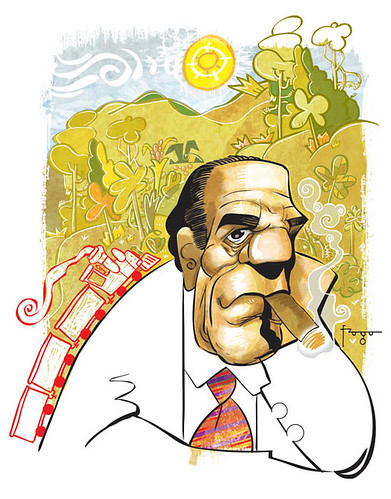
Villa-Lobos by Fraga
#ThrowBackThursday, from August 2010.
Tuesday, January 19, 2016
Villa-Lobos Symphonies Project
I missed this when it came out: the March-April 2013 issue of Musical Opinion includes an article by conductor Isaac Karabtchevsky about the upcoming Naxos series of Villa-Lobos Symphonies recordings with OSESP. Here is the original plan laid out in the article:
There's been some slippage on the timelines, but it's nice to see some pieces on this list that are overdue for modern, easily accessible recordings. Specifically, I'm excited about Odisséia de uma raça and the Fantasia Concertante for 32 cellos.
Here's where we are so far in the project:
2012:
Symphonies no. 6 & 7
2013:
Symphonies no. 3 & 4
2014:
Symphony no. 10
2015:
Symphony no. 12
Uirapuru
Mandu-Carará
What's next? Maestro Karabtchevsky will be performing Symphonies no. 9 & 11 in two OSEP concerts in February, so it's a good bet those two pieces will show up on the next CD. Check it out if you're in Sao Paulo next month!
Monday, January 18, 2016
Letters to Posterity
The guitar music of Villa-Lobos is popular. Of 541 Villa-Lobos CDs available at ArkivMusic, 156 include music for guitar, and new ones show up pretty regularly. It’s relatively inexpensive music to record, with a single artist who brings his or her instrument, and not impossibly difficult engineering requirements. And this understates the broader popularity of this music in the Classical Guitar (CG) community. Back in 2009 I analyzed ten years of Villa-Lobos concerts, and found that music for guitar near the top in popularity (139 performances for Bachianas Brasileiras #5, against 30 for Choros #1, 29 for the Preludes, 25 for the Suite Populaire Bresilienne, 20 for the Etudes, and 49 for ‘Works for Guitar’). I mentioned then that a search of YouTube would show how ubiquitous these works were. Here are the current YouTube stats:
How, then, does a guitarist position a new Villa-Lobos CD, and get the music heard? In last year’s excellent recital CD, Kazu Suwa chose to include three Villa-Lobos pieces. I quote from my review:
Now we come to Thomas Lyng Poulsen’s Letters to Posterity, which includes pretty much the full solo music for guitar on two CDs. This includes music of a very broad range, from salon pieces and dances Villa remembered from his days playing in chorões bands, to the more-than-pedological Etudes of the late 1920s, and on to the great Preludes of the 1940s. I wouldn’t expect a single guitarist to excel in all three areas, but Poulsen provides credible versions of pretty much all of the music. His technique is strong, and the music is clearly communicated. He’s strongest, I think, in the Preludes, which are all five really excellent. This is maybe a bit of a surprise considering Poulsen’s teaching experience; I would have expected the Etudes to be the sweet spot for a guitar teacher. Choros no. 1 didn’t quite swing the way I like it to (I prefer the Brazilians Fabio Zanon, Manuel Barrueco and Turibio Santos), and parts of the Suite Populaire Bresilienne seemed over-thought, over-serious.
But Thomas certainly did his homework. It was fun following his process from his original plan to the publication of this recording in his blog My Villa-Lobos Journey. He grappled with just this issue many times. Here he is, from August 2014, working on the Schottisch (Choro):
Villa-Lobos Preludes: about 216,000 resultsThis is core CG repertoire, partly because of early championship by artists like Segovia, Abel Carlevaro and Julian Bream, but also because the music is so accessible, with elements of popular and erudite music intertwined. In the end, though, it’s because this music is so damn good.
Villa-Lobos Etudes: about 124,000 results
Villa-Lobos Choros 1: about 87,900 results
How, then, does a guitarist position a new Villa-Lobos CD, and get the music heard? In last year’s excellent recital CD, Kazu Suwa chose to include three Villa-Lobos pieces. I quote from my review:
He’s picked three Villa-Lobos pieces with great character, and more importantly he plays each of them in a character-ful way. And he puts them in the penultimate spot, as they deserve, with just a sad, beautiful little piece by Mompou as a coda.This seems an excellent way to introduce more Villa-Lobos into such a crowded marketplace. That CD, by the way, ended up on my Top 10 Albums list for 2015.
Now we come to Thomas Lyng Poulsen’s Letters to Posterity, which includes pretty much the full solo music for guitar on two CDs. This includes music of a very broad range, from salon pieces and dances Villa remembered from his days playing in chorões bands, to the more-than-pedological Etudes of the late 1920s, and on to the great Preludes of the 1940s. I wouldn’t expect a single guitarist to excel in all three areas, but Poulsen provides credible versions of pretty much all of the music. His technique is strong, and the music is clearly communicated. He’s strongest, I think, in the Preludes, which are all five really excellent. This is maybe a bit of a surprise considering Poulsen’s teaching experience; I would have expected the Etudes to be the sweet spot for a guitar teacher. Choros no. 1 didn’t quite swing the way I like it to (I prefer the Brazilians Fabio Zanon, Manuel Barrueco and Turibio Santos), and parts of the Suite Populaire Bresilienne seemed over-thought, over-serious.
But Thomas certainly did his homework. It was fun following his process from his original plan to the publication of this recording in his blog My Villa-Lobos Journey. He grappled with just this issue many times. Here he is, from August 2014, working on the Schottisch (Choro):
A word that has filled my thoughts this past week is rubato. Another one is pulse. It appears to me, that the balancing of these two mighty musical weapons is the key, to succesfully solving the pieces I have worked on so far, on this blog. Finding that balance means - I believe - searching territory bordering absurdity. Absurdly rigid and on-time, and absurdly fluid to the point of incomprehensible. When you’ve been there, I guess it’s all a matter of relaxing, and just playing... But as always, easier said, than done.This is music which takes an interesting route between simplicity and complexity. When the issues are technical - and even Segovia had his troubles with Villa’s music - solving the technical issues won’t ‘solve’ the music by itself. When the music seems simple an artist can bring out subtleties that aren’t immediately apparent, but were clearly put there by the composer. Leonard B. Meyer called this Grammatical Simplicity and Relational Richness, in a key paper about (of course) Mozart. I value Thomas’s journey as much as his destination; both demonstrate a significant subset of the Relational Richness of the music of Villa-Lobos.
Saturday, January 9, 2016
Roger Wagner conducts Villa-Lobos
I was pleased to see this album on Spotify. Wagner's LP of the Nonetto and the Quatuor, featuring the Roger Wagner Chorale and The Concert Arts Ensemble, was released in 1957. The Nonetto is a great modernist work that's still waiting for a modern, easily available recording, but this performance, and the other excellent one from the 1950s, by The Brazilian Festival Orchestra and Schola Cantorum, conducted by Hugh Ross, will certainly do in the meantime. Villa-Lobos gave this big thumb's up to Wagner for his recording:
"Roger Wagner deserves all my admiration for his dedicated work...a notable achievement in technique and sound as well as perfect interpretation."Both recordings from the 1950s were released on a CD in 2008, which is still available, and very highly recommended.
Villa's greatest work?
I've always thought that Choros #10 is Villa-Lobos's greatest work. Written in 1926, it's been called Villa's Beethoven 9th Symphony. I remember a special performance of this work conducted by David Robertson, in the Last Night of the Proms concert of 2009. I saw it live via satellite in a Red Deer AB theatre.
My favourite version, though, is the version by John Neschling and OSESP (the Sao Paulo Symphony Orchestra & Chorus).
It's the climax of the great Choros series on 3 CDs from BIS, and also available in a box set along with the equally-great BIS series of Bachianas Brasileiras. You cannot do without these discs!
My favourite version, though, is the version by John Neschling and OSESP (the Sao Paulo Symphony Orchestra & Chorus).
It's the climax of the great Choros series on 3 CDs from BIS, and also available in a box set along with the equally-great BIS series of Bachianas Brasileiras. You cannot do without these discs!
Thursday, January 7, 2016
New York Skyline
Villa-Lobos's New York Sky Line Melody is based on the concept of millimetrization. I quote myself, from my original post on Symphony no. 6 (which used the same technique in 1944) at the old Villa-Lobos Website (now at the new Villa-Lobos Website in Indiana):
This technique, invented by Joseph Schillinger (1895-1943), and first used by him in the late 1920s, takes pictures of real-world things - skylines or mountains, for example - and turns them into musical phrases. It's analogous to digitization, I guess, if I'm not mixing digits, analogues and/or metaphors. Prof. Tarasti explains:
"...one needs a photograph of a mountain, landscape or a hill, whose contours are transferred onto graph paper. One then writes vertically in the margin, working upward through 85 tones in chromatic order (i.e., of the tempered scale) from C to C." - Tarasti (1995), p. 376
Apparently George Gershwin used Schillinger's system when he was writing Porgy & Bess. Villa-Lobos used the system in New York Skyline Melody (1939), before he moved to a bigger canvas, both in his input (the mountains around Rio de Janeiro), and output (a full-scale symphony). He also used it in on a picture of Nicholas Slonimsky's family - a story told in Slonimsky's 1945 book Music of Latin America.
The picture above is taken from Carlos Kater's article "Villa-Lobos e a 'Melodia das montanhas': Contribuição à revisão crítica da pedagogia musical brasileira", Latin American Music Review / Revista de Música Latinoamericana, Vol. 5, No. 1 (Spring - Summer, 1984), pp. 102-105. I discussed NY Skyline in this post at The Villa-Lobos Magazine.
This technique, invented by Joseph Schillinger (1895-1943), and first used by him in the late 1920s, takes pictures of real-world things - skylines or mountains, for example - and turns them into musical phrases. It's analogous to digitization, I guess, if I'm not mixing digits, analogues and/or metaphors. Prof. Tarasti explains:
"...one needs a photograph of a mountain, landscape or a hill, whose contours are transferred onto graph paper. One then writes vertically in the margin, working upward through 85 tones in chromatic order (i.e., of the tempered scale) from C to C." - Tarasti (1995), p. 376
Apparently George Gershwin used Schillinger's system when he was writing Porgy & Bess. Villa-Lobos used the system in New York Skyline Melody (1939), before he moved to a bigger canvas, both in his input (the mountains around Rio de Janeiro), and output (a full-scale symphony). He also used it in on a picture of Nicholas Slonimsky's family - a story told in Slonimsky's 1945 book Music of Latin America.
The picture above is taken from Carlos Kater's article "Villa-Lobos e a 'Melodia das montanhas': Contribuição à revisão crítica da pedagogia musical brasileira", Latin American Music Review / Revista de Música Latinoamericana, Vol. 5, No. 1 (Spring - Summer, 1984), pp. 102-105. I discussed NY Skyline in this post at The Villa-Lobos Magazine.
Saturday, January 2, 2016
RIP Gilberto Mendes
![]() |
| Photo by Luiza Sigulem |
What matters in Villa-Lobos, says Mendes, "is not the Brazilian character that his music can have, rather it is the modernity of such a personal musical language that he built, at times, with some elements of our folklore and popular urban music, at other times with elements of Bach’s music, as it could have been built with any other elements and would have always been the same language, his language". This is from the excellent liner notes to the 2011 OSESP album Gilberto Mendes 90 Anos. By the way, you can download the entire album + notes at the OSESP site.
Though his music fit smack in the middle of the avant garde in Brazil, he was never doctrinaire or too serious about anything. One of my favourite pieces of his is Ulysses in Copacabana Surfing with James Joyce and Dorothy Lamour. As ironic as it might be intended, it's full of lush, romantic exoticism, and is a lovely piece in itself.
Back in 2009 I posted here at The Villa-Lobos Magazine on Mendes's analysis of Villa-Lobos the Modernist. Mendes was a perceptive fellow!
One of my favourite Mendes CDs is from Filip Rathé and the Spectra Ensemble. Unfortunately, it's not on Spotify or the Naxos Music Library. Here's a link to more information, with 30 second clips from each track.
Monday, December 14, 2015
Merry Christmas from The Villa-Lobos Magazine
Here's a Christmas staple for the Villa-Lobos lover: the beautiful Praesepe, a choral work written in 1952 for alto soloist and mixed chorus, #21 in the collection Musica Sacra, vol. 1.
Villa-Lobos set the words of Padre Jose de Anchieta, a Portuguese missionary to Brazil, written in 1563.
Sed iuvat interia tanti primordia partus,
nascentisque urbem volvere mente Dei.
But it is profitable to turn over in our minds the hidden origins
of this great birth, the town in which God was born.
Tuesday, November 10, 2015
New Villa-Lobos CD
Except for the Naxos Symphonies series, some guitar CDs and some reissues, there haven't been too many new Villa-Lobos releases this year. Here's a major release, from cellist Anne Gastinel, which includes the 1st and 5th Bachianas Brasileiras, along with arrangements for cellos of works by Piazzolla.
I'm working on a review right now. I'll post it on my new review site - Music for Several Instruments - Real Soon Now.
Sunday, November 8, 2015
Madona
One of the best things about the new Naxos series of Villa-Lobos Symphonies was the inclusion of the cantata Mandu-Çarará. This was close to the top of my wish-list for a new recording. Now that it's out there, the top spot goes to Madona, the symphonic poem written for Serge Koussevitsky in 1945. Since Madona was included in the new edition of Villa-Lobos scores from the Brazilian Academy of Music, it's only a matter of time before it shows up on disc.
In the meantime, here is a very fine live performance from July 2015, with the Orquestra Sinfônica da UFRJ is conducted by Roberto Duarte.
Thanks to пока from Brazilian Concert Music for the head's-up on this!
In the meantime, here is a very fine live performance from July 2015, with the Orquestra Sinfônica da UFRJ is conducted by Roberto Duarte.
Thanks to пока from Brazilian Concert Music for the head's-up on this!
Saturday, November 7, 2015
Presença de Villa-Lobos na Música Brasileira para Violoncelo e Piano
Cellist Hugo Pilger and pianist Lucia Barrenechea are featured in this lavish documentary directed by Liloye Boubli. Pilger plays Villa's own cello. More information is here.
Wednesday, November 4, 2015
A new blog
Here is a new blog about the world of classical music outside of Villa-Lobos (no, really, there is one!) It's called Music for Several Instruments, and it starts with about 140 reviews I posted around the web in the past 5 or 6 years. Go take a look. I'll wait here.
Subscribe to:
Posts (Atom)