Thursday, July 19, 2012

Villa and Mindinha arrive in Los Angeles


Villa-Lobos & Mindinha arrive at Los Angeles Airport. I haven't seen this photo by Otto Rothschild before; it's from the LA Philharmonic Archive, and I found it at University of California's Calisphere.  Though it's undated, I believe it might be from 1958. Compare this picture with one from New York - Villa received an honorary degree from NYU in December. Earlier that year Villa was in Hollywood dealing with MGM about his score for Green Mansions.

Friday, July 13, 2012

Arranging Villa-Lobos


An interesting article (with an amazing, uncredited picture, above) from the Continente Online blog: should arrangements of works by Villa-Lobos be allowed under any circumstances?

The Academia Brasileira de Música, which holds the copyright of Villa's works, is having this debate. Speaking in the negative: Guilherme Bauer, who complains about "...a work tampered with arrangements or versions that disfigure, like the inclusion of drumming."  Speaking for is former ABM President Ricardo Tacuchian, who says "A arte é a arena da liberdade": "Art is the arena of freedom".

I'm sure I'm missing all sorts of subtleties having to rely on Google Translate. But it's clear what side of this argument I'm on. It's been amazing to see the many popular versions of Villa-Lobos works and themes that have come out of Brazil in the past few years.  Highlights include the jazz projects A Viagem de Villa-Lobos by Projeto B, and Villa's Voz with Bruce Henri; and O Papagaio do Moleque by the Choro Novo group Rabo de Lagartixa. One of the reasons Brazil has such a strong musical culture is the incredible interplay between erudite and popular music, going back to Villa's involvement with choro and samba, and continuing through Tom Jobim's hero-worship of Villa-Lobos to Villa's high profile in MPB and other forms of Brazilian popular music.

Villa-Lobos was no stranger to copyright controversy in his own career, when he quoted the song Rasga Coração by Anacleto de Mediros and Catulo da Paixão Cearense in Choros #10.

The music of Villa-Lobos is in the Public Domain here in Canada, where we have a reasonable 50-years-after-death rule. Villa-Lobos royalties are undoubtedly welcome to the ABM, which I'm sure does great work for classical music in Brazil.  But I would hope that the ABM doesn't put too many barriers up for new generations of Brazilian musicians to use Villa's works as a stepping-stone for their own music. After all, Villa-Lobos made use of a certain German composer to create some of his own most important pieces. I'm sure there were academicians who didn't appreciate the transformation of Bach's music into the Bachianas Brasileiras. Music marches on!

Friday, July 6, 2012

Miloš Karadaglić plays Villa-Lobos in Brussels

Miloš Karadaglić plays the Valsa Chôro from the Suite Populaire Bresilienne, along with Etude #11.

Thursday, July 5, 2012

Villa-Lobos as Conductor


When Villa-Lobos came to New York after the war, it was primarily to present himself to America as a composer.  He was a very busy conductor as well, though, and not just of his own music.  This list of his conducting repertoire is from his file at the New York Philharmonic Digital Archive.

This is an interesting list, with some names I wouldn't have expected. It was a surprise to see Haydn,  Handel and Brahms.  More congenial composers include Ravel, Debussy, Scriabin, Honegger, Stavinsky, his close friend Florent Schmitt, Bach (of course), Beethoven, Liszt and Wagner.  The only Brazilian composer is Oscar Lorenzo Fernandez. The Italian composers Pizzini, Casella and Petrassi were, I think, more popular then than today; their neo-classical style would have appealed to Villa-Lobos in the 1940s.  I wasn't familiar with the music of Paul Le Flem, but from what I've read in Wikipedia, I can see the appeal for Villa-Lobos. Le Flem is from the same generation as Villa-Lobos, he studied with Vincent d'Indy and Paul Roussel, and he had an interest in folklore (from his native Britanny).

Villa was about to enter a period of major success in America and Western Europe, but by the 1950s it was his pretty much only his own music that he was conducting. It's a shame we haven't any recordings of him conducting other composers. I would love to hear his version of the Bach B minor Mass!

Caixinha de Boas Festas


Here's a Villa-Lobos work that's only had a single recording: a 1954 RCA Victor LP of the 1932 orchestral work Caixinha de Boas Festas (The Surprise Box).  It's now available on CD, thanks to Klassic Haus Restorations. I received a pre-production copy in the mail today, and was very pleased with the quality of the restoration.  I had a banged-up copy of the LP, and even with the nostalgia factored in, the pops & clicks got in the way of my enjoyment of this very fun piece. Now you can buy the CD (which also includes de Falla's Homenajes which was on Side B of the LP, along with Albeniz's Iberia from a 1952 Decca LP) at a very low price, and download 320 kbps MP3s at an even lower price. This is highly recommended.

A significant portion of Villa-Lobos's music concerns the world of children. This is an excellent example, with its quotations of children's songs from the Guia pratico. Like the Saudade da Juventude, this work would fit nicely in a Symphonic Pops program, though there's enough interest in Villa-Lobos nowadays that it would be popular on any symphonic stage.

Here's more about the piece.  Thanks to Harold Lewis for his translation:
In the text of a radio talk given in August 1975, Walter Burle Marx recalled (Presença de Villa Lobos no. 10) that Villa-Lobos had offered to produce a piece for one of the young persons' concerts he (Burle Marx) was organising. Two days before the concert, in November 1932, he visited Villa-Lobos in his little apartment in the centre of Rio. The composer had just finished dinner and was clearing the table.

"Villa-Lobos," he inquired, "how far have you got with the work you've promised?"
"I'll work on it tonight, and should finish it at 4 a.m."
"And the parts?"
"I'll do them myself and some friends are coming to help me later."
"Then I'll let you get on with it and not disturb you."
"You're not disturbing me at all," said Villa-Lobos, insisting that Burle Marx stayed. After sorting the manuscripts on the table, Villa-Lobos went on working on the orchestration while talking to his visitor. At the same time, in another room of the apartment, the pianist Jose Brandão was playing the transcription of the symphonic poem 'Amazonas', and from time to time, Villa-Lobos, hearing something that wasn't right, called out to Brandao, "No, no, it's G flat in the bass," and so forth.

The fact was that next day at 9 a.m., the young musicians received the score of the Caixinha de Boas Festas, with all the parts written out.

Wednesday, July 4, 2012

Saudade da Juventude


This score is from the New York Philharmonic Digital Archive - it's the marked-up version of Saudade da Juventude (Memories of Youth) that Andre Kostelanetz used in a Carnegie Hall concert on November 2, 1957. Though it's called "1st Suite" in the score, there isn't a 2nd or 3rd. This happens so often with Villa-Lobos!  The piece sounds like a really interesting one: arrangements of children's songs from the Guia pratico.


For some reason there's been very little interest in this piece since the late 1950s. I found a reference to an OSESP performance conducted by Eleazar de Carvalho that was shown on TVCultura in 2011, but no other performances since the 50s. It seems like this would be a popular Pops Concert item, especially with the addition of a Narrator reading the words of the original songs, as happened at Carnegie Hall.  After a while one gets tired of Peter & the Wolf and The Young Person's Guide to the Orchestra. And it should be fairly easy to put on, since the parts are available for hire from Schirmer.


Pops programmers: let's do this!

Internet Bonus: The Little Brown Kitten seems like a great YouTube item: it could go viral!

Tuesday, July 3, 2012

Chef Ivo Faria brings together food and music

Chef Ivo Faria (left) has created a meal inspired by the music of Villa-Lobos at the Vecchio Sogno restaurant in Belo Horizonte. This meal will be presented at two concerts at the Grande Hotel São Pedro on July 7, and the Grande Hotel Campos do Jordão on July 14.

The first course, "Darne de peixe sobre moquequinha de abóbora e molho de cupuaçu", is matched with Uirapuru, the 1917 ballet which is one of Villa's great early orchestral works. Google Translate isn't too much help with this dish, though it involves both a fish sauce and pumpkin.

The main course is "Envelope de galinha caipira à caipora sobre cremoso aipim", a dish of country chicken on a bed of creamy yucca. This is matched with the great piano work Choros #05, "Alma Brasileira". For some reason Google Translate insists on calling it "unlucky country chicken"; I guess the chicken is by definition unlucky.

Next comes "Teclado de costelinha de porco em baixa temperatura à moda sertaneja", slow-cooked pork ribs from the hinterland. To go with this: the "Little Train" movement from Bachianas Brasileiras #2.

For dessert: "Infinita doçura"- "infinite sweetness" to go with Villa's most beautiful work: the Aria from Bachianas Brasileiras #5.

All of the dishes in the dinner are matched by Chef Faria with the wines of Concha y Toro.

Villa-Lobos loved the good things in life: music, wine, a good cigar, and good food. It's great to see it all come together in this project.

Friday, June 29, 2012

Cristina Ortiz plays Choros #11


Cristina Ortiz plays the piano and John Neschling conducts OSESP in Choros #11. What an amazing piece!

Thursday, June 21, 2012

Villa-Lobos & Abel Carlevaro


Villa-Lobos (second from the left in the back row) stands next to the Uruguayan guitarist Abel Carlevaro, in a photo taken in Petropolis, Brazil, on December 12th, 1943. Carlevaro had premiered the Preludes for Guitar in Montevideo the previous year. Villa's wife Armindha is seated in the front row, 4th from the left.

This is from an excellent Spanish-language web-page which includes an interview with Carlevaro about his relationship with Villa-Lobos.

Wednesday, June 20, 2012

Suite for Voice & Violin


The Suite for Voice & Violin is one of Villa-Lobos's most important modernist works, written during his Paris stay in 1923. "That this proved a vintage year for him was attributable more to a sense of liberation than to the cultural shot-in-the-arm provided by the French capital." - Wilfred Mellers, Singing in the Wilderness, Urbana: University of Illinois Press, 2001, p. 85.

Featured in this performance from The Playground Ensemble are soprano Megan Buness and violinist Sarah Johnson. The 2nd & 3rd movements are posted on YouTube as well.

Tuesday, June 5, 2012

Quintette Instrumental from Brasilia

The Quintette Instrumental is one of my favourite chamber works of Villa-Lobos. It's a late work (written in 1957) for flute, harp & strings that's very reminiscent of the Ravel/Debussy inspired music of the 1920s. This version features the Dolce Duo and friends, from the Escola de Musica de Brasilia. All three movements are up on YouTube.

The popularity of the Bachianas Brasileiras

The concerts database at The Villa-Lobos Website goes back more than 10 years. I try to include every important concert I come across. Every once in a while I report on the relative popularity of certain works. Here's the latest on Villa's Bachianas Brasileiras:
No surprise that #5 comes out on top, with 342 concerts. Probably half of the performances are of the Aria alone. As well, I think more than half are either in the arrangements Villa-Lobos himself made for voice & guitar or for voice & piano, or in another of the many versions for flute or cello, guitar ensemble, or accordion.

Next, with 218 is #4, with more performances of the piano version than the orchestral one. Lately I'm seeing more orchestras (especially youth orchestras) playing only the first movement.

A significant subset of #2 concerts include only the Little Train movement - either in the original scoring or jazz or MPB versions. This shows up so often that one can think of it as a National Song.

BB#9 includes mainly the version for strings, though the choral version has become more popular in the past few years.

BB#1 is fairly common, with 79 performances. When 8 cellos are rounded up to perform #5, the first Bachianas Brasileiras is often included in the program. As well, there seem to be more cello ensembles out there, and this is one of the most important works for "an orchestra of cellos." I just wish more would play the other rare works that Villa wrote for the orchestral combination he helped to invent.

With only two performers required for #6, there are quite a few concerts out there. There aren't too many works from other composers for flute & bassoon.

BB#7 is one of my favourite works, and I'm quite surprised there are only 30 concerts in total. I'm actually surprised in the opposite way that there are as many as 24 performances of BB#3, which is a big, sprawling piano concerto. And BB#8 brings up the rear with only 16 performances; it deserves more!

Monday, June 4, 2012

43rd Festival Internacional de Inverno de Campos do Jordão


The 43rd Festival Internacional de Inverno de Campos do Jordão begins on July 1st, and this year's festival includes 10 concerts with pieces by Villa-Lobos. Included are concerts by Quarteto Radamés Gnatalli, the Brazilian Guitar Quartet, the Aulus Trio, Claudio Cruz & Antonio Meneses, the Quarteto de Cordas da Cidade de São Paulo, Marcelo Bratke & Camerata Brasil, and Quarteto OSESP. Important orchestral works include Uirapuru and Bachianas Brasileiras #7.

Thursday, May 31, 2012

Luiz de Moura Castro from Radio MEC

You can listen to pianist Luiz de Moura Castro playing Brazilian music on the Radio MEC program Música e Músicos do Brasil. The podcast can be streamed here. [fixed the link!]
Sáb, 31/03 - 16h

Luiz de Moura Castro (parte 2)

Músico fez seu primeiro recital aos 9 anos
Luiz de Moura Castro
As participações em concursos e a estadia na Europa, onde completou seus estudos, estão entre os assuntos abordados na segunda parte da série dedicada a Luiz de Moura Castro.
No programa, ele interpreta:
Canto do Cisne Negro, de Villa-Lobos
Elegia, de Henrique Oswald
ambas com a participação do violoncelista Guerra Vicente
Bébé s’endort, de Henrique Oswald
Suíte Brasileira nº 1, de Lorenzo Fernandez
Villa-Lobos
Do Carnaval das Crianças Brasileiras
A gaita do precoce fantasiado
A manha da Pierrete
O ginete do Pierrozinho
Das Bachianas Brasileiras nº 4 –
Prelúdio
Com a cantora espanhola Maria José Montiel: Acalanto da Rosa, de Cláudio Santoro, e Melodia Sentimental e Nhapopê, de Villa-Lobos.

Saturday, May 26, 2012

Rudepoema from Concertgebouw


Radio Netherlands Worldwide recently broadcast a concert from the Concertgebouw that featured Richard Rijnvos's orchestration of Rudepoema, and you can listen (until June 4) to the concert online. Though Villa-Lobos made his own orchestration of the famously complex and difficult piano piece, Rijnvos brings out some really interesting orchestral sounds. However, as Prof. Tarasti said:
When one compares the piano version of Rudepoema to the orchestral arrangement made by the composer himself, one can only be amazed at how 'orchestral' the piano work already is.

Friday, May 25, 2012

Villa-Lobos in New Orleans


I remember the Beethoven Bicentennial of 1970 very well - each month I waited by the mailbox for the next Time-Life Bicentennial set of 5 Deutsche Gramophon LPs to arrive. But I was too young to remember the 1956 Mozart celebrations; his 200th birthday was on January 27, 1956.

Mozart isn't a composer one thinks of in connection with Villa-Lobos, who was closer musically and in temperament to Bach, Beethoven & Wagner. But Villa did write his first Sinfonietta in 1916 "À memória de Mozart". Therefore it was a great piece to start off a concert Villa-Lobos was conducting in New Orleans on January 17, 1956, with the NO Philharmonic-Symphony Orchestra.

The above excerpt from the program of that concert is from Lisa M. Peppercorn's book The World of Villa-Lobos in Pictures & Documents (p. 247). I was able to piece together the rest of that concert from mentions in the Museu Villa-Lobos's Villa-Lobos: Sua Obra (2009).  After the Danses Africanes (also written in 1916) and the Intermission came an early American performance of Choros #06, and what seems to be the first complete version of Bachianas Brasileiras #5 in the U.S. (the Aria had been performed in New York in 1939). That's a pretty big deal, considering how popular the work has become in the years since.

M.J. (Mary Jane) Euphemie Blanc was, I assume, the soprano who sang BB#5, though I haven't found anything on the web about her as a singer. All I could find about M.J. is that she wrote (with her husband Louis Alfred Blanc) a book called Make Music Yours (1949), and that she and Louis Alfred endowed Loyola University with a music scholarship. Can anyone from the Crescent City tell us more?

Tuesday, May 22, 2012

Revisiting Mário de Andrade and Villa-Lobos


A major Villa-Lobos event takes place in Belém beginning today: "Revisitando Mário de Andrade e Villa-Lobos".  Villa-Lobos and the great modernist Andrade had a rather ambiguous relationship over the years, but in 1922, the year of the Semana de Arte Moderna, Andrade was presenting Villa-Lobos as the most important musical proponent of Modernism in Brazil (as he was). Indeed, Villa's music stood alone in the Semana.

The event celebrates the 125th anniversary of Villa-Lobos's birth, the 85th anniversary of Andrade's visit to Belém, and the 90th anniversary of the Semana de Arte Moderna. It includes concerts, films, exhibits and lectures, and runs until mid-June.

The portrait of Andrade above is by another great Brazilan modernist, Anita Malfatti, from about the time of the Semana.

Monday, May 21, 2012

Saturday, May 19, 2012

5th Festival Villa-Lobos in Caracas


Last month the 5th Festival Villa-Lobos took place in Caracas. Previous Festivals have featured some impressive concerts that are documented on YouTube, including important performances of Choros #06, Choros #09 and Momoprecoce. This year's Festival included an amazing Bachianas Brasileiras #4; Roberto Tibiriçá conducts the Orquesta Sinfónica Simón Bolívar.

Wednesday, May 16, 2012

A Menina Das Nuvens from Belo Horizonte


The beginning of the 3rd Act of Villa-Lobos's "Fairy-Tale Opera", A Menina Das Nuvens (The Girl of the Clouds). This is from the September 2009 revival in Belo Horizonte. The Orquestra Sinfônica de Minas Gerais is conducted by Roberto Duarte. Gabriella Pace sings the title role.

Thursday, May 10, 2012

Hearing Madona for the first time


This picture from the American Memory Project of the Library of Congress shows conductor Serge Koussevitzky with his Boston Symphony Orchestra in 1949. In 1945 the Koussevitzky Foundation commissioned an orchestral work from Villa-Lobos, which became the symphonic poem Madona. Villa dedicated the work to Koussevitzky's wife Natalie.

Madona is a work that I had never heard until today, when I visited the excellent Brazilian Concert Music blog. An ancient (I would guess 1950s vintage) off-the-air broadcast of the work from Belgium made its way to the collection of the Brazilian composer Harry Crowl, and then on to the blog. This sounds like a shortwave broadcast; it's complete with Morse code interference.


Perhaps it came from ORU, The International Goodwill Station, and was recorded in Brazil. The romance of Shortwave Listening in the olden days! The QSL above is from the Committee to Preserve Radio Verification at the Library of American Broadcasting.

In any case, I urge you to listen to this work, written in the same year as Bachianas Brasileiras #9 and the String Trio.  I'm hoping it's not too long before we hear about new performances of Madona (or even new recordings), since it's one of the scores included in the new Villa-Lobos Digital Project of the ABM.


Tuesday, May 8, 2012

Concertgebouw Concert on Dutch Radio 4


One of the most important recent concerts featuring the music of Villa-Lobos took place on October 21, 2011 in the Concertgebouw in Amsterdam. It includes an amazing Villa-Lobos choral work that has yet to be commercially recorded: Vidapuru, the "mass-oratorio" that Villa wrote in Rio in 1919.  Also included was the rarely performed Noneto, one of Villa's modernist works, and the now fairly popular Choros #10, which many people (including myself) consider his greatest work.

The Brazilian conductor Celso Antunes conducts the Radio Kamer Filharmonie and Groot Omroepkoor. Thanks to the Dutch broadcaster Radio 4, you can listen to this concert online. My Dutch is as poor as my Portuguese, so it took me a bit of time to figure things out, but you can start at this page, and click on "Luister Terug", which will start up the program Zondagochtend Concert from October 23rd in a new window. Vidapuru begins at about 33:00.

Included in the program are two interviews by Thea Derks: a 9 minute interview of soprano Anitra Jellema and a 23 minute interview of Celso Antunes.

Monday, May 7, 2012

Cuarteto Latinoamericano in the jungle

This won't be to everyone's taste, I know, but I think it's great. The Cuarteto Latinoamericano play the finale of Villa-Lobos's String Quartet no5, in this excerpt from a film by Sergio Yazbek, shot on location at Las Pozas, Xilitla, Mexico.

Sunday, May 6, 2012

Museum Week in Rio


At the Museu Villa-Lobos during the 10th Museum Week in Rio this month, two presentations about Villa-Lobos's life and music. 

Wednesday, May 2, 2012

Steve Howe plays Bachianas Brasileiras #5


I've always been a big fan of the progressive rock group Yes, and their guitarist Steve Howe. Howe's 2011 album Time includes this arrangement of the aria from Bachianas Brasileiras #5. And for Yes fans, after the break is one of their songs that features some mean guitar work by Howe.

Monday, April 30, 2012

Sonia Rubinsky and the Suite for Piano & Orchestra


Brazilian pianist Sonia Rubinsky has a new website in the works, but in the meantime, you should check out her Facebook Bandpage. It features an outstanding version of Rudepoema, and exciting news about two concerts this fall (spring in Brazil), featuring a piece that has only been heard a few times since its premiere in 1923. This is the 1913 Suite for Piano and Orchestra. I'm hoping that we end up with YouTube video from one of these concerts, or even a CD.

Tuesday, April 10, 2012

Carlé Costa's CD Alma de uma terra

The guitarist Carlé Costa was born in Uruguay in 1959, the year Villa-Lobos died. Growing up (in Argentina) as a classical guitarist, he must have learned Villa's music for guitar early. By today he has the Preludes and Etudes mastered, judging by this new disc, recorded in the Genezarethkirche in Berlin during two midnight sessions in August of 2011. We're extraordinarily blessed with great recordings of this music, and Costa adds to the riches with this CD. This isn't a routine run-through of a chunk of the CG canon, but something that comes across as deeply thought-out and organic.


Organic is the right word: Costa's CD is entitled "Alma de uma terra" - "Soul of the earth", and he adds a tagline "with hope for the day we respect the soul of the earth." The connection between Villa-Lobos's music and the natural world is one that the composer made himself, many times. The landscape of Brazil is obvious throughout Villa-Lobos's music: in early pieces like Amazonas, middle works like Bachianas Brasileiras #4, and late music such as Erosao. And while the guitar works don't have an explicit connection with nature - the Preludes are studies of Brazilian characters or "types", and the Etudes are technical exercises souped-up for concert presentation - this music feels like it flows from two basic sources: the music of JS Bach and the soil and flora & fauna of Brazil.

All this is evident in Costa's playing. Perhaps the German recording location brings him to a more classical way of playing this music, without as much rubato as many guitarists use in this music. But it's controlled rather than overly severe. There is often a bit of swing to his playing, which is evident, for example, in the 5th Prelude, a picture of teenage Cariocas.

Costa plays the original 1928 score of the Etudes rather than the 1953 version which was heavily edited by Segovia. A number of other guitarists have recorded this version, most notably David Leisner in 2000. The recent recording by Frédéric Zigante includes both versions of Etudes #10 & 11, which show the biggest differences. The importance of this is much more than purely technical, though Segovia & Villa-Lobos got into heated arguments about fingering. Villa was pushing the envelope as far as what the guitarists of the day could actually play.  In the mid- to late-1920s Villa-Lobos was at his absolute peak as a composer, and the music he wrote then (the Choros series especially, but also the magnificent Rudepoema) surely sounded wild and dissonant to Segovia. The later version of the Etudes have some of their sharp edges rounded off; they're a bit manicured. Costa's Etudes are as close to the rain forest as they are to Bach's Well Tempered Clavier or the piano music of Chopin.

Though it may not have as wide a distribution as some CDs in this repertoire,  I recommend this disc very highly. Carlé tells me that he'll soon have the disc on Amazon, but in the meantime, you can email him to find out about purchasing the CD.

Monday, April 9, 2012

Rehearsing Symphony #10


Here's the first video from the complete symphony series now under way in São Paulo: Isaac Karabtchevsky rehearses Symphony #10 with the São Paulo Symphony (OSESP) and Chorus. There's more information on the BIS recording project here.

The 10th Symphony, written in 1952 to celebrate the 400th anniversary of the founding of São Paulo, is very well represented on CD. There are three excellent recordings, from Harmonia Mundi, Koch International, and cpo.

Thursday, April 5, 2012

Sexteto Mistico from Porto

Here is a fine recording of the Sexteto Mistico, by faculty of the Conservatório de Música do Porto.


Recorded at the Casa da Música on 25/10/2007.

Olavo Barros - flauta
Elen Telles - oboé
Francisco Ferreira - saxofone
Paulo Peres - guitarra
Áurea Guerner - harpa
João Queirós - celesta

Tuesday, April 3, 2012

The Second Piano Concerto

I came across this story about Villa-Lobos's 2nd Piano Concerto in Seymour Bernstein's memoir Monsters and Angels. Bernstein is visiting with his teacher, Alexander Brailowsky and his wife Ela:
Rummaging through some scores, she produced the manuscript of Concerto No. 2 by Heitor Villa-Lobos, a work that the composer had written for, and dedicated to, Brailowsky. Villa-Lobos had once heard Brailowsky in Rio de Janeiro perform two concerti on the same program - the Tchaikovsky B flat minor and the Rachmaninoff C minor. He was so impressed by his playing that he decided to create another big romantic vehicle tailored to Brailowsky's virtuosic style. It was this score, then, that Ela handed me. With a sense of awe, I turned over the front cover and saw the following inscription:

Ministerio da Educacao e Saude Conservatorio Nacional de Canto Orfeonico
Rio, 12/25/49
Cher Brailowsky,
Voila le concerto que je vous avais promis. La partition et materiel d'orchestre vous pouvez trouver a la Maison Villa-Lobos Corp., 1585 Broadway, New York.
Heureux 1950.
Bien a vous,
Villa-Lobos

[Here is the Concerto that I promised you. You can find the score and orchestral parts at the Maison Villa-Lobos Corp. Happy 1950. My best to you.]
Ela explained, 'With all of the big warhorses in my husband's repertory, he never learned this concerto. Now, of course, he never will. Perhaps if it interests you, you might premiere it with some major orchestra. But whether you decide to study it or not, we would like you to have it.'
p. 128-129. Bernstein finally played what he termed the US premiere of the concerto with the Chicago Symphony, in 1969.

It's interesting that the latest version of Villa-Lobos: Sua Obra (v. 1.0, 2009, Museu Villa-Lobos) makes no reference to Brailowsky. According to the listing for the 2nd Piano Concerto, the work was dedicated to the Brazilian pianist João de Souza Lima. Also listed is the actual American premiere, with Gerson Yessin and the City Symphony Orchestra at the American Museum of Natural History on February 27, 1955.

Monday, April 2, 2012

Saxophone Fantasia


Jan Gričar is the saxophonist in Villa-Lobos's Fantasia for Saxophone & Strings. The Slovenian Philharmonic Orchestra is conducted by Simon Krečič.

Saturday, March 31, 2012

Nahin Marum's new book on Villa's Vocal works


Nahin Marum's brand new book Revisão crítica das canções para voz e piano de Heitor Villa Lobos publicadas pela editora Max Eschig is available as a free eBook in Chapter's Kobo store. It includes a wealth of information about the manuscripts and published scores of Villa-Lobos's songs. The book is published by Editora UNESP - ISBN: 9788579831102.

Wednesday, March 28, 2012

Festivals Simfonics Ibero-Americans

In 1929 Villa-Lobos was living in a flat on Place St.Michel in Paris. He was having a great time, hanging out with people like Cocteau, Diaghilev and Varese. He returned to Rio in August, but was back to Europe in October for this Festival of Ibero-American music in Barcelona. This notice in Mirador: setmanari de literatura, art i política includes a notice about a concert on October 25, 1929, that includes two of his greatest works, Amazonas and Choros #10.


I found this thanks to the Spanish Biblioteca Virtual de Prensa Historica.

Tuesday, March 27, 2012

Kuarup is back!

And has been for a while. How did I miss this? It was a huge disappointment when the great Brazilian music company Kuarup went out of business in January 2009. They were an important source of Villa-Lobos recorded by Brazilian musicians, especially in earlier days when there was far less of his music being recorded. Important releases included:
  • the complete string quartets, with the Bessler-Reiss Quartet and the Quarteto Amazônia 
  • some early recordings by the Quinteto Villa-Lobos
  • Roberto Szidon's Cirandas e Cirandinha
  • concertos played by Turibio Santos, Paulo Moura & Noel Devos
  • songs by Leila Guimarães & Teca Calazans
  • important early guitar recordings by Turibio Santos and the Assads
  • two special discs that I'll mention later
Read this 1998 interview by Bruce Gilman of Brazzil, with Kuarup's Mário de Aratanha to get an idea how important Kuarup was back in the day.

Now the company is back, and at the same website address: http://www.kuarup.com.br. The present selection on the website doesn't include all of the records mentioned above. The two Villa-Lobos CDs, though, are amongst the most important:

The disc Os Choros de Câmara included all of the Choros for chamber ensemble, played by an all-star lineup that included guitarist Sérgio Assad, pianist Murilo Santos and saxophonist Paulo Moura. This was one of the first CDs I bought from a vendor in Brazil, and it was the first time I heard some important Villa-Lobos works: Choros #3 and 4, and Villa's piano version of #2.

The other disc is a really interesting "rediscovery" of Villa's suite A Floresta do Amazonas, his music from Green Mansions, recorded in the centennial year of 1987.


Created by João Carlos Assis Brasil & Mario de Aratanha, this disc features vocalist Ney Matagrosso and pianist Wagner Tiso.  You can listen to the whole thing, a track at a time, on the Kuarup site.

    Monday, March 26, 2012

    Le Concert Impromptu


    This is so cool: the French wind quintet Le Concert Impromptu adds theatre and football to the standard chamber music concert. They'll be presenting their show Allemagne-Brésil this month in a variety of French locations.

    Tiradentes

    A couple of years ago I wrote about the Brazilian Congress's Livro dos Heróis da Pátria - the Book of Heroes of the Fatherland. Besides Villa-Lobos himself, one of the Heroes is Tiradentes, about whom I wrote:
    Joaquim José da Silva Xavier, known as Tiradentes, was a revolutionary from the same generation as the American Founding Fathers and the French Revolutionaries. From what I've read in the Wikipedia article, he seems somewhat like the Canadian Louis Riel; both were hanged by their governments, and the names of both have lived on as heroes.
    In 1938 Villa-Lobos wrote a Canto patriotico called Tiradentes, which is included in his collection Canto Orfeônico. The text is by Viriato Correa, and the music credit goes to E. Villalba Filho (a commonly used pen-name of Villa-Lobos).


    I haven't come across a recording (or a performance) of this work. The two volumes of Canto Orfeônico are full of interesting choral pieces. Unfortunately, it's not easy tracking down these scores, published by Irmaos Vitale in 1940. I got v. 1 through the excellent Interlibrary Loan service of my library.

    Wednesday, March 21, 2012

    Momoprécoce

    Here's a Villa-Lobos work that only a few years ago rarely showed up in concert (I show no performances in the Villa-Lobos concerts database between 2001 and 2009), but which has been quite in vogue lately. A through-composed arrangement of tunes from his 1920 piano suite Carnaval das Crianças, Momoprécoce is a sparkling evocation of the world of the Carnaval, seen through the eyes of children. The work has been played recently by Cristina Ortiz, Simone Leitão (who wrote her thesis on the work), Jose Feghali, and Nelson Freire. Freire will play the work this summer in Sao Paulo (with Marin Alsop conducting the OSESP), and at Tanglewood. The complete list of Momoprécoce in concert is here.

    Here is the first part of a concert featuring another great Brazilian pianist, Marcelo Bratke, with Fábio Mechetti conducting the Orquestra Filarmônica de Minas Gerais. The performance begins at the 2 minute mark; I await part 2 impatiently!


    It's interesting that none of the 3 greatest Villa-Lobos works for piano and orchestra is called "Piano Concerto". Though Villa wrote 5 with that name (all of them perfectly good concertos), his stand-outs for piano & orchestra are Choros #11, Bachianas Brasileiras #3, and Momoprécoce.

    Saturday, March 17, 2012

    Jorge Luis Prats plays Caixinha de musica quebrada


    Jorge Luis Prats plays Caixinha de musica quebrada (The broken little music box), from a concert earlier this month at the Miami International Piano Festival. Prats' new CD includes Villa-Lobos as well: the piano version of Bachianas Brasileiras no4.

    Expo Villa-Lobos, take 2


    Last week I wrote about the Villa-Lobos exhibit which is currently at the Shopping Villa-Lobos mall in Sao Paulo. This video shows that it's much more dynamic than the usual presentation. If you're a Villa-Lobos fan, you should be able to get the gist of things even if you don't speak Portuguese.

    Friday, March 16, 2012

    Licia Albanese sings Bachianas Brasileiras no5

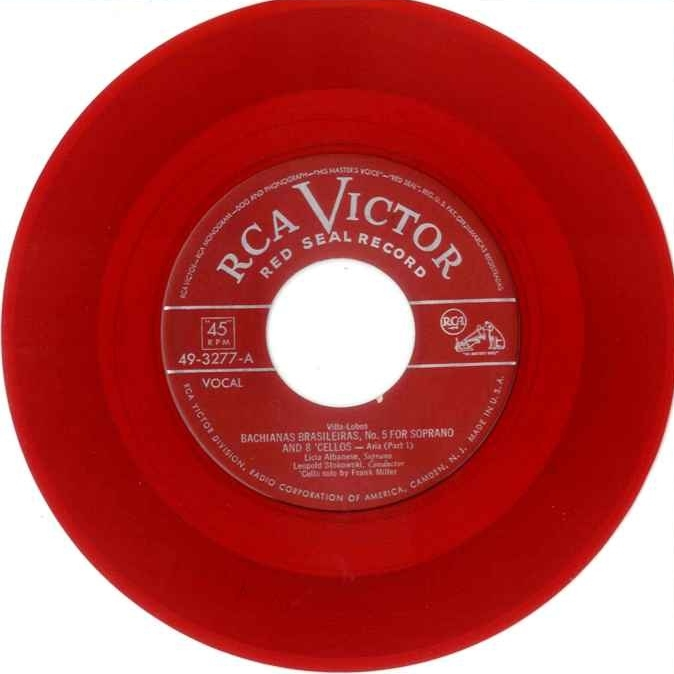
    A few years ago I bought this 45rpm record on eBay:


    Licia Albanese is the soprano in this famous version of the Aria from Bachianas Brasileiras #5. Frank Miller is the solo cellist, and Leopold Stokowski conducts the cello ensemble. You can listen to this 1953 recording at the Hispana digital library.

    Wednesday, March 14, 2012

    Viva Villa! Pelo Brasil


    Shopping Villa-Lobos, a mall in São Paulo, presents the exhibit Viva Villa! Pelo Brasil, in honour of the 125th Anniversary of the mall's namesake's birth in 1887. The exhibit runs from March 5th to April 15th. It's all explained in this story (in English) from Time Out São Paulo.

    Tuesday, March 6, 2012

    Sonia Rubinsky - Inspirations Orientales


    For those of you who will be in Paris later this month, check out this concert by Sonia Rubinsky at the Musée d'art et d’histoire du Judaïsme. Rubinsky's complete set of Piano Music by Villa-Lobos is, of course, indispensable.

    Villa-Lobos Artistic Excursion (Excursão Artistica Villa-Lobos), by Antônio Chechim Filho

    The Excursão Artistica Villa-Lobos, which began in 1931, was one of the most important events in Villa's life. Along with a group of musician friends the composer performed at nearly 100 concerts in small towns in the states of São Paulo, Minas and Paraná.

    Accompanying the group on this trip was Antônio Chechim Filho, a piano technician. His entertaining memoir has been translated by New Mexico-based pianist Fred Sturm. Fred has generously posted this important document (in PDF format) at the Piano Technicians Guild website.

    Fred is an accomplished pianist who knows Villa-Lobos well. His album Brazilian Soul: The Piano Music of Villa-Lobos is recommended. Fred has been busy organizing a Villa-Lobos Festival: 4 events in Albuquerque to celebrate Villa-Lobos's 125th birthday.

    Here is Fred playing Caixinha de Musica Quebrada, a great little piece that Villa-Lobos wrote during the Excursão:

    Choros no10 with OSN-UFF, Ligia Amadio


    There are a number of very high quality videos on the web of Choros no10, which is perhaps Villa's greatest work. This excerpt from the DVD Alma Brasileira features the Orquestra Sinfônica Nacional - UFF and the Coral Brasil Ensemble, conducted by Ligia Amadio. I haven't seen the DVD, but there is a CD of the concert available.

    Tom e Villa


    I love this album: "Tom e Villa". Antonio Carlos Jobim & Heitor Villa-Lobos play pool on the cover of this 1986 album by Gilson Peranzzetta (piano) and Arthur Maia (bass), sponsored by Coca-Cola in honour of the Villa-Lobos Centennial.

    Monday, March 5, 2012

    Yerma in Sao Paulo


    Here are some scenes from last month's production of Magdalena at the Theatro Municipal in Sao Paulo.

    Audio-visual presentation from the Museu Villa-Lobos


    Museu Villa-Lobos Curator Nara Abud Tauile put together this 2-screen audio-visual presentation that makes great use of Villa-Lobos home movies, and the Bidu Sayão version of the Bachianas Brasileiras #5 Aria.

    Feliz Aniversário Maestro!


    In 1945 Villa-Lobos wrote the Canções de Cordialidade, 5 songs of celebration based on poems by Manuel de Bandeira. One of them is Feliz Aniversário, Happy Birthday, which is played by the Orquestra da Sociedade de Concertos Sinfônicos de São João del-Rei and sung by the audience (beginning at 1:20). It's cool that everyone seems to know the words.

    Happy 125th Birthday, Villa-Lobos.

    Happy Birthday Heitor!

    This Google Doodle showed up on Google.com.br today, to celebrate the 125th Anniversary of Villa-Lobos’s birth on March 5, 1887.

    Not an especially good likeness of the young (pre-cigar) composer. He's conducting the Uirapuru, the Amazon song-bird who is featured in Villa's early orchestral work of the same name. It is a pretty good likeness of the bird:

    Thursday, March 1, 2012

    Villa-Lobos/Brandão at St. Martin-in-the-Fields

    Every time I'm in London I try to get to one of the great lunchtime concerts at St. Martin-in-the-Fields, which date back to WWII and Dame Myra Hess. One concert last month featured the Italian pianist Vincenzo Delli Noci playing music by Villa-Lobos, Ponce, and Piazzolla.

    Delli Noci chose really interesting Villa-Lobos works: the arrangements for piano of the 5 Preludes for Guitar by José Vieira Brandão. The Preludes are among the greatest works ever written for the guitar, and they work very well on the piano.

    Here is the 4th Prelude from that concert:


    Incidentally, for all you pianists out there, the Brandão arrangements of the Preludes are available in the compilation Heitor Villa-Lobos en dix-huit morceaux pour piano, from Di-Arezzo.

    Saturday, February 18, 2012

    Radamés Gnattali String Quartet plays Villa-Lobos on DVD/Blu Ray


    The Radamés Gnattali String Quartet play the first movement of Villa-Lobos's great 7th String Quartet. The Quartet will be releasing the first ever DVD/Blu Ray set of all of the 17 String Quartets, at 8pm on March 5th (Villa's birthday) in the Museu Villa-Lobos in Rio de Janeiro. The discs are released on the Visom Digital label and will be distributed by Biscoito Fino.

    Thursday, February 2, 2012

    Rheingau Music Festival


    I love it when I can bring my love of wine into my Villa-Lobos web work. I've always been a huge fan of German wine. Riesling is one of the world's greatest grapes, and the complicated universe of the German wine label really intrigues me.

    Which brings me to the 2012 Rheingau Musik Festival, to be held from the 23rd of June to the 14th of December, in the home of some of Germany's finest wines. There are two concerts of special interest to Villa-Lobos fans:
    • on August 5th, the Romero family of guitarists will play music by Villa-Lobos, Chapi, Granados, & Pepi Romero, in the Fürst-von-Metternich-Saal of Schloss Johannisberg 
    • the Orquestra Sinfônica do Estado de São Paulo (OSESP) travels to Germany for a concert on August 18th in Kurhaus Wiesbaden. Marin Alsop conducts, and Nelson Freire will play Mômoprécoce for piano and orchestra 

    Another Brazilian concert of note: classical & jazz pianist Eliane Elias will present her jazz quartet at a concert on August 1st, in the Kurpark, Bad Homburg. I love Elias's jazz - especially when she plays music by Tom Jobim - but she's also an accomplished classical pianist. Check out her EMI album On the Classical Side, which includes a number of works by her country-man Villa-Lobos.

    It occurs to me that the great sweet wines of Germany have some similarities with the music of Villa-Lobos. They're both "over-ripe" in a technical sense, but they can both show power and delicacy at the same time. I have a bottle of 1976 Oppenheimer Sackträger Gewürztraminer Trockenbeerenauslese made by Hajo Guntrum in my cellar that I plan to drink soon. When I open it, I think I'll play this music by Heitor Villa-Lobos:


    Saturday, January 28, 2012

    90th Anniversary of the Semana de Arte Moderna


    Next month brings the 90th Anniversary of a seminal event in the cultural history of Brazil: the Semana de Arte Moderna, which was held in Sao Paulo's Theatro Municipal from the 13th to the 17th of February 1922. The music of Villa-Lobos was featured in a series of famous controversial concerts.

    The Theatro Municipal will be the scene of some really interesting concerts celebrating this event. Pianist Caio Pagana will perform Carnaval das Criancas and the first book of the Guia pratico. Pablo Rossi will play Momoprecoce. And the 2010 Paris production of Magdalena will be revived with five performances.

    Wednesday, January 25, 2012

    Al Bustan Festival 2012: Music from Latin America


    Latin American music is featured at the 2012 Al Bustan Festival, which takes place in Beirut from February 21st to March 25th.  The headliners include pianists Cristina Ortiz and Jose Feghali, conductor Alondra de la Parra, cellist Antonio Meneses, guitarists Sergio & Odair Assad, and the Cuarteto Latinoamericano.

    Saturday, January 21, 2012

    Report from Paris, April 1930


    From Le Ménestrel, April 11, 1930. Villa-Lobos was making quite a stir in Paris with these works, some of his best music from the 1920s.

    Thursday, January 12, 2012

    New Marcelo Bratke CD

    In 2010 Marcelo Bratke began his series of complete Villa-Lobos piano music on Quartz Music.  Here is the second volume.


    As Irineu Franco Perpetuo notes in his liner notes, all of the works on this disc make specific reference to Brazil:

    • Bachianas Brasilerias No 4
    • A Lenda Do Caboclo
    • Saudades Das Selvas Brasileiras
    • Choros No 5 "Alma Brasileira"
    • Ciclo Brasileiro
    This disc is available at the Quartz Music site.  It hasn't shown up yet on Amazon.com, but is available at Amazon.co.uk.

    Monday, December 12, 2011

    Humberto Mauro's Sangue Mineiro


    The Brazilian film-maker Humberto Mauro is best known for his 1937 film Descobrimento do Brasil, the score of which was written by Villa-Lobos. New to YouTube is this beautiful silent film Sangue Mineiro, from 1929, a restored print from BossaFilmes with an excellent soundtrack of music from the period.

    Villa-Lobos's first String Quartet plays an important role in the score, as does his rarely-heard orchestral work Ruda: God of Love. The complete music credits are at 1:16:40; included are pieces by Mignone, Hekel Tavares, Camargo Guarnieri, Nazareth, and Guerra Peixe.

    Thursday, December 1, 2011

    Villa-Lobos Top 10

    In commemoration of the 52nd anniversary of Villa-Lobos's death, journalist Rui Agapito wrote this excellent article at ovale.com.br [English translation by Google]. I was really pleased that Rui asked me to come up with my favourite 10 pieces by Villa-Lobos. My choice:
    1. Preludes for guitar
    2. Choros #10
    3. Nonetto
    4. Quarteto simbolico
    5. Bachianas Brasileiras #5
    6. String Quartet #07
    7. Prole do Bebê, book 1
    8. Uirapuru
    9. Floresta do Amazonas
    10. Missa São Sebastião
    What are your favourite 10 works by Villa?

    Monday, November 21, 2011

    Villa-Lobos for trumpet & orchestra


    Here's a brand-new video from the 49th Festival Villa-Lobos taking place this month in Rio. This is a fabulous new arrangement of the Saxophone Fantasia for trumpet and orchestra, by Roberto Duarte.

    Marcelo Rodolfo from the Museu Villa-Lobos says this about the new piece in an email:
    According to Flávio Gabriel, the splendid trumpet player who accepted the challenge, this is the most difficult work he ever played in his life. But the result, as you'll hear is worth it. A lot!!! My expectation is that other trumpet players will be encouraged to meet this challenge, too. Strangely, Villa-Lobos never wrote a work for trumpet, even in chamber music, just some solos in orchestral parts.
    This concert is from November 19th, and featured Orquestra Sinfônica de Barra Mansa, under the direction of Vantoil de Souza. Two other concerto arrangements are being premiered at this year's Festival: Cirandas das Sete Notas (for cello - originally for bassoon), and the Guitar Concerto (for harp).

    I'm anxious to hear what you Villa-Lobos lovers think about this new take on a very familiar work.

    Thursday, November 17, 2011

    Sunday, November 13, 2011

    1930 Varese/Villa-Lobos Concert in Paris


    Here is the notice in La Semaine a Paris of the March 14, 1930 concert in Paris with important performances of music by Edgard Varese (Octandre, Offrandres) and Villa-Lobos (Quinteto em forma de choros, Saudades das Selvas Brasileiras, Deux Choros Bis, Poeme de l'Enfant et Sa Mere, Cirandas, and Chansons typiques bresiliennes).

    I don't know the music of Marcel Mihalovici, but he hung out with some very talented musicians.

    Saturday, November 12, 2011

    Agenda VivaMúsica


    The monthly magazine Agenda VivaMúsica is available on the web. This month's issue focuses on Villa-Lobos, with the highlight being the 49th Festival Villa-Lobos.

    Tuesday, November 8, 2011

    Danças Brasileiras from BIS


    A new CD from BIS features the São Paulo Symphony Orchestra (OSESP) under the direction of Roberto Minczuk. It includes dances by Alberto Nepomuceno, Alexandre Levy, Francisco Mignone, Heitor Villa-Lobos, Oscar Lorenzo Fernández, Camargo Guarnieri, Edino Krieger, Antônio Carlos Jobim, Clóvis Pereira and César Guerra-Peixe. 

    The Villa-Lobos piece is the Dança Frenética, written in 1919. This is the second recording of the piece; it's also on an old Marco Polo disc conducted by Roberto Duarte. The disc will be released on Amazon.com on November 22nd.

    Maestro Minczuk spends part of the year in Rio de Janeiro as the Principal Conductor of the Brazilian Symphony Orchestra, but he's also the Music Director of the Calgary Philharmonic. I'm looking forward to making the 150km trip down Highway 2 from Red Deer to Calgary to see Minczuk conduct the Calgary Philharmonic Orchestra & Chorus in Choros #10, Villa-Lobos's greatest work, on December 3rd.

    Monday, November 7, 2011

    The Green Mansions Project


    Alfred Heller is the founder and president of the Villa-Lobos Music Society of New York City. Alfred is a composer, conductor, and pianist, and, I'm pleased to say, a friend of mine.  It's great to see today's announcement of the Green Mansions Project. There's more information at the project website. I'm hoping I might be able to make it to New York for the October 1, 2012 Gala at the NYU Skirball Center for the Performing Arts.

    Wednesday, November 2, 2011

    49th Annual Festival Villa-Lobos


    The 49th Annual Festival Villa-Lobos takes place in Rio de Janeiro from November 11 to November 27. Featured performers include soprano Rosana Lamosa, pianist Lúcia Barrenechea, the Quinteto Villa-Lobos, Art Metal Quinteto, Quarteto Radamés Gnattali, violinist Daniel Guedes, Trio Aquarius, Wagner Tiso, Naná Vasconcelos, Andre Mehmari & Hamilton de Holanda, guitarist Turibio Santos, and pianist Cristina Ortiz.

    Wednesday, October 12, 2011

    Two Modernists in Paris


    Villa-Lobos and Edgard Varese met in Paris in 1929, and soon became best friends. I'll be adding some posts in the next few days about their interactions, and how two great modernist composers explored new musical ideas and new sounds together.

    Here is a poster from an important concert at the Maison Gaveau Salle des Concerts on May 30th, 1927.  Opening and closing the concert were a couple of ground-breaking works: Amazonas, the 1917 ballet by Villa-Lobos, and Ameriques, a large-scale work written by Varese in 1918-21 and revised in 1927.

    Thursday, October 6, 2011

    The Award-Winning Miloš Karadaglić Plays Villa-Lobos


    Miloš Karadaglić, who recently won the Specialist Classical Chart Award and the Young Artist of the Year awards at the 2011 Gramophone Classical Music Awards, plays the first Villa-Lobos Prelude.

    Thursday, September 29, 2011

    Villa-Lobos Trio Video


    Here is a bit of the 1st Villa-Lobos Piano Trio by the Austria-based Villa-Lobos Trio (along with some beautiful Piazzolla and Zequinha de Abreu's great "Tico Tico no fuba"). The Villa-Lobos Trio was recently nominated for a Latin Grammy for their 2010 Oehms Classics CD.

    Tuesday, September 27, 2011

    Roberto Burle Marx: The Modernity of Landscape


    A new book about the great modernist landscape architect and designer Roberto Burle Marx (1909-1994) shows his versatility and originality. Roberto and his musician brother Walter were friends of Villa-Lobos. One of Roberto Burle Marx's Villa-Lobos legacies is the garden he designed in 1986 for the Museu Villa-Lobos.

    Roberto Burle Marx also collaborated with the composer: in 1959 (the year of Villa's death) he worked on stage and costume designs for the ballet Zuimaluti, with music by Villa-Lobos, and a libretto by Mario de Andrade. I haven't been able to track down any references to this work other than the Burle Marx designs.  Zuimaluti isn't included in the latest version of Villa-Lobos: Sua Obra. Have any Villa-Lobos scholars out there heard of any surviving music from this project?

    Burle Marx is an amazing artist; you can see many of his designs in this preview of the new book.

    Friday, September 16, 2011

    Alfred Heller on Villa-Lobos


    My good friend Alfred Heller says all sorts of great things about Villa-Lobos in this short interview on Veja TV, including this: "Villa-Lobos is the most important composer since Beethoven."

    Alfred Heller knew Villa-Lobos well during the last few years of the composer's life, when he acted as his assistant in New York in the late 1950s. Alfred's conducting and piano playing on a wide range of CDs has enriched the Villa-Lobos discography. Read his excellent article "The One-World Style of Villa-Lobos".

    Thursday, September 15, 2011

    Two Villa-Lobos Discs Nominated for Latin Grammy Awards


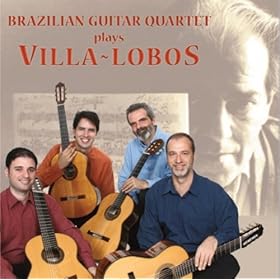
    Two Villa-Lobos discs have been nominated for Latin Grammy awards.  The excellent Delos CD from the Brazilian Guitar Quartet [pictured above] includes a wide variety of piano and chamber works arranged for four guitars by group member Tadeu do Amaral. You can listen to Track 14 from the disc at Soundcloud: it's one of Villa-Lobos's Cirandas, A procura de uma agulha (Hunting for a Needle).


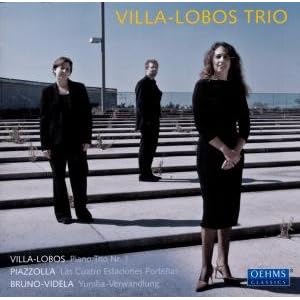
    The other disc is from the young Austrian ensemble the Villa-Lobos Trio: pianist Rosângela Antunes, violinist Florian Wilscher, and cellist Katrin Schickedanz. This fine Oehms Classics CD includes Villa-Lobos's early (1911) First Piano Trio, along with an arrangement by J. Bragato of Piazzolla's Las Cuatros Estaciones Portenas, and an interesting work by Lucio Bruno-Videla called Yumba Verwandlung. You can listen to the first movement of the Villa-Lobos Piano Trio at the VLT website.

    Good luck to both groups!

    Monday, September 12, 2011

    A Arte de Villa-Lobos


    In 2009 TV Cultura showed the documentary "A Arte de Villa-Lobos" on Programa Mosaicos. It's so nice to have the entire show, in 6 parts, on YouTube. There are lots of great bits in this first section: Anna Stella Schic playing the 2nd Piano Concerto in a 1979 concert, and an endorsement from Aaron Copland, who didn't often say nice things about Villa-Lobos:
    "A passionate type of man. I don't know how he ever managed to get to sleep at night. He seemed to be so very much alive all the time: very spontaneous, easily combustible, you know, just very lively in the head. So it was fun to be with him."

    Tuesday, September 6, 2011

    Video: Portrait of Villa-Lobos in Rio


    Portrait of Heitor Villa-Lobos in Rio by medicitv

    This excerpt from a longer documentary on Villa-Lobos at Medici.TV includes one of the greatest of Villa-Lobos stories: the meeting in Rio between the young composer and the pianist Arthur Rubinstein.

    Saturday, September 3, 2011

    Villa-Lobos at 8Tracks.com


    From 8tracks.com, a mix of Popular Villa-Lobos, music by Villa-Lobos in jazz & MPB versions by Cyro Baptista, Egberto Gismonti, Rabo de Lagartixa. And a second mix: Villa-Lobos Chamber Music.

    Friday, September 2, 2011

    Tarsila do Amaral


    Yesterday (September 1) was the 125th anniversary of the birth of Tarsila do Amaral. Born the year before Villa-Lobos, the great Brazilian painter was a friend of the composer's, and a participant with Villa-Lobos in the festivities during the Semana de Arte Moderna in Sao Paulo in 1923. Many of Tarsila's paintings show up on Villa-Lobos CDs. The painting above (Carnaval em Madureira, 1924), for example, is on the BIS set of the Complete Choros and Bachianas Brasileiras.